In the subsistence agricultural social context of the Hebrew Bible, children were necessary for communal survival. In such an economy, childrens labor contributes to the familys livelihood from a young age, rather than simply preparing the child for future adult work. Ethnographic research shows that this interdependent family life contrasts significantly with that of privileged modern Westerners, for whom children are dependents. This text seeks to look beyond the dominant cultural constructions of childhood in the modern West and the moral rhetoric that accompanies them so as to uncover what biblical texts intend to communicate when they utilize children as literary tropes in their own social, cultural, and historical context.
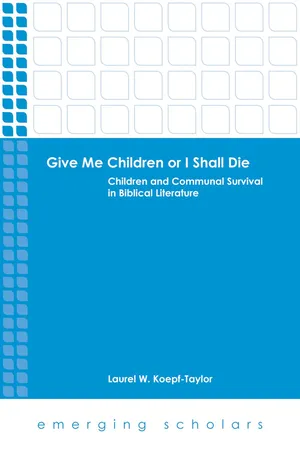
eBook - ePub
Give Me Children or I Shall Die
Children and Communal Survival in Biblical Literature
- 224 pages
- English
- ePUB (mobile friendly)
- Available on iOS & Android
eBook - ePub
Give Me Children or I Shall Die
Children and Communal Survival in Biblical Literature
About this book
Information
4
The Child and the Community at Risk
The history of childhood is a nightmare from which we have only begun to Awaken.
—Lloyd DeMause
Introduction
In previous chapters, we have seen how offspring were essential for the survival of both the mišpaha (“family”) and the broader community of Israel in a very practical sense. The effect of the ancient association of children with livelihood that I have noted in texts regarding (in)fertility and education/enculturation is also evident in images of the loss of a child throughout biblical texts. The rhetoric of child loss would have frightened an ancient intended audience in ways that reflect ancient, rather than modern, constructions of childhood. The loss of a child aptly expresses the threat of extinction in biblical prophecy and poetry because of the dependence on offspring that led ancient Israelites to associate children with the biological and cultural reproduction necessary for familial and communal survival. As a result, biblical imagery depicting the loss of a child through rejection and premature death posed a threat to ancient audiences that they and their culture would not survive. Each birth carried the communal hope of a family and a people’s survival, and each premature death the threat that biological and cultural reproduction might cease with this generation. Without offspring, there would be no future for the children of Israel.
The Rhetoric of Childhood
Anneke Meyer has argued that for contemporary English-speakers, childhood has become a kind of moral shorthand.[1] She sees this as directly resulting from the sacralization of childhood, leading to public indignation at actions that challenge the solely emotional value of children, for which Viviana Zelizer has argued.[2] In a series of focus-group interviews with British adults affiliated with Manchester University,[3] Meyer points to her subjects’ rhetorical use of children and childhood so as to make assumedly indisputable arguments without the necessity of support.
Meyer’s empirical research documents a trend in moralistic speech. Phrases such as “because they’re kids” have come to stand on their own as explanations for moral judgments, most particularly regarding the qualitative difference between crimes committed against adults and those perpetrated against children. One of Meyer’s research subjects explained the difference in this way: “that’s like people don’t like seeing murders and stuff on TV, we do, but obviously . . . when seeing kids go missing, obviously they think it’s worse.”[4] The speaker does not see the need to describe any particular differences between the crimes or the victims other than to state that it is somehow worse when the victims are “kids” and that this distinction is (in his evaluation) “obvious.” Those adults in the focus group who did articulate differences used phrases such as “that’s wrong because their . . . their childhood innocence will be lost”;[5] “Yeah, cause kids are innocent”; and the explanation that as a result of such a crime the victims are “not children anymore.” As a result of this evidence, as well as documentary and discourse analysis of legal documents and print media respectively, Meyer concludes,
Several factors indicate that the perception of the special and moral status of the child is deeply entrenched, widespread and powerful: (1) children are used as a shorthand explanation; (2) such explanations are understood and not disputed by those listening; and (3) words such as obviously can be used. These aspects combined suggest that the perception has become so powerful and accepted as to seem natural. When a discourse becomes “natural” it becomes powerful: it gains the status of an irreversible, natural fact and obliterates its origin as a social idea. Children can become an explanation because of this natural fact status, and the concept of sacralization can be developed into the concept of childhood as a moral rhetoric.[6]
Meyer’s research highlights the influence that the cultural construction of childhood innocence has as a social idea, one evolving out of the sacralization of childhood at the turn of the century, as documented by Zelizer.
The rhetorical use of childhood as moral shorthand reflects an assumption that the moral value of childhood is universal and therefore does not need to be defended: any assault on children is worse than the same action perpetrated against an adult because “they’re children.” In that it is a result of a twentieth-century Western cultural shift, this moral shorthand is a recent and culturally specific invention. Interpreters cannot assume that it is at play in biblical rhetoric of children’s suffering. A historically grounded interpretation of any biblical text depicting the suffering, death, or rejection of a child must instead look to the social and cultural context of biblical childhoods to reveal the value with which children would have been laden in the ancient world, how it differs from the reader’s own understanding of what the loss of a child means, and the appropriately different effect the ancient context might have had on the rhetoric of childhood.
The moral value of child protection is directly related to constructions of childhood innocence. Meyer argues, “By portraying children as entirely virtuous beings, the discourse of innocence predisposes children to become objects of emotional and moral valuation. Children are constructed as the deserving recipients of attention, care, effort and protection, which they need. Hence, anyone speaking on behalf of children can represent him- or herself as a moral person, as somebody who protects the weak.”[7] As a part of this cultural construction, children are portrayed as needing protection because they lack skills and knowledge. While this may be the case in many situations, the perception is perpetuated even when it does not apply. Meyer gives the example of Internet use, in which print media portray children as “experts,” knowing more than their parents, and therefore needing protection.[8]
The necessity for protection is created in part by the pervasive rhetoric of childhood innocence, which requires that children lack the social skills necessary for their own protection, socializing children into compulsory vulnerability, “By presenting children as lacking a range of social skills (e.g. being street-smart, able to judge dangerous situations), the discourse of innocence constructs vulnerability as directly deriving from the being of the child. Innocence also produces children as structurally vulnerable, for instance by encouraging protectionist legislation, but this kind of discursive effect is rarely acknowledged.”[9] Indeed, Perry Nodelman’s analysis of patterns in children’s literature, as noted in chapter 3, reveals other socializing influences. One of the strongest among these is that which teaches children how to be appropriately “childlike” within adult cultural definitions of the word by setting out plots in which child characters exhibit their lack of particular social skills to the amusement of both adult characters and child readers, often to their own benefit. He observes,
In the world of Henry Huggins, it seems, adults like children to know less than they do (or, perhaps more accurately, like to be able to believe that children know less than they ...
Table of contents
- Cover
- Title Page
- Copyright
- Dedication
- Table Of Contents
- Acknowledgments
- Abbreviations
- Biblical Children, Biblical Childhoods
- Interpreting (In)fertility
- The Value of Education and Enculturation
- The Child and the Community at Risk
- Conclusion
- Bibliography
- Index of Subjects
- Index of Names
Trusted by 375,005 students
Access to over 1.5 million titles for a fair monthly price.
Study more efficiently using our study tools.
Frequently asked questions
Yes, you can cancel anytime from the Subscription tab in your account settings on the Perlego website. Your subscription will stay active until the end of your current billing period. Learn how to cancel your subscription
No, books cannot be downloaded as external files, such as PDFs, for use outside of Perlego. However, you can download books within the Perlego app for offline reading on mobile or tablet. Learn how to download books offline
Perlego offers two plans: Essential and Complete
- Essential is ideal for learners and professionals who enjoy exploring a wide range of subjects. Access the Essential Library with 800,000+ trusted titles and best-sellers across business, personal growth, and the humanities. Includes unlimited reading time and Standard Read Aloud voice.
- Complete: Perfect for advanced learners and researchers needing full, unrestricted access. Unlock 1.5M+ books across hundreds of subjects, including academic and specialized titles. The Complete Plan also includes advanced features like Premium Read Aloud and Research Assistant.
We are an online textbook subscription service, where you can get access to an entire online library for less than the price of a single book per month. With over 1.5 million books across 990+ topics, we’ve got you covered! Learn about our mission
Look out for the read-aloud symbol on your next book to see if you can listen to it. The read-aloud tool reads text aloud for you, highlighting the text as it is being read. You can pause it, speed it up and slow it down. Learn more about Read Aloud
Yes! You can use the Perlego app on both iOS and Android devices to read anytime, anywhere — even offline. Perfect for commutes or when you’re on the go.
Please note we cannot support devices running on iOS 13 and Android 7 or earlier. Learn more about using the app
Please note we cannot support devices running on iOS 13 and Android 7 or earlier. Learn more about using the app
Yes, you can access Give Me Children or I Shall Die by Laurel W. Koefp-Taylor, Laurel W. Koepf-Taylor,Laurel W. Koepf in PDF and/or ePUB format, as well as other popular books in Theology & Religion & Biblical Criticism & Interpretation. We have over 1.5 million books available in our catalogue for you to explore.