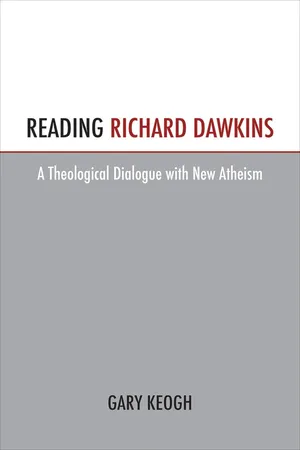
- 272 pages
- English
- ePUB (mobile friendly)
- Available on iOS & Android
eBook - ePub
About this book
Theological reactions to the rise of the new atheist movement have largely been critically hostile or defensively deployed apologetics to shore up the faith against attack. Gary Keogh contends that focusing on scholarly material that is inherently agreeable to theology will not suffice in the context of modern academia. Theology needs to test its boundaries. Engaging Richard Dawkins illustrates how dialogue with antithetical viewpoints may offer new perspectives on classical theological problems. Keogh demonstrates how a dialogical paradigm may take shape—one which is up to the task of facing its critics in the context of modern academia.
Information
Topic
Theology & ReligionSubtopic
Christian Theology5
Evil, Evolution, and God
Dawkins and Theology in Dialogue
Introduction
In Chapters Two and Three, we began our dialogue with Dawkins by exploring his worldview. These chapters enabled us to begin to explore avenues where Dawkins’ scientific hermeneutic could be utilized by the theologian. In the last chapter, we took his outlook on evolution and particularly his meme theory, and examined how it can be applied it to religion. In doing so, it was argued that Dawkins’ evolutionary perspective of culture could be integrated into a theological project that contributes to Anselm’s classic definition of theology, ‘fides quaerens intellectum’, as it seeks to understand the origins and development of religious faith as a concept. This chapter will continue to show how bringing Dawkins’ worldview into consideration could be beneficial for theology. As we have seen in Chapter Three, Dawkins uses the existence of evil to pose a challenge to theistic belief. Consequently, this chapter will centre around this fulcrum, which we will term Dawkins’ ‘theodicy challenge’. The term ‘theodicy’, coined by the seventeenth-century philosopher Gottfried Leibniz, is a theological attempt to reconcile the existence of evil with an omnipotent/beneficent creator. We will first address the question of whether Dawkins could be considered a servant of theology, and then introduce Dawkins’ theodicy challenge, and demonstrate how it can be used as a challenge to theism (though as we will see, Dawkins does not use it to validate atheism).
Dawkins as a Servant of Theology?
In Chapter One, we noted that there are significant limitations when engaging in a dialogue with Dawkins. One such limitation is that Dawkins’ comprehension of theology is weak at best. He has thus been rightly criticized on this point by a number of scholars. Dawkins’ misinterpretations of theology and Christianity are particularly acute given that he seeks to castigate theological themes. This is one of Dawkins’ most prominent weaknesses, as one can seriously question the legitimacy of his critiques if he does not demonstrate a solid comprehension of the topics he is critiquing. Therefore, one could easily adopt the position that Dawkins is not a worthy dialogue partner for theology, given that his treatment of theological themes is so devoid of substance. Gerard J. Hughes, for example, points to the fact that Dawkins fails to grasp the allegorical nature of aspects of the Bible.[1] Hughes illustrates that when texts are read out of their context, they are more vulnerable to misinterpretations: “In some future era, even our own culture could be open to much misunderstanding. Imagine a future generation which . . . did not realize that Animal Farm is an allegorical novel, and read it as a description of some extraordinary episode in evolutionary history”.[2] Hughes continues to assert how the opening chapters of Genesis can be misinterpreted in a similar fashion, to be taken as a “factual description of the stages in which the matter in the universe was organized into the cosmos as we know it”.[3] There are clear examples of such misreading, for example, in Dawkins’ thoughts on the theological concept of original sin. Original sin has been the subject of much theological investigation—some of which will be discussed in this chapter—and represents interesting notions around the responsibility of humanity and the existence of suffering. Yet Dawkins highlights both his misreading of the allegorical nature of the Genesis narrative, and his ignorance of theological thinking on the issue in the following passage:
Adam (who never existed) bequeathed his “sin” in his bodily semen (charming notion) to all of humanity. That sin, with which every newborn baby is hideously stained (another charming notion), was so terrible that it could be forgiven only through the blood sacrifice of a scapegoat. But no ordinary scapegoat would do. The sin of humanity was so great that the only adequate sacrificial victim was God himself.[4]
However, Hughes makes the very interesting assertion that Dawkins has been given encouragement to misread and misinterpret the Bible and theological tradition: “[H]e has been given considerable encouragement to do so by the way in which Christians themselves have misread the bible and in so doing have failed to see which are the truths which the biblical texts convey”.[5] Many Christians have succumbed to the same misinterpretations of the Bible and theology that Dawkins has. A situation has thus arisen where Dawkins and Christian apologists have been engaged in an ongoing debate that is based upon faulty premises, as Hughes articulates. “Thus, some Christians have responded to misdirected criticisms by trying to defend creationism, or the moving star of Bethlehem, as though the bible is trying to make truth claims about cosmogony or astronomy, rather than about monotheism and Christology”.[6] The prevalence of such debate was discussed earlier, as we referred to the lively polemic around the teaching of intelligent design in the United States. In this sense, a large part of the tension between Dawkins and Christianity stems from both sides of the debate misunderstanding key principles of biblical and theological scholarship.
What Hughes does suggest, though, is that it is “to a considerable extent our own fault that Christianity has been so misunderstood”.[7] It is the responsibility of theologians, educators, and others, to ensure that Christianity is faithfully proclaimed and understood. This is particularly important when it comes to discussing Christian themes with those from outside the tradition, if we are to take the necessity of interfaith dialogue as an imperative. We can also advance Hughes’ idea slightly, to suggest that Dawkins may be taken as a representative of those who, either from an antagonist or apologetic standpoint, have misinterpreted the Bible or theological tradition. In other words, could it be assumed that Dawkins’ misunderstandings are often echoed in the public? It would appear from the previously mentioned debates around intelligent design, and Hughes’ references to apologetic defenses of creationism, that this is indeed the case. Therefore, popular misinterpretations of theological concepts and traditions could arguably be considered as a failing of theology. Something that Dawkins may offer to theology is to make evident its failings in adequately conveying its own message, as Hughes explains: “To conclude, then. Dawkins does indeed provide a useful wake-up call to make the accepted conclusions of most biblical scholars and most theologians much more widely known and accepted in the Christian churches”.[8]
Hughes is thus implying that theology is failing to accurately represent itself in the public sphere. If Dawkins, as a member of the nontheological public, is misreading theology, then it could be argued that theologians are ultimately to blame for this misreading. Dawkins’ misinterpretations could be seen to indicate a deficit of theology in the public, which David Tracy identified as one of the three distinct audiences that theology addresses: the public, the academy, and the church.[9] Particularly in the context of modern pluralism and the accessibility of knowledge, the ‘public’ audience of theology is becoming increasingly important. If Dawkins understands religion to be historically a tool of oppression and terror, then it is arguably the responsibility of theology that its own rich history of commitment to social justice is not being properly conveyed. We have already indicated Dawkins’ understating of the role of religious faith in the civil rights movement, but further examples of the role of religion in social justice abound in history, such as the influence of Catholic social teaching and in particular Pope John Paul II on the Polish Solidarity movement in the 1980s.[10] If the view of religion as a tool of the oppressor is a popular one, as Dawkins’ popularity would suggest, then theology is failing to portray its own history and themes.
Similarly, in Dawkins’ ongoing crusade against religion, he brings to the fore the troubled history of science and religion. In doing so, he highlights another of theology’s weaknesses—an unsettled, often dismissive attitude toward advancements in science that may appear to have implications for how we view God and the world, as Hughes observes:
Believers have on the whole a bad record in the way we respond to the advancement of science and the growing complexity of morality in our technologically and environmentally ever more complex world. We have tended to sound, and often to be, reluctant to accept undisputed scientific findings so that we can try to work out how they can be integrated into our overall picture of our world as God’s creation. The lessons of Galileo, biblical criticism, evolutionary biology, contemporary physics, psychology and medicine forever seem to catch believers unprepared, nervous, and defensive. At his best, Dawkins calls attention to that fact.[11]
The perennial advancement of our scientific understanding has had significant theological implications. We have already indicated areas of theology where science may bear weight on our concepts of the world. For example, evolutionary science has arguably shown that we can no longer view ourselves as the pinnacle of creation, as we are merely part of an ongoing process. As Christian apologists respond to Dawkins’ arguments against theism by referring to concepts of intelligent desi...
Table of contents
- Cover
- Title Page
- Copyright
- Table Of Contents
- Acknowledgements
- Abbreviations
- Introduction
- A Distinct Methodological Framework
- Encountering Evolution
- Beyond Biology
- Religion
- Evil, Evolution, and God
- Conclusion
- Appendix
- Bibliography
- Index
Trusted by 375,005 students
Access to over 1.5 million titles for a fair monthly price.
Study more efficiently using our study tools.
Frequently asked questions
Yes, you can cancel anytime from the Subscription tab in your account settings on the Perlego website. Your subscription will stay active until the end of your current billing period. Learn how to cancel your subscription
No, books cannot be downloaded as external files, such as PDFs, for use outside of Perlego. However, you can download books within the Perlego app for offline reading on mobile or tablet. Learn how to download books offline
Perlego offers two plans: Essential and Complete
- Essential is ideal for learners and professionals who enjoy exploring a wide range of subjects. Access the Essential Library with 800,000+ trusted titles and best-sellers across business, personal growth, and the humanities. Includes unlimited reading time and Standard Read Aloud voice.
- Complete: Perfect for advanced learners and researchers needing full, unrestricted access. Unlock 1.5M+ books across hundreds of subjects, including academic and specialized titles. The Complete Plan also includes advanced features like Premium Read Aloud and Research Assistant.
We are an online textbook subscription service, where you can get access to an entire online library for less than the price of a single book per month. With over 1.5 million books across 990+ topics, we’ve got you covered! Learn about our mission
Look out for the read-aloud symbol on your next book to see if you can listen to it. The read-aloud tool reads text aloud for you, highlighting the text as it is being read. You can pause it, speed it up and slow it down. Learn more about Read Aloud
Yes! You can use the Perlego app on both iOS and Android devices to read anytime, anywhere — even offline. Perfect for commutes or when you’re on the go.
Please note we cannot support devices running on iOS 13 and Android 7 or earlier. Learn more about using the app
Please note we cannot support devices running on iOS 13 and Android 7 or earlier. Learn more about using the app
Yes, you can access Reading Richard Dawkins by Gary Keough in PDF and/or ePUB format, as well as other popular books in Theology & Religion & Christian Theology. We have over 1.5 million books available in our catalogue for you to explore.