eBook - ePub
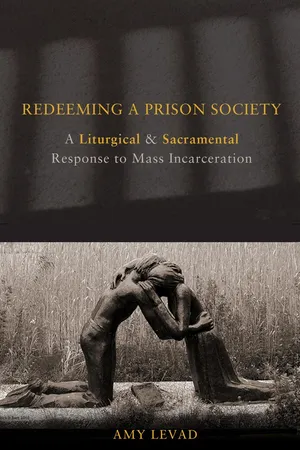
Redeeming a Prison Society
A Liturgical and Sacramental Response to Mass Incarceration
- 192 pages
- English
- ePUB (mobile friendly)
- Available on iOS & Android
eBook - ePub
About this book
The U.S. criminal justice system is in a state of crisis, from unprecedented (and increasing) rates of imprisonment and recidivism to the privatization of the prison system and the disproportionate representation of particular racial, ethnic, social, and economic groups within the penal system, all of which is subtended by a larger social justice context. Catholics and Protestants have largely failed to offer vital theological responses: Catholics have either inadequately addressed the interrelationship of the social and justice crises or failed to engage the current realities of the problem through recourse to abstract theory, while Protestant responses have been generated from a socio-political perspective distant from the crucial theological resources. In Redeeming a Prison Society, Amy Levad offers a Catholic perspective that directly addresses the concrete issues from a strongly interdisciplinary approach and utilizes the rich liturgical and sacramental resources of penance and Eucharist to offer a theological vision of reform.
Information
Topic
Teologia e religioneSubtopic
Teologia cristiana5
A Movement for Justice
The proposals of the previous chapter are important for responding to crime and individual wrongdoing in ways that reduce reoffending, lead to social reintegration of offenders, maintain public safety, and establish justice for all people affected by crime, especially victims. They provide direction for effective criminal justice reform. These proposals alone, however, will not end mass incarceration in the United States. The first genuine prison society was not created because of high crime rates, but because of social, cultural, economic, and political factors that coalesced into a willingness in our country to imprison more people for longer periods of time, especially young black men from socioeconomically disadvantaged backgrounds. Our crisis of criminal justice reflects a crisis of social justice in our society. The effects of mass incarceration in the United States, in turn, have helped sustain, and even worsen, this social justice crisis in ways that further marginalize, disempower, and endanger members of our society. Because of the ways in which criminal and social justice are fundamentally intertwined, an adequate response to these crises cannot stop with implementing restorative justice and rehabilitation as alternatives to incarceration or with downscaling prison populations. We must also attend to the ways in which social injustices fostered our criminal justice crisis and the ways in which our criminal justice policies and practices help perpetuate social injustices.
This criterion for an adequate response to our circumstances suggests that we must move beyond the questions of chapter 4 regarding how to respond effectively to crime and individual wrongdoing. It indicates that our concerns cannot be limited to crime control, guilt or punishment, costs or benefits, deterrence, retribution, or incapacitation. If we wish no longer to be the first genuine prison society, we must engage in more thoughtful reflection on our character, beliefs, and actions as individuals, as communities, and as a society as a whole. What kind of people do we want to be? What do we want our communities to be like? What holds us together, and what breaks us apart? What barriers prevent us from achieving a common good in which everyone is treated as a fully human person? If not a genuine prison society, then what type of society do we wish to create? Director of The Sentencing Project Marc Mauer argues that answering these sorts of questions and acting upon our answers are necessary for ending mass incarceration. He writes, “The first step [in addressing mass incarceration] involves expanding the discussion of crime policy beyond the day-to-day debates on the relationship between prison and crime to more fundamental concerns about the type of society we wish to create.”[1]
Catholics have a rich heritage of social teaching that informs our answers to these questions. This heritage ultimately finds its ground in our liturgical and sacramental life, particularly our participation in the Eucharist. Through liturgy, we engage in the public service of prayer, but also the public service rendered by the ekklesia unto others, especially the poor, oppressed, and marginalized. As sacramental, our service consecrates human life, disclosing the hidden reality of salvation and drawing us more deeply into the world in anticipation of the ultimate mystery of God’s reign. Our hope in God’s reign enlivens us as we work for justice by serving God and neighbors, particularly victims of injustice. The Eucharist, as the pinnacle of liturgy and sacrament, is the perfection of the church in the consecration of the world through public service in emulation of Jesus Christ. In this sacrament, Catholics and many other Christians are reoriented in light of a new vision or world-picture that upholds certain norms and behaviors as meaningful. Others’ needs and God’s will for establishing love, peace, freedom, justice, humanity, and life in response to those needs are disclosed. We are formed morally to a eucharistic vision, and this vision inspires our understanding of just individuals, communities, and societies. To answer the fundamental concerns about the type of society we wish to create and to find direction about how we should individually and collectively respond to our social justice crisis, Catholics must begin with our eucharistic life.
The Eucharistic Vision and Social Justice
Our ritual lives shape us morally. In our individual and communal worship practices, reiterated from week to week, we encounter a vision of God’s reign. Liturgical theologian Don Saliers writes that liturgy is a “continuing exercise of recalling, sustaining, and reentering [a] picture of the cosmos,” and that as we become reoriented through this picture, we are “characterized.”[2] As the Eucharist offers a vision of God’s reign, our participation in this sacrament forms our consciousness, enabling us to view the world and our work in it in view of justice under God. In liturgy, we traverse through this vision, a world-picture that transforms our ways of being, perceiving, and acting in the world. We adopt views of the world from God’s perspective. We become de-centered, aware of others’ needs as they too are people loved by God. God’s will becomes our own will. We become shaped by the patterns of God’s reign. Through the grace conveyed in the Eucharist, this sacrament accomplishes the public service of consecrating the world as we engage in it as persons and communities united to the eucharistic vision.
The moral vision of the Eucharist directs us to justice. This world-picture of justice, however, is particular to God’s reign and opposes the reign of the principalities and powers of this world and their understanding of justice. Justice in God’s reign is rooted in covenant, an abiding and sacred agreement to maintain relationship for the well-being of all humanity. This covenant is inclusive, welcoming everyone to the table, especially people who have experienced the exclusion of poverty, oppression, and marginalization. Jesus Christ provides an example for us in our celebration of the Eucharist through his table fellowship, which offered seats even for moral outcasts—sinners, prostitutes, and tax collectors. We are also asked to emulate Christ at the eucharistic gathering by becoming servants to all others, particularly to those who are in need and who are excluded from relationship. The Eucharist invites us, the reconciled community, to strive for reconciliation among our members and within the wider world.
Together we remember in the Eucharist Christ’s victory over the principalities and powers through his death and resurrection by embodying God’s justice. We especially recall his condemnation as a criminal, which reminds us that this extension of justice, reconciliation, relationship, and inclusion reaches those people who are the most despised and degraded. We also anticipate the coming of God’s reign in fullness. Our anticipation undergirds our hope that justice under God will ultimately triumph and feeds our longing for its realization. This eucharistic vision reorients Christians to communion, and when we are morally formed by this vision, we “find [ourselves] in many unexpected ways being a voice for those without a voice, speaking the truth when it is both awkward and unpopular, appearing to be . . . nonconformist.”[3]
As the eucharistic vision awakens our eschatological imaginations in remembrance of Christ’s death and resurrection and in anticipation of God’s reign, Christians are called to confront social injustice in our midst here and now. The Eucharist—the heart of our liturgical and sacramental lives—is radically this-worldly. William Cavanaugh describes the implications of the communion brought about by this sacrament:
The church becomes visible, obeying the Eucharistic demand that true unity be achieved, that people overcome alienation from each other and become reconciled, caring for each other, especially the weak, in community and solidarity. The church, as in the Eucharist, thus becomes a present foretaste of the future eschatological feast. The poor can wait no longer; the church must witness to the Kingdom in the present.[4]
Living in the tension between our memories of Christ and our hopes for God’s reign, we live in the present as followers united in the body of Christ, the church, who endeavor to embody the world-picture of the Eucharist, and we do so by working for social justice. Discussing themes similar to those lifted up by Cavanaugh, Kevin Seasoltz writes,
[T]hose who celebrate the Eucharist in memory of Jesus, who follow his command to “do this,” must feed the same sort of people and involve themselves with the same sort of dinner guests as Christ had at table. . . . Christ became incarnate primarily to free his people from slavery to sin and then from other forms of slavery which find their roots in slavery to sin. If the Eucharist is to be celebrated with integrity, the church must be about the same sort of liberation.[5]
Without confronting social injustice, we do not live into the eucharistic vision; we fall short of the moral transformation that this sacrament demands of us.
This description of the transformation of our consciousness in the Eucharist is of course idealistic. Sacramental and liturgical ethics must always account for the challenges of privatization and politicization of worship, of pluralism, of injustice within the church, and of problems with the meaning of participation in liturgy and sacraments. Nevertheless, social injustice raises perhaps a more devastating challenge to us: our own indifference and lack of awareness about poverty, oppression, and marginalization. An important aspect of the power of the eucharistic vision is its potential to pique our consciences about the exclusion of some people. Kenneth Himes argues, “The vast majority of Catholics do not read magisterial statements, even the most important conciliar decrees. It is not the intellectual appeal of theological documents which moves people at the level of the daily life of the church. For Roman Catholics it is the Sunday eucharist [sic] that continues to be the important ecclesial experience.”[6] Despite the challenges to liturgical and sacramental ethics, the Eucharist is the most likely medium through which Catholics will come to embrace the demands of social justice upon them. Himes continues, “Unless and until the concern for justice is integrated with the central spiritual exercise of the gathered community there will remain a sense that the social ministry of the church is an adjunct not a constitutive dimension of gospel life.”[7] As Catholics, we must shed our indifference and lack of attention to social injustice in response to the call toward justice, relationship, inclusion, reconciliation, and hope found in the moral vision of the Eucharist.
This vision undergirds Catholic teaching about the kinds of people we ought to become and the type of society we ought to create. As Jesus Christ welcomed all people to his table, so we recognize that all people are equal before God. We share in a basic equality as we all bear God’s image, the source of our dignity. Recognition of the dignity of all human persons is the basis for our pursuit of the common good and of humane and just conditions of life for every person. Without exception, every person must have access to everything necessary to enable her to realize herself fully. These conditions include not only material goods such as food, clothing, water, shelter, and healthcare, but also spiritual, intellectual, social, cultural, and political resources that mark our existence as human. We require these conditions because without them we cannot participate fully in the dignity, unity, and equality of all people. Just as social justice demands that we create a society that treats every person as fully human, it also compels us to oppose anything that marginalizes, disempowers, or endangers anyone. We must reject deliberate acts that dehumanize our neighbors. But because oppression is often much more insidious than any overt action, we must strive to identify and dismantle structures that directly or indirectly limit the capacities of some individuals and groups to achieve a life that rises to their dignity as human persons. In response to the eucharistic vision, we need to create “a new social, economic, and political order, founded on the dignity and freedom of every human person, to be brought about in peace, justice, and solidarity.”[8] We must become people who “seek the good of others as though it were one’s own good”[9] and who embody “a firm and persevering determination to commit oneself to the common good.”[10]
If we wish to express fully our sacramental lives, if we want to exist, perceive, and act as if we have in reality been morally transformed by the eucharistic vision, if our liturgy is to become public service that consecrates the world in its fullest sense, then we need to work for social justice. With respect to our criminal justice crisis in the United States, we must attend to the ways in which mass incarceration both reflects and helps sustain a social justice crisis that marginalizes, disempowers, and endangers many members of our communities. We may begin our efforts by mitigating the deleterious effects of our criminal justice systems on the individuals, families, and communities most directly affected by their policies and practices.
Responses to Effects of Mass Incarceration on Social Justice
While our criminal justice systems reflect a crisis of social justice, they also help sustain, and even exacerbate, conditions in which many members of our society—not only prisoners—are not treated as fully human persons and are not vested with the resources necessary to participate in the dignity, unity, and equality of all people. Some of these conditions can be addressed through criminal justice reforms based on a model of restorative justice and rehabilitation, in which prisons are used only in exceptional cases where the incapacitation of an offender is necessary for public safety. But because the effects of our criminal justice systems extend beyond prison walls and reach ex-prisoners, families, and communities as well, we must also consider responses to the social injustices that these systems often worsen. In doing so, we must attend especially to the exclusion from the common good of people from racial or ethnic minority groups and from socioeconomically disadvantaged backgrounds, as these groups have been disproportionately affected...
Table of contents
- Cover
- Title Page
- Copyright
- Dedication
- Table Of Contents
- Acknowledgements
- Introduction
- Our Crisis of Justice
- Catholic Responses to Our Criminal Justice Crisis
- A Liturgical and Sacramental Approach to Justice
- A Model for Criminal Justice Reform
- A Movement for Justice
- Epilogue
- Bibliography
- Index
Trusted by 375,005 students
Access to over 1.5 million titles for a fair monthly price.
Study more efficiently using our study tools.
Frequently asked questions
Yes, you can cancel anytime from the Subscription tab in your account settings on the Perlego website. Your subscription will stay active until the end of your current billing period. Learn how to cancel your subscription
No, books cannot be downloaded as external files, such as PDFs, for use outside of Perlego. However, you can download books within the Perlego app for offline reading on mobile or tablet. Learn how to download books offline
Perlego offers two plans: Essential and Complete
- Essential is ideal for learners and professionals who enjoy exploring a wide range of subjects. Access the Essential Library with 800,000+ trusted titles and best-sellers across business, personal growth, and the humanities. Includes unlimited reading time and Standard Read Aloud voice.
- Complete: Perfect for advanced learners and researchers needing full, unrestricted access. Unlock 1.5M+ books across hundreds of subjects, including academic and specialized titles. The Complete Plan also includes advanced features like Premium Read Aloud and Research Assistant.
We are an online textbook subscription service, where you can get access to an entire online library for less than the price of a single book per month. With over 1.5 million books across 990+ topics, we’ve got you covered! Learn about our mission
Look out for the read-aloud symbol on your next book to see if you can listen to it. The read-aloud tool reads text aloud for you, highlighting the text as it is being read. You can pause it, speed it up and slow it down. Learn more about Read Aloud
Yes! You can use the Perlego app on both iOS and Android devices to read anytime, anywhere — even offline. Perfect for commutes or when you’re on the go.
Please note we cannot support devices running on iOS 13 and Android 7 or earlier. Learn more about using the app
Please note we cannot support devices running on iOS 13 and Android 7 or earlier. Learn more about using the app
Yes, you can access Redeeming a Prison Society by Amy Levad in PDF and/or ePUB format, as well as other popular books in Teologia e religione & Teologia cristiana. We have over 1.5 million books available in our catalogue for you to explore.