- 272 pages
- English
- ePUB (mobile friendly)
- Available on iOS & Android
eBook - ePub
About this book
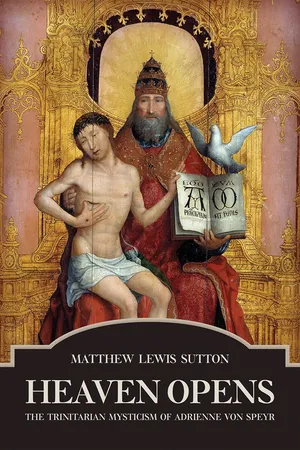
Adrienne von Speyr was one of the most important mystical theologians of the last century, heralded by figures like John Paul II and T.S. Eliot. However, her work has been eclipsed in many ways by her personal connection to Catholic theologian Hans Urs von Balthasar. Heaven Opens provides one of the first comprehensive accounts of von Speyr's theology, MatthewLewis Sutton argues that the eternal, immanent relations of the Triune God ground the mystical theological vision of von Speyr. Rooted in this vision of divine love, von Speyr's work is an account of the opening of heaven, a revelation of the Trinity's interior life turned outward to the world, that links intimately to the sacraments, prayer, the church, and the ethical life of obedience. In von Speyr's mystical theology, God as Triune journeys to us in order to brings into the inner life of the Trinity. Here, von Speyr's work is for the first time given an independent hearing, expositing its content, features, and connections, and assessing its contribution to contemporary Catholic theology.
Information
Topic
Theology & ReligionSubtopic
Christian Theology7
The Son’s Mission of Obedience
By bringing together the theological interpretation of obedience and mission in the previous chapter, I can now interpret von Speyr’s thought on the economic Trinity as an obediential theology of the Trinitarian missions. The Son’s mission will occupy this chapter, and the Holy Spirit’s mission will be the focus of the next.
The redemption of the world happens through the passion of the Son, who was “obedient unto death, even death on a cross” (Phil. 2:8). In von Speyr’s obediential theology of the Trinitarian missions, as it relates to the Son, her concern is for the interior aspects of Christ’s life and mission. Without attempting a psychology of Christ, which she thinks impossible, she is concerned with Christ’s interior state during the passion.[1]
Some of what von Speyr says results from her mystical experiences of “being admitted” into the interior experience of Christ during his passion, which is her special charism.[2] Her experiences give the understanding of how obedient Christ is to his mission to redeem the world. We now turn to his mission, to the Obedient One who offered himself for the sake of the world.
There are many ways to consider the incarnation and passion of Christ. In the third chapter, the passion was considered in founding Trinitarian mysticism; thus, it was through the passion that the gate of heaven was opened to reveal the Trinity. Now this chapter presents the incarnation and passion as the Son of God’s mission of obedience. Following Christ through his incarnation, his public ministry, and during the days of the passion, the eternal Trinitarian relations are stretched to the point of almost breaking. Fundamental to von Speyr is that the Son at every moment of his earthly life, especially during his passion, spoke every word to and in the Father and Holy Spirit.[3] Every word is a Trinitarian word. Knowing this idea will help us understand von Speyr’s thoroughly Trinitarian Christology.
The Son’s mission of obedience reveals his being generated from the Father. As discussed in Chapter Four, the Father generates the Son, and the Son lets himself be generated. The economic translation of this immanent relation is the Son’s obedience to his being sent. The Father sends the Son on a mission, and the Son lets himself be sent in pure obedience, in pure letting happen. Immanently, the Son lets himself be generated as Son of the Father; economically, the Son lets himself be sent to be the Obedient One to the Father for the sake of his Father’s creation. The Father gives him this creation to be its Lord, and “his being Lord is the expression of his obedience to the Father.”[4] Creation’s salvation happens through the Lord’s obedience to the Father.
The Son is sent by the Father to lead humankind to obedience by being the Obedient One. The Son is pleased to be sent by the Father’s will to become human and to take the cross of disobedience upon himself so that humans would learn to be obedient to the Father.[5] His mission is to be the Obedient One so that humans will follow him to the Father in obedience. If we let the words obedience and mission guide the following theological narrative of the Son’s incarnation and passion, we will have synthesized and analyzed von Speyr’s Trinitarian Christology. Her obediential theology of the Son’s mission encapsulates her vision of the open heaven that has revealed the Trinity.
I. Incarnation, Birth, and Childhood
The Father sends his Son to be the Son of Man. The Son wants to be obedient to this mission “not only to be the Son of God on earth, but to be a son of man in all things.”[6] This mission results in a human birth, a human life, and ultimately a human death in the forsakenness on the cross. As Son of Man, he became man in every way except sin (Heb. 4:15), because sin is ultimately not authentic, human nature. It is a perversion of the good and not natural. He unites in himself an uninterrupted union between heaven and earth.[7] As God, he images everything of what goes on in heaven; as man, he images everything that happens on earth.[8] As such, he is the center of heaven and center of earth. The incarnation becomes the precise meeting point of heaven and earth, or in the words of T. S. Eliot, “The point of intersection of the timeless / With time.”[9] With the incarnation, the Trinity is revealed in a never-before-seen fullness (Heb. 1:1-2). The Son’s incarnation translates the Trinitarian reality into terms humans can understand.[10] This extroversion of the Trinity reveals itself in the incarnation. It begins the decisive action of the Trinity to bring God’s creation back into God’s self.
For von Speyr, the incarnation must be seen as a mission of obedience. It is the act of fulfilling all of the Old Testament promises to their utmost out of obedience.[11] The Son lets himself be incarnate in the virgin (Isa. 7:14). He comes as the Son on a mission from the Father in the fullness of time by bringing together all of the past promises and fulfilling them in an always obedient way. The Son is not just obeying a stipulated plan. Rather, “he personally obeys the personal Father.”[12] He lets himself be incarnated out of obedience to the Father in order to fulfill the will of the Father. His being incarnate shows already that he exists in relation to the Father in a full Yes of obedience.[13]
In obedience, the Son of God became a man, and his whole life as a man remains an expression of this first obedience of being sent to be incarnate. To be the Incarnate One is to be the Obedient One. The Son’s incarnation is an obedience at once understood as an obedience of a man to God and at the same time is a mystery between the Father, Son, and Holy Spirit.[14] This mystery accompanies everything relating to his human life. The Father asks all of creation to imitate this obedience of the Son.
The obedience of the Son is preceded by Mary’s obedience, which is already a prefigured imitation of the Son’s obedience. Mary is a vessel of obedience for the Son’s obedience, and her obedience is fulfilled by the Son’s.[15] Mary’s obedience, the Holy Spirit’s overshadowing, and the many supernatural elements surrounding this event are all a “function of the obedient self-offering of the Son.”[16] Mary gives her assent to the angel out of a loving obedience: “This encounter of Mary with the angel is of the pure essence of obedience, it is a concentration of her love to God and of her life to a single point and this point is called: the acceptance of her mission.”[17] Her obedience is an acceptance of the Father’s will being done within her by the overshadowing of the Holy Spirit. Her obedience is an acceptance in love. Mary holds her little child and knows all of the secret moments of joy. In the incarnation, nativity, and childhood, it becomes impossible to separate the seam of obedience that brings together the obedience of Mary and her Son.[18]
The Son appears, in the fullness of time, as a little human child of Mary. This nativity is accompanied by a star. This star shows that the Father as creator “stands in a special relationship to this particular child and that the heavens are willing to bend their rules to the needs of the Son.”[19] The presence of the star as the Father and the overshadowing of the Holy Spirit bring the incarnation and nativity as the sending of the Son to be a full Trinitarian mystery. Through the non-presupposing nature of the child, the invisible divine nature appears to creation.[20] The three magi by following the star, already are learning the kind of obedience the Father desires.[21] They do not know where their travels will end, but they know they must follow. The end of their obedient journey from the east ends with their encountering the incarnation of the Ob...
Table of contents
- Cover
- Title Page
- Copyright
- Dedication
- Epigraph
- Table Of Contents
- Preface
- Chronology of Adrienne Von Speyr
- Abbreviations of Adrienne Von Speyr's Works
- Encountering Adrienne Von Speyr
- Trinitarian Mysticism as an Opening of Heaven
- Trinitarian Mysticism in the Drama of Redemption
- Original Image of the Always-Greater God
- Love Theology of the Immanent Trinity
- Obedience and Mission
- The Son’s Mission of Obedience
- The Holy Spirit’s Mission of Obedience
- The Trinitarian Origin of the Sacraments
- The Trinitarian Origin of Prayer
- “Lift Up Your Heads, O Gates”
- Bibliography
- Index of Names
Trusted by 375,005 students
Access to over 1.5 million titles for a fair monthly price.
Study more efficiently using our study tools.
Frequently asked questions
Yes, you can cancel anytime from the Subscription tab in your account settings on the Perlego website. Your subscription will stay active until the end of your current billing period. Learn how to cancel your subscription
No, books cannot be downloaded as external files, such as PDFs, for use outside of Perlego. However, you can download books within the Perlego app for offline reading on mobile or tablet. Learn how to download books offline
Perlego offers two plans: Essential and Complete
- Essential is ideal for learners and professionals who enjoy exploring a wide range of subjects. Access the Essential Library with 800,000+ trusted titles and best-sellers across business, personal growth, and the humanities. Includes unlimited reading time and Standard Read Aloud voice.
- Complete: Perfect for advanced learners and researchers needing full, unrestricted access. Unlock 1.5M+ books across hundreds of subjects, including academic and specialized titles. The Complete Plan also includes advanced features like Premium Read Aloud and Research Assistant.
We are an online textbook subscription service, where you can get access to an entire online library for less than the price of a single book per month. With over 1.5 million books across 990+ topics, we’ve got you covered! Learn about our mission
Look out for the read-aloud symbol on your next book to see if you can listen to it. The read-aloud tool reads text aloud for you, highlighting the text as it is being read. You can pause it, speed it up and slow it down. Learn more about Read Aloud
Yes! You can use the Perlego app on both iOS and Android devices to read anytime, anywhere — even offline. Perfect for commutes or when you’re on the go.
Please note we cannot support devices running on iOS 13 and Android 7 or earlier. Learn more about using the app
Please note we cannot support devices running on iOS 13 and Android 7 or earlier. Learn more about using the app
Yes, you can access Heaven Opens by Matthew Lewis Sutton in PDF and/or ePUB format, as well as other popular books in Theology & Religion & Christian Theology. We have over 1.5 million books available in our catalogue for you to explore.