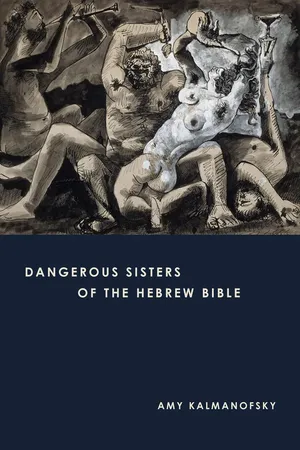
Fathers, sons, and mothers take center stage in the Bibles grand narratives, Amy Kalmanofsky observes. Sisters and sisterhood receive less attention in scholarship but, she argues, play an important role in narratives, revealing anxieties related to desire, agency, and solidarity among women playing out (and playing against) their roles in a patrilineal society. Most often, she shows, sisters are destabilizing figures in narratives about family crisis, where property, patrimony, and the resilience of community boundaries are at risk. Kalmanofsky demonstrates that the particular role of sisters had important narrative effects, revealing previously underappreciated dynamics in Israelite society.
- 176 pages
- English
- ePUB (mobile friendly)
- Available on iOS & Android
eBook - ePub
Dangerous Sisters of the Hebrew Bible
About this book
Information
3
Sisterhoods
7
The Daughters of Adam, Moab, the Land, and Israel
In the previous parts, I identified a biblical sister story that is centered upon the vulnerable patriarchal home and that reflects the Bible’s implicit gender ideology. Although there are ideal sisters like Rebecca and Miriam, who support their natal households, most of the Bible’s sisters are dangerous. Dangerous sisters threaten their households by conspiring together, asserting agency or desire, or eliciting desire in others. They challenge patriarchal authority and societal norms like incest taboos that protect the patriarchal family. My analysis not only reveals the prominence of dangerous sisters, it reveals the important narrative role they play in weakening rival patriarchs, thereby enabling the Bible to focus on its designated family. My analysis also shows how dangerous sisters help preserve the Bible’s patriarchal values by encouraging proper behavior. As destabilizing figures, dangerous sisters contribute to and reflect the vulnerability of their natal households. To protect the ideology that supports the patriarchal household, dangerous-sister stories warn women to control their desires, to remain within their proper familial roles, and not to defy patriarchal authority. They also warn men to be aware of dangerous sisters who can wreak havoc within even the most secure households.
I now broaden my focus and consider the Bible’s sisterhoods—women’s networks that are not necessarily defined by immediate kinship ties. In this part, I examine narratives that include groups of women that function as cohesive units. My goal is to understand how the Bible represents sisterhoods, and to consider how sisterhoods function within their narratives as well as within the Bible at large. As we will see, sisterhoods raise many of the same anxieties that actual sisters raise, and their narratives share common themes and concerns with the sister stories in the Bible. Yet, because sisterhoods extend beyond the family, sisterhood narratives cast wider nets than the sister stories. Their focus is more broadly on society and not on a particular family as in the sister stories. Whereas ideal sisters support their natal households in their narratives, ideal sisterhoods support Israelite society. Dangerous sisterhoods are destabilizing figures that threaten Israelite society. Marriage is a central concern of the sisterhood narratives as it is of the sister stories. Ideal sisterhoods ensure appropriate marriages that strengthen patriarchal Israelite society, whereas dangerous sisterhoods threaten those structures.
Given the prominence of dangerous sisters in the Bible, it is not surprising that dangerous sisterhoods appear frequently in the Bible, and I begin this chapter with their stories. Like the dangerous-sister stories, these narratives function as cautionary tales designed to encourage proper behavior and support patriarchal norms. They demonstrate the dangers of sororal solidarity and improper alliances though on a much broader scale than sister stories do. As we will see, dangerous sisterhoods weaken Israelite society and threaten its defining relationship with God.
More surprising, given the prominence of dangerous sisters, are the ideal sisterhoods that play significant roles within their narratives and within the Bible at large. In the next chapter, I examine the daughters of Jerusalem, an ideal sisterhood that appears in the Song of Songs. In the final chapter, I consider the ideal sisterhood formed between Ruth and Naomi—perhaps the Bible’s most significant relationship—in the book of Ruth. Ruth and Naomi’s ideal sisterhood, I argue, redeems dangerous sisters and sisterhoods and offers an essential paradigm of human relationship. My conclusion considers the theological implications of Ruth and Naomi’s sisterhood and why sisterhoods may, in general, fare better than sisters in the Bible.
The groups of women who appear throughout the Bible are identified most often as daughters. In Gen 6:1-4, divine sons are attracted to בנות האדם, human daughters. In Gen 34:1, Dinah leaves home to see the daughters of the land, בנות הארץ. Moabite daughters, בנות מואב, seduce the Israelites in Num 25:1-5, and Jephthah’s daughter spends her last two months alive among the daughters of Israel, בנות ישראל.
The daughters of Jerusalem, בנות ירושלם, appear throughout the Song of Songs. These daughters form sisterhoods—social networks of women that are not necessarily defined by immediate kinship ties. Living in small villages that consisted of several family compounds, it is likely that these young women were in fact distantly related to each other and comprised a clan.[1]
The frequent mention of these sisterhoods indicates that women were not confined to their individual households and natal families, but were part of larger cohorts in ancient Israel. Although there are only textual traces of them left in the Bible, based on epigraphic, archaeological, and ethnographic evidence, scholars, such as Carol Meyers, posit the existence of informal networks among Israelite women.[2] Despite the support for their existence, women’s networks, as Aubrey Baadsgaard observes, “are rarely noted in public discourse or in historical writing, but nevertheless they provide critical social linkages among women.”[3]
Meyers contends that gender was a determinative feature of life in ancient Israel. Although Israelite society depended on the labor of both men and women, gender defined the nature of their labor.[4] Samuel’s grim prediction of what a king would require from Israel’s sons and daughters illustrates how gender determines work:
He said: This will be the practice of the king who will rule over you. He will take your sons and appoint them as his charioteers and horsemen, and they will run before his chariot. He will appoint them as his chiefs of thousands and of fifties; to plow his fields, reap his harvest, and make weapons and equipment for his chariots. He will take your daughters to be spice-mixers, cooks, and bakers. (1 Sam 8:12-13)
According to this text, a king would appoint Israel’s sons as horsemen (making them plow and reap) and as soldiers (forcing them to construct weapons).
From this passage we learn that Israel’s daughters performed tasks such as cooking and baking. Like women throughout the ancient world, Israelite women prepared the food and made the clothing for their households. The remains of communal ovens, grinders, and kneading troughs convince archaeologists like Jennie R. Ebeling that women performed these tasks communally. Ovens discovered outside of homes were larger and were often found alongside other food processing equipment, suggesting to Ebeling “that women worked on various household tasks in groups.”[5] The skill, strength, and stamina required to do these household tasks demanded that women work in groups. Meyers notes the many steps involved in processing grain, which had to be soaked, milled, ground, and mixed before it could be set to rise. Meyers estimates that these steps would take at least two or more hours a day of a woman’s time.[6] Indeed, the curse of Lev 26:26 that ten women would bake bread in one oven may have been the reality. In truth, Israelite women may have experienced this more as a blessing than as a curse.
Scholars consider the positive impact women’s networks had for Israelite women and society. Cooperative labor could foster supportive relationships among the women who would share expertise and form alliances. Ebeling envisions Israel’s women sharing wisdom and gossiping as they grind grain.[7] Women’s networks potentially validated women’s experience and expertise by providing a social space for women to appreciate and excel at their labor. Women, as Meyers suggests, would teach other women the technically complex skills required for cooking, producing cloth, or making baskets and ceramics.[8] Women’s networks also could empower women by proving them essential to communal life and enabling them to exercise power within these networks—at least over other women. Given the technical expertise required to do the work that women regularly did, Meyers assumes there was a hierarchy within women’s networks in which certain women enjoyed status and privilege over other women.[9]
Along with the social benefits afforded individual members, women’s networks performed essential tasks that contributed to the stability of individual households, as well as to the society at large. Although not formally documented, Meyers asserts that Israelite women’s networks established important alliances within and between villages and may have played a significant role in negotiating marriages.[10] They also may have engaged in the ritual activities of the community, particularly those related to child birth and mourning, as certain biblical texts suggest. For example, at the end of the book of Ruth, a network of female neighbors blesses and names Ruth’s newborn son. The prophet Ezekiel condemns a network of female prophets that engages in activities that resemble birth rituals.[11] The specific mention of female mourners throughout the Bible suggests that there were formal, perhaps professional, networks of female mourners in ancient Israel.[12] In Jer 9:16-19, God summons the female lamenters to mourn over Zion’s destruction. Jeremiah 49:3 commands the daughters of Rabbah, בנות רבה, to mourn over Ammon. Ezekiel 32:16 commands the daughters of the nations, בנות הגוים, to lament over Egypt. In 2 Sam 1:24, David commands the daughters of Israel,
בנות ישראל to mourn for King Saul.
בנות ישראל to mourn for King Saul.
What is good for the individual woman and even good for Israelite society may not be considered good in the context of the Bible, which is invested in patriarchal authority. Although sisterhoods, defined by sororal solidarity, are essential for community life, they potentially challenge patriarchal authority. Ezekiel 16:45 relates the devastating effect of sororal solidarity when the women of Israel and Judah band together to defy their husbands and sons. As we will see, within the context of women’s networks, male authority, even men themselves, could be dispensable. For Beverly Bow, this explains the Bible’s discomfort with women’s networks. Examining many of the same narratives I examine, Bow concludes that the Bible negatively depicts the interpersonal relationship among women to convey the “patriarchal message” that “women cannot or should not band together.”[13] Rivalry among women serves the Bible’s patriarchal interests and proves that Israelite society is better off when women do not cooperate with one another. Women who do cooperate in the Bible often do so to pursue evil purposes. From this, Bow draws the conclusion that “sisterhood is antithetical to patriarchy” and is “dangerous.”[14]
Much of my study thus far supports Bow. I agree that sororal solidarity can threaten the home and, as we see in the sisterhood narratives, society. Yet, we also see that the sisterhood narratives present a more complicated picture of the interpersonal relationship among women than the sister narratives. Perhaps because of the crucial role women’s networks played, the Bible also depicts significant ideal sisterhoods that support Israelite society and its patriarchal ideology. These ideal sisterhoods, if not redemptive, are stabilizing forces in their narrative context. Before turning to these ideal sisterhoods however, I consider four dangerous sisterhoods whose brief appearances have devastating narrative consequences.
Daughters of Humanity
Although there are common elements between the Bible’s sisterhood and its sister stories, one thing is clear: the stakes are higher with sisterhoods than they are with individual sisters. A dangerous sister threatens a household, but a dangerous sisterhood threatens society. This is evident in the Bible’s first sisterhood story in Gen 6:1-4:
When humanity began to increase upon the face of the earth, daughters were born to them. The divine sons saw the daughters of humanity, for they were beautiful and they took them as wives, any of them that they chose. YHWH said: “My spirit shall not abide in them forever for they are also flesh. Their lifetime will...
Table of contents
- Cover
- Title Page
- Copyright
- Table Of Contents
- Acknowledgments
- Ideal and Dangerous Sisters in the Bible
- Sister Pairs
- Incestuous Sisters
- Sisterhoods
- Bibliography
- Index of Names and Subjects
- Index of Biblical References
Trusted by 375,005 students
Access to over 1.5 million titles for a fair monthly price.
Study more efficiently using our study tools.
Frequently asked questions
Yes, you can cancel anytime from the Subscription tab in your account settings on the Perlego website. Your subscription will stay active until the end of your current billing period. Learn how to cancel your subscription
No, books cannot be downloaded as external files, such as PDFs, for use outside of Perlego. However, you can download books within the Perlego app for offline reading on mobile or tablet. Learn how to download books offline
Perlego offers two plans: Essential and Complete
- Essential is ideal for learners and professionals who enjoy exploring a wide range of subjects. Access the Essential Library with 800,000+ trusted titles and best-sellers across business, personal growth, and the humanities. Includes unlimited reading time and Standard Read Aloud voice.
- Complete: Perfect for advanced learners and researchers needing full, unrestricted access. Unlock 1.5M+ books across hundreds of subjects, including academic and specialized titles. The Complete Plan also includes advanced features like Premium Read Aloud and Research Assistant.
We are an online textbook subscription service, where you can get access to an entire online library for less than the price of a single book per month. With over 1.5 million books across 990+ topics, we’ve got you covered! Learn about our mission
Look out for the read-aloud symbol on your next book to see if you can listen to it. The read-aloud tool reads text aloud for you, highlighting the text as it is being read. You can pause it, speed it up and slow it down. Learn more about Read Aloud
Yes! You can use the Perlego app on both iOS and Android devices to read anytime, anywhere — even offline. Perfect for commutes or when you’re on the go.
Please note we cannot support devices running on iOS 13 and Android 7 or earlier. Learn more about using the app
Please note we cannot support devices running on iOS 13 and Android 7 or earlier. Learn more about using the app
Yes, you can access Dangerous Sisters of the Hebrew Bible by Amy Kalmanofsky in PDF and/or ePUB format, as well as other popular books in Theology & Religion & Biblical Criticism & Interpretation. We have over 1.5 million books available in our catalogue for you to explore.