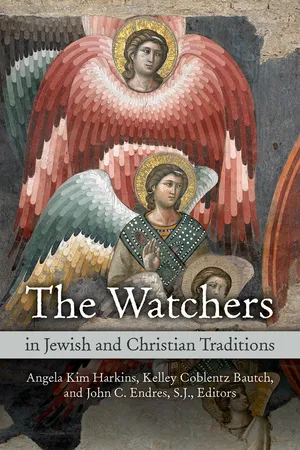
At the origin of the Watchers tradition is the single enigmatic reference in Genesis 6 to the sons of God who had intercourse with human women, producing a race of giants upon the earth. That verse sparked a wealth of cosmological and theological speculation in early Judaism. Here leading scholars explore the contours of the Watchers traditions through history, tracing their development through the Enoch literature, Jubilees, and other early Jewish and Christian writings. This volume provides a lucid survey of current knowledge and interpretation of one of the most intriguing theological motifs of the Second Temple period.
eBook - ePub
The Watchers in Jewish and Christian Traditions
- 224 pages
- English
- ePUB (mobile friendly)
- Available on iOS & Android
eBook - ePub
The Watchers in Jewish and Christian Traditions
About this book
Information
Topic
Theology & ReligionSubtopic
Biblical Studies1
Origins and Biblical Discussions of the Fallen Angels
1
Mesopotamian Elements and the Watchers Traditions
Ida Fröhlich
Introduction
By the time of the exile, early Watchers traditions were written in Aramaic, the vernacular in Mesopotamia. Besides many writings associated with Enoch, several works composed in Aramaic came to light from the Qumran library. They manifest several specific common characteristics concerning their literary genres and content. These are worthy of further examination.[1] Several Qumran Aramaic works are well acquainted with historical, literary, and other traditions of the Eastern diaspora, and they contain Mesopotamian and Persian elements.[2] Early Enoch writings reflect a solid awareness of certain Mesopotamian traditions.[3] Revelations on the secrets of the cosmos given to Enoch during his heavenly voyage reflect the influence of Mesopotamian cosmological lore.[4] The figure of Enoch and the elements of the revelation tradition associated with him originate in the figures of the Mesopotamian apkallū-s (wise ones), more exactly in the figure of the Mesopotamian diviner-king Enmeduranki, and in the tradition about divine revelation given to him.[5] Thus it can be assumed that the kernel of the Enochic tradition, the Book of the Watchers (1 Enoch 1–36), was shaped either in a Babylonian Jewish diaspora community or perhaps in a community of returnees that maintained traditions from the Babylonian exile. This group of writings might have been expanded by later additions to the text.[6]
The narrative of the Watchers (1 En. 6–11) belongs to the earliest textual layer of 1 Enoch and represents one of the earliest traditions of the collection. In chapters 6–11 two distinct narratives exist: the narrative on Shemihazah and that on Asael.[7] The bulk of this early tradition is contained in the Shemihazah story (1 En. 6:1–7:62). According to the Shemihazah story, a group of the sons of heaven (6:2), whom the text refers to as the Watchers (‘îrîn as in Dan. 4:10), glimpses the daughters of men, desires them, and decides to descend to them. Their leader Shemihazah (šmyḥzh) considers the plan to be sinful, and he does not want to bear the responsibility alone (6:3). Therefore, the Watchers, in order to fulfill their plan, swear to unite on Mount Hermon (1 En. 6:6). Then the Watchers “. . . began [to go in to them, and to defile themselves with them and (they began) to teach them] sorcery and spellbinding [and the cutting of roots; and to show them plants” (7:1). The women became pregnant from them and bore children, who became Giants. The Giants “were devouring [the labour of all the children of men and men were unable to supply] them.” (7:4). After this, the Giants begin to devour men, and then “. . . they began to sin against all birds and beasts of the earth] and reptiles . . . and the fish of the sea, and to devour the flesh of one another; and they were] drinking blood. [Then the earth made the accusation against the wicked concerning everything] which was done upon it” (7:5-6).[8] These then are the transgressions, which finally bring about the punishment of the flood (1 En. 9:1ff). Thus the story serves as a justification for the catastrophic punishment wreaked upon humanity.
The Asael story (1 En. 8:1-2) is not a retelling of the story of the Watchers; it is rather a commentary on certain elements of the narrative. It mentions Asael who taught metalworking, making weapons and jewels for men, and the knowledge of eyeshadows, of precious gems and dyes of mineral origins for women.[9] The section on Asael’s teaching is followed by a report on the teachings of Shemihazah and his companions; they taught the interpretations of heavenly omina, each Watcher teaching the signs of the natural phenomenon that was included in his name (1 En. 8:3-4).
The whole section ends with a report of the punishment of Asael and the Watchers. Asael was punished by the angel Raphael for the sin Asael perpetrated; he was bound and cast into darkness, where the Watchers will stay until “the great day of judgment” (1 En. 10:4-7). On the other hand, the punishment mentioned in the Shemihazah story is the binding of Shemihazah and his companions by Michael “for seventy generations” after they were forced to witness their children, the Giants, perish (1 En. 10:11-12). The devastation of the flood following these events signifies the purification of the earth (1 En. 10:1-3, 20-22).[10] The narratives on Shemihazah, Asael, and the flood revolve around the problem of the origin of evil. The Shemihazah narrative is similar to Gen. 6:1-4, which is also connected with the flood. The relation of the two stories is complicated. The story of Shemihazah and his companions is a logical and continuous narrative, whereas Gen. 6:1-4 seems to be a series of theological reflections on the story narrated in 1 Enoch.[11] As to the background and meaning of the story of the Watchers, earlier theories saw historical and mythological motifs behind the narrative. The motif of the integration of heavenly and earthly beings would have referred to and negatively judged the mixed marriages of the priests in the postexilic era, objected to by Ezra. The motif of the bloodshed would have mirrored the wars of the Diadochi.[12] Other theories look for mythological models, seeing the motif of the teachings of the Watchers as modeled after the myth of Prometheus, Asael being a protos heuretes. Of course, neither historical-sociological nor mythological models, including Greek images, can be ruled out. However, observation of only one or two motifs of the narrative does not illuminate the background and meaning of the whole story. Many elements of the story, such as cannibalism and consuming blood, the basically negative nature of the teachings of the Watchers, magic and interpretation of omina, are left unexplained. In order to ascertain the background and the exact meaning and message of the narrative, all major elements of the narrative must be considered. This can be followed by a discussion of the issue of foreign literary influences. The traditions associated with the Watchers were relevant themes in Qumran literature. They were often cited and referred to in other works, certainly because the meanings were considered relevant for the spiritual world of the community.[13] The Watchers supposedly held significance for them, and motifs associated with them embodied basic ideas of the Essene tradition.[14] Notions that are related to each of the motifs of the story are those of sin and impurity and magic and the demonic.
Sin, Impurity, and the Story of the Watchers
The purity system of ancient Israel is acquainted not only with physical impurities, but also ethical ones.[15] Ethical impurity grows out of situations that are controllable and are not natural or necessary, such as delaying purification from physical impurity, polluting specific sancta, sexual transgressions, idolatry, and murder. The locus of uncleanness may be the person, but proscriptions refer more to the pollution of the sanctuary or land.[16] Punishments of these sins are more severe than the consequences of physical impurities. Punishment of the sinner is usually the banishing/driving away (kārēt) from the land or the extinguishing of one’s family.[17] The main list of ethical impurities is in the Holiness Code (Lev. 17–26). Sins are related to four categories: sexuality, violence, death, and magic.
1. Sins related to sexual relations are cases of the zenūt, usually translated as fornication, which includes all kinds of illicit sex: sex among blood relatives, with another’s wife, homosexual relations, sex with a menstruating woman, and prostitution (see Lev. 18:1-30; 19:29). A special case in the list is kilayim, the prohibition of mixing together different kinds of animals, plants and materials in human clothing (Lev. 19:19, Deut. 22:9-11). A special case of zenūt not listed in Lev. 17–26 is remarriage with one’s divorced wife with her, in the meantime, having been remarried and then divorced or widowed (Deut. 24:1-4; cf. Jer. 3:1).
2. Sins related to blood: bloodshed (Deut. 21:1-9; cf. Gen. 4:10; Ps. 106:38-39).
3. Sins related to the dead: a corpse left on the tree for the night (Deut. 21:22-23; cf. 11QT 64:11-12).
4. Sins related to magic: “Do not resort to ghosts and spirits or make yourselves unclean by seeking them out. I am the lord your God” (Lev. 19:31). Magical practice is sometimes conceived as zenūt (Lev. 20:6), and those who practice it are to be killed (Exod. 22:17).
Results of ethical impurities are summarized in Lev. 18:27-30: “The people who were there before you did those abominable things and the land became unclean. So do not let the land spew you out for making it unclean as it spew...
Table of contents
- Cover
- Title Page
- Copyright
- Dedication
- Table Of Contents
- Abbreviations
- Introduction
- Origins and Biblical Discussions of the Fallen Angels
- Second Temple Developments
- Reception in Early Christianity and Early Judaism
- Index of Names
- Index of Biblical References and Ancient Literature
Trusted by 375,005 students
Access to over 1.5 million titles for a fair monthly price.
Study more efficiently using our study tools.
Frequently asked questions
Yes, you can cancel anytime from the Subscription tab in your account settings on the Perlego website. Your subscription will stay active until the end of your current billing period. Learn how to cancel your subscription
No, books cannot be downloaded as external files, such as PDFs, for use outside of Perlego. However, you can download books within the Perlego app for offline reading on mobile or tablet. Learn how to download books offline
Perlego offers two plans: Essential and Complete
- Essential is ideal for learners and professionals who enjoy exploring a wide range of subjects. Access the Essential Library with 800,000+ trusted titles and best-sellers across business, personal growth, and the humanities. Includes unlimited reading time and Standard Read Aloud voice.
- Complete: Perfect for advanced learners and researchers needing full, unrestricted access. Unlock 1.5M+ books across hundreds of subjects, including academic and specialized titles. The Complete Plan also includes advanced features like Premium Read Aloud and Research Assistant.
We are an online textbook subscription service, where you can get access to an entire online library for less than the price of a single book per month. With over 1.5 million books across 990+ topics, we’ve got you covered! Learn about our mission
Look out for the read-aloud symbol on your next book to see if you can listen to it. The read-aloud tool reads text aloud for you, highlighting the text as it is being read. You can pause it, speed it up and slow it down. Learn more about Read Aloud
Yes! You can use the Perlego app on both iOS and Android devices to read anytime, anywhere — even offline. Perfect for commutes or when you’re on the go.
Please note we cannot support devices running on iOS 13 and Android 7 or earlier. Learn more about using the app
Please note we cannot support devices running on iOS 13 and Android 7 or earlier. Learn more about using the app
Yes, you can access The Watchers in Jewish and Christian Traditions by Angela Harkins,Kelley Coblentz Bautch,John C. Endres,Angela Kim Harkins, Angela Kim Harkins,Kelley Coblentz Bautch, Angela Kim Harkins, Kelley Coblentz Bautch in PDF and/or ePUB format, as well as other popular books in Theology & Religion & Biblical Studies. We have over 1.5 million books available in our catalogue for you to explore.