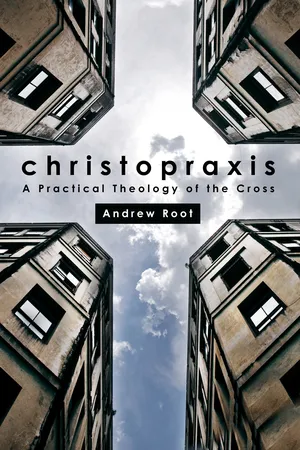
Since the late 1970's practical theology has had a significant voice and influence in the academy. While many have seen great hope and potential in this work, not everyone has agreed. Some, for instance, have examined the conversation and found by focusing on the concrete and lived experiences of humanity, by and large, practical theology has not had the theological vision to present frameworks for understanding concrete and lived experience with divine action. So argues Andrew Root, who in Christopraxis seeks to reset the entire edifice of practical theology on a new foundation. While not minimizing practical theology's commitment to the lived and concrete, Root argues that practical theology has neglected deeper theological underpinnings, and seeks to create a practical theology that seeks to be fully post-postmodern, post-Aristotelian, and that in seeking to attend to doctrines such as divine action and justification, is properly and fully theological.
- 260 pages
- English
- ePUB (mobile friendly)
- Available on iOS & Android
eBook - ePub
About this book
Information
Topic
Theology & ReligionSubtopic
Christian Theology3
8
Critical Realism and Practical Theology
In the last two chapters the theological lifting has been heavy. I have sought to drag practical theology onto significant theological ground, making a case for a Christopraxis practical theology of the cross. I’ve left open the critique that my discourse is more theological than social scientific, empirical, or even philosophical. These have often been the more comfortable tongues of practical theology, especially post–Seward Hiltner, leaving open the possibility that I have left the demarcation zone of practical theology itself.
Yet, I would disagree. I have sought to stay consistently within the field by focusing on the concrete and lived, by giving central attention to experiences of God’s coming like those in chapter 3. I have focused on the concrete and lived by thrusting ministry into the center, and the experiential by claiming the event of encounter with divine being. Therefore, I have turned from the common tongues of practical theology to explore the theological depths of experience. And while the tongues practical theology has used have been severally critiqued, most directly by Purves—with his effort to evacuate such discourse and return to classical doctrine—I do not share his sentiment. I’ve shown my own unease with Purves’s path, a single minded emphasis on doctrine is just as disconcerting as the absence of attention to divine action in much of established practical theology.
My own immersion in theological language in the last two chapters has little to do with disdain for the practical theological “common tongue” and its turning from classic theological language. Rather, my own turning to the theological is to keep with the heart of practical theology itself! I have turned to the theological to attend more fully to experience, to the very foolish experience of divine love for us! Where the likes of Purves have turned to (a rigid Barthian) theology to escape what is perceived as the cul-de-sac of the experiential, I have aimed to show that a Christopraxis perspective embraces experience as central for practical theology.
Yet, unlike those scholars in established practical theology, I have claimed that this experience is the encounter with the divine being itself. I have claimed that persons have concrete experiences of the divine breaking into time, of feeling the Spirit ministering to their person, of being swept up into the participation in the divine being by ministering to others, by feeding the hungry and embracing the weeping, and by listening and not talking, as Sarah did with Erin.
I turned from the social-scientific, empirical, and philosophical tongue of practical theology not because such discourse is vapid but because it has not helped us articulate the depth of experience, especially the evangelical experience that so often stands outside the aesthetic or political commitments of established practical theology.
This means that my theological turn in the last three chapters is not for the sake of theology but for the sake of articulating experience as richly as possible. I have used theology in an ad hoc way (Hans Frei); I have used it because it most helpfully allows me to speak of the depth of experience, to make sense of experiences like those that Paul had on the road to Damascus (Acts 9) and those in our own lives that, though they may not be as dramatic, are nevertheless real. I have said that practical theology’s heart is not theology, but ministry. But ministry (as opposed to practice alone) needs the discourse of the theological to attend to the fullness of its subject. It is true that I would prioritize theology above the other tongues practical theology has most often used, but not because theology is superior—theology, like all other forms of discourse, is a human project. I would do so because theology possesses within itself the ability to speak of these experiences we have of God’s becoming to us, of God’s ministering to our person. Theology helps us make sense of the experience of hearing God speak to or meet us, as almost all the people I interviewed witnessed to. Theological discourse gives us the best epistemological tools to express and reflect on the reality of God’s act in our concrete lives (I will say much more about this below).
Therefore, in the last three chapters I have spoken (theologically) of how the divine being encounters the human being as an experienced reality (I am claiming this as an essential heart of the field of practical theology). But this attention to how the divine being encounters the human being and how the human being acts in response to the experience of divine being risks the critique of theological hegemony and the loss of the practical. Practical theology has sought to do its work from the ground, using social-scientific, empirical, and philosophical perspectives to do so (for they are perceived to be more grounded—which I’m not sure is true). Yet, I am claiming that experiences with the divine are real. And theology is more helpful because it attends to this realism, which the social sciences often ignore.
It is now time to justify this assertion. Therefore, keeping the evangelical experience central (the experience of divine encounter with the human), we will turn in this chapter from the theological to the philosophical and social scientific. Picking up a philosophical/social-scientific perspective that allows us to attend to divine encounter, we will connect it with the claims that divine action is in itself a reality. Turning to this position places my deeply theological perspective squarely within the zone of practical theology. While my Christopraxis perspective has drawn deeply from theology, it nevertheless also roots itself in a philosophical/social-scientific perspective that allows for (certain) empirical examinations, but never in a reductionistic way that denies concrete experience itself—even concrete experience with the divine.
The perspective I’ll explore is critical realism. My assertion is that a Christopraxis practical theology of cross is embedded in a critical realist personalism that not only allows for the statements I have made above, statements I admit can only be confessed, but also allows for these confessional statements the possibility of truly being real, and real from the level of scientific discourse (that is, the language to which established practical theology has wanted to attend).[1]
The objective of this chapter, then, is to explicate how my Christopraxis practical theology is embedded within critical realism, making it possible for us to speak of divine action not as only a foreign confessional statement outside of or disconnected from reality, but as confession of reality, as the experience of something real—dare we even say, true.
Critical Realism
Critical realism is a philosophical/social-scientific perspective that has its origins (at least in the vein I’m working) in the thought of Roy Bhaskar, Margaret Archer, and Andrew Collier, to name just a few. It is a secular scientific perspective inasmuch as it does not seek to provide an apologetic for theism, and many atheists work from a critical realist perspective in the sciences.[2] Yet, as we’ll see, because of its realist attention, there are deep convergences with some of the theological perspectives we’ve explored above.[3]
As a scientific perspective, critical realism rests on three overarching commitments. These three commitments will be explored in turn (though there will be large chunks of dialogue between each of the three) and connected to practical theology. We’ll see how they deepen the Christopraxis perspective I’ve been constructing, placing Christopraxis within the scientific purviews that practical theology seeks to attend to.
1. Ontology over Epistemology
The first commitment of critical realism is to reverse the priority of epistemology over ontology that has been en vogue since the Enlightenment and the work of Kant.[4] Critical realism is a realism; it claims that there are entities that are real in the world that exist outside what can be known. Reality itself exists independent of any epistemological structure. Philosopher John Searle says it this way, “Realism is the view that there is a way that things are that is logically independent of all human representations. Realism does not say how things are but only that there is a way that they are.”[5]
Epistemology, the realist asserts, is always a representation and an imperfect one at that. Epistemology is a model of reality and should not be confused with reality itself. Reality always overspills our epistemological conceptions of it. All forms of science, critical realism asserts, are epistemological representations of reality. Reality is always more than any science (including theology) can measure or know. This doesn’t make science futile, but it does direct it toward humble articulations of reality. It does this rigorously and critically but always under confession of its limit. Science’s rigorously formed epistemologies are always in the end “believed” or trusted or confessed or taken in faith (all ministerial language) because no scientific epistemology can get its arms completely around reality.
Though science can never possess reality in its scientific representation (in its epistemologies), though what is (ontologically) is always more than these representations, science nevertheless seeks to say something true about reality. Thus, the objective of science is never to possess reality but “to conform the shape of our minds to the nature of the reality that exists beyond (but also including) our minds.”[6]
From a realist perspective, then, there are things that exist in the world that we cannot know. Reality itself is stratified in such a way that human consciousness cannot completely capture reality; reality exists independent of the human mind. Reality includes the human mind but is (ontologically) more than what the human mind can know (epistemologically). While to some this seems like a truism, it has not been the trajectory of philosophy—or of the social sciences, here following philosophy—since the Enlightenment. This has moved humans to often contend that only what can be epistemologically known (or even proven) can be real. Critical realism, however, calls into question this conflation of epistemology that swallows ontology. It does not hold to the equation that what can be known is real but rather asserts that there are brute realities (again following Searle) that are, whether they are ever cognitively conceived by epistemological frameworks or not.
From a realist perspective, we as human knowers and our sciences as human constructs do not possess the equipment to know reality completely and finally. There are real things in the world that we cannot know as a totality. For instance, we cannot know for certain the expanse of the universe; its mass is not only not measurable but also existentially crushing—it transcends our consciousness. We believe the universe is real (really massive), though we cannot fully epistemologically conceive of it. We contend that the universe is massive because, though we cannot know it in toto, we have experienced it in part through the epistemologies of science. But because we have experienced it in part, we understand that there is much we cannot know about it.
In similar ways, God in Godself is not a reality that humanity is able to conceive. God in Godself is hidden to us. This does not mean God doesn’t exist, as that would be to subordinate ontology to epistemology. But it does mean that we have no access to this reality and in the end, then, cannot say if there is a God or not.[7] At the same time, we cannot say that we know there is no God on the basis of not being able to epistemologically conceive of this God beyond a doubt (this very perspective is why the revelatory realism of God’s being as becoming is central to my perspective).[8] Archer, Collier, and Porpora state: “We thus arrive at the critical realist affirmation of ontological realism. Does God exist? From the standpoint of ontological realism, the question is legitimate. The question has both sense and possible answers. From the standpoint of ontological realism, reality in general exists quite apart from our knowledge of it. There is, then, nothing inappropriate about asking whether or not that reality includes God.”[9]
Critical realism moves fully into a postpositivist position in the sense that it does not concede to the epistemological hubris of contending that what is real is only what can be proven. Critical realism is a perspective that reminds scientists that they are creatures and, as creatures, are epistemologically fallible.
The Epistemic Fallacy
To deny this realist perspective (to yield to Hegelian idealism or Humean empiricism, for instance) and contend that epistemology constitutes reality, that reality itself is only what can be known or constructed by knowers, is to enter what critical realists call “the epistemic fallacy.”[10]
The epistemic fallacy is the belief that human knowers construct reality through their epistemological operations. But this, again, is for epistemology to swallow up ontology. This swallowing up starts with scientific positivism, wh...
Table of contents
- Cover
- Title Page
- Copyright
- Table Of Contents
- Preface
- Bibliography
- Index of Names and Subjects
Trusted by 375,005 students
Access to over 1.5 million titles for a fair monthly price.
Study more efficiently using our study tools.
Frequently asked questions
Yes, you can cancel anytime from the Subscription tab in your account settings on the Perlego website. Your subscription will stay active until the end of your current billing period. Learn how to cancel your subscription
No, books cannot be downloaded as external files, such as PDFs, for use outside of Perlego. However, you can download books within the Perlego app for offline reading on mobile or tablet. Learn how to download books offline
Perlego offers two plans: Essential and Complete
- Essential is ideal for learners and professionals who enjoy exploring a wide range of subjects. Access the Essential Library with 800,000+ trusted titles and best-sellers across business, personal growth, and the humanities. Includes unlimited reading time and Standard Read Aloud voice.
- Complete: Perfect for advanced learners and researchers needing full, unrestricted access. Unlock 1.5M+ books across hundreds of subjects, including academic and specialized titles. The Complete Plan also includes advanced features like Premium Read Aloud and Research Assistant.
We are an online textbook subscription service, where you can get access to an entire online library for less than the price of a single book per month. With over 1.5 million books across 990+ topics, we’ve got you covered! Learn about our mission
Look out for the read-aloud symbol on your next book to see if you can listen to it. The read-aloud tool reads text aloud for you, highlighting the text as it is being read. You can pause it, speed it up and slow it down. Learn more about Read Aloud
Yes! You can use the Perlego app on both iOS and Android devices to read anytime, anywhere — even offline. Perfect for commutes or when you’re on the go.
Please note we cannot support devices running on iOS 13 and Android 7 or earlier. Learn more about using the app
Please note we cannot support devices running on iOS 13 and Android 7 or earlier. Learn more about using the app
Yes, you can access Christopraxis by Andrew Root in PDF and/or ePUB format, as well as other popular books in Theology & Religion & Christian Theology. We have over 1.5 million books available in our catalogue for you to explore.