- 272 pages
- English
- ePUB (mobile friendly)
- Available on iOS & Android
eBook - ePub
About this book
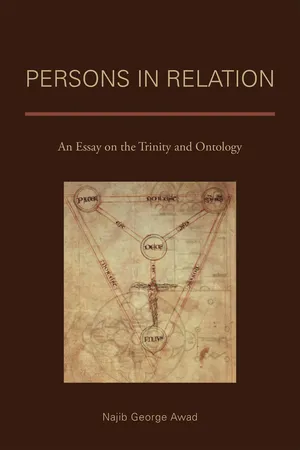
The recent 'turn to the Trinity' in modern and contemporary systematic theology has been inundated with models and proposals for construing the concepts of personhood, persons, and relations in connection to a proper understanding of the Trinity. These proposals have at the same time involved borrowing and applying philosophical and anthropological notions in the construction of a doctrine of the Trinity. Tracing out the origins of the Trinitarian 'revival' in the modern era, particularly on account of the influence of Schleiermacher, Tillich, Barth, Rahner, and Pannenberg, through to the destabilizing effects of postmodernity on Trinitarian discourse, the author provides a critical hermeneutic for the evaluation and implementation of thoughtful Trinitarian theology in the contemporary world. Within this frame, the author argues for viewing the Trinity as the intellectual and conceptual context and interdisciplinary arena of interaction between theology and other forms of intellectual inquiries to generate a robust, multifaceted, and historically fluent doctrine of the Trinity.
Information
Topic
Theology & ReligionSubtopic
Christian Theology2
The Challenge: Trinitarian Theology and/in Postmodernity
3
The Postmodernist Conditioning
I. Setting the Scene
The second half of the last century witnessed the birth of an intellectual phenomenon called “the postmodern condition,” a condition that has deeply shaped today’s intellectual scene. Opinions oscillate between belief in the possibility of a fixed definition of “postmodernity,” or argue instead that it is impossible to define this multifaceted phenomenon at all,[1] let alone inquire about whether postmodernity is an expression of an intellectual breach with modernity or rather a revised extension of modernity itself.
Within this new intellectual context, theologians are faced again with the question of the nature of the relationship between Christian theology and the surrounding intellectual culture of the “postmodern condition.”[2] They therefore relate to this condition with a caution colored by various kinds of expectations. Some theologians are fully supportive of postmodernity and believe that it is the savior of theology from the conditions of modernity.[3] Others, to the contrary, anticipate that time will reveal postmodernity to be just another anthropocentric condition that imposes on theology no less constraining criteria of verifiability than modernity.[4] If anything, this suggests that before theologians support either of these two positions they ought first to develop once more from Christian history clear answers to classical, yet principal, questions like the following: What sort of a relationship should theology have with other intellectual forms of inquiry? Should theology develop an insider view of these forms of inquiry by becoming one discourse, among many others, that speaks on behalf of these forms of knowledge and understanding? Or should theology rather maintain an outsider understanding of these new forms of inquiry, before consequently turning into a polemical opponent of a newly growing intellectual condition? In other words, should postmodernity be a condition that shapes and molds theological thinking, or should it be a new question that is asked and answered only from theological standpoints and on theological bases?[5]
In this part, “The Challenge,” I endeavor to analyze some of the major philosophical trends of thought that shape the postmodern intellectual forms of inquiry. In the following parts, I will offer a “model”[6] that answers the question of the proper relationship that theology should have with its surrounding intellectual conditions. This twofold purpose will be achieved first by displaying in this part a recent theological proposal which claims that in its central characteristics “postmodernity” represents a “theological conditioning” that essentially aims at correcting defects in theology and human secular knowledge of modernity. I will unpack the presumed logic behind this proposed theological recontextualization, before suggesting, in the last part of this study, another, more appropriate model of interaction between theology and postmodernity that attempts to restrain theology from becoming: 1) either a religious manifestation of contemporary intellectual conditions, or 2) a discourse that endeavors only to justify itself before postmodern, rational forms of understanding. Instead of making theology a “postmodern condition” and postmodernity a total “theological condition”—either of which is, in my opinion, an invocation of a modernist epistemological hierarchism that was once mistakenly followed by other, no less than referential theologians (see the second chapter of part one)—I will point to an option of relationality, wherein postmodernity can be theologically challenged and theology can go beyond the constraints of modernity. “Theologically challenged” means that postmodernity is not reduced to a mere theological phenomenon, although it is invited to acknowledge the theological dimensions of so many of its cherished notions. “Theologically challenged” rather than “theological condition” implies that postmodernity is questioned, and even corrected, by the theology of God the Trinity, without which an allegiance is imposed on theological assumptions or textual premises that may not, in the first place, be relevant to the concern of every contemporary inquiry.
I see such a model of theological contribution to the postmodern intellectual scene in a correlational form of relationality between theology and postmodern forms of inquiry. I am not offering here unconditional support for “correlation” as a notion or a model of connectedness. Rather, I argue that not every model of correlation is compatible with the nature of theological knowledge and inquiry. Thus I expose, in chapter five, two different understandings of correlational relationality. On the one hand are the proposals by David Tracy, Gordon Kaufman, and Mark Taylor, and on the other hand those of Hans Frei and Francis Watson. While critiquing the first and giving support to the second, I hope to show that discussing the appropriate relation between theology and postmodernity is not only necessary,[7] but also crucial to maintaining the rational and normative integrity of both Christian theology and the surrounding intellectual paradigm(s).
Let me now move to the main purpose of this part: 1) analyzing the claim that postmodernity should be from beginning to end “theologically conditioned”; 2) pointing at the negative consequences of this claim on trinitarian theology; and 3) criticizing the understanding of “relationality” and “participation” that is invested heavily by a few trinitarian theologians, and suggesting a theological correction to it from Christian patristic tradition.
II. The Goal: The Ambition of Theologizing Postmodernity
In an anthology on postmodern theology, Kevin Vanhoozer surveys the theological schools that emerged in response to, or in support of, the postmodern campaign against any claim of “objectivity” and any belief in the existence of such thing as the “essence” of anything.[8] One gleans from Vanhoozer’s survey that these theological schools emerged out of a perception of the serious threats such campaigning may generate against Christian faith and theology. For, contrary to this rejection of objectivity and “essence,” and according to the tradition of doctrinal theology of revelation, the idea of the “objective truth” that encounters the human from without by means of revelation, as well as the concept of “essence” as an expression of the inner nature of God, are two principal concepts for understanding and relating to the God of Jesus Christ and the Holy Spirit. Because such concepts are foundational to Christian faith, evaluating and questioning the validity of this recent rejection of “objectivity” and of “essence” that Vanhoozer points to becomes a crucial task for contemporary theology. It may pave the way for denying theology certain particular concepts that are central to its discourse about God. In the light of this, Vanhoozer suggests, it is quite essential to ask:
Does postmodernity present [theology] with enabling conditions and hence with new opportunities and possibilities, or does postmodernity represent a disabling condition, a condition of impossibility say, for discovering truth or for talking about God?[9]
In theology, there are various answers to Vanhoozer’s questions. Some theologians believe that postmodernity presents enabling conditions that liberate theology from the problematic and inappropriate constraints of modernity. One of the classical claims that reflect a zeal for subjecting theology to the constraints of the changing cultural factors in the world is the one that argues against the logical and existential tenability of conceiving God as an objective reality other than the world. Such a rejection is based on the allegation that any claim of the existence of an objective, ontological, and metaphysical God is threatening to human freedom and dignity. And, eventually, any reservation of traditional theology in the light of recent developments in the surrounding cultural context is impossible and unallowable.[10] Some of the theologians who commit themselves to this perspective, as Colin Gunton shows, take their stand on the belief that the early church committed a theological mistake in looking for, and in deriving ontological and metaphysical assumptions about God, from Scripture. Because the biblical texts, Gunton explains, are just “records of experience,” rather than philosophical or metaphysical texts, “we should, therefore, be free to develop a doctrine of God that conforms to our experience.”[11] Such a succumbing to the surrounding intellectual conditions, as Vanhoozer and Gunton concede, takes theology into various dead-ends and imposes untenable doctrinal assumptions on the Christian understanding of God and of humanity.
Alarmed by this danger, many theologians who believe in the ability of theology to remodel the contemporary age opt for challenging theologically any form of external subordination directed against theology by endeavoring to subordinate the contemporary intellectual conditions to theological constraints. A number of these theologians counter the subordination of theology by calling for a theological mission (almost evangelistic in some respects) toward the contemporary (postmodernist) cultural context. Driven by strong conviction about the collapse of the project of modernity, which considered dogmatic Christianity historically irrelevant and rationally invalid, they zealously endeavor to show the substantial relevance and referential position of Christian faith for the contemporary intellectual world. We hear today, as Diogenes Allen points out, theologians who strongly affirm that
[i]n a postmodern world, Christianity is intellectually relevant. It is relevant to the fundamental question, why does the world exist? And why does it have its present order, rather than another? It is relevant to the discussion of the foundations of morality and society, especially on the significance of human beings.[12]
After ex...
Table of contents
- Cover
- Title Page
- Copyright
- Table Of Contents
- Preface
- Introduction
- The Roots: Theology and the Question of Self in Modernity
- The Challenge: Trinitarian Theology and/in Postmodernity
- The Proposal: Trinitarian Theology and Postmodernity: In Correlation?
- Conclusion: When Theology Stands in History
- Bibliography
- Index of Names
- Index of Subjects
Trusted by 375,005 students
Access to over 1.5 million titles for a fair monthly price.
Study more efficiently using our study tools.
Frequently asked questions
Yes, you can cancel anytime from the Subscription tab in your account settings on the Perlego website. Your subscription will stay active until the end of your current billing period. Learn how to cancel your subscription
No, books cannot be downloaded as external files, such as PDFs, for use outside of Perlego. However, you can download books within the Perlego app for offline reading on mobile or tablet. Learn how to download books offline
Perlego offers two plans: Essential and Complete
- Essential is ideal for learners and professionals who enjoy exploring a wide range of subjects. Access the Essential Library with 800,000+ trusted titles and best-sellers across business, personal growth, and the humanities. Includes unlimited reading time and Standard Read Aloud voice.
- Complete: Perfect for advanced learners and researchers needing full, unrestricted access. Unlock 1.5M+ books across hundreds of subjects, including academic and specialized titles. The Complete Plan also includes advanced features like Premium Read Aloud and Research Assistant.
We are an online textbook subscription service, where you can get access to an entire online library for less than the price of a single book per month. With over 1.5 million books across 990+ topics, we’ve got you covered! Learn about our mission
Look out for the read-aloud symbol on your next book to see if you can listen to it. The read-aloud tool reads text aloud for you, highlighting the text as it is being read. You can pause it, speed it up and slow it down. Learn more about Read Aloud
Yes! You can use the Perlego app on both iOS and Android devices to read anytime, anywhere — even offline. Perfect for commutes or when you’re on the go.
Please note we cannot support devices running on iOS 13 and Android 7 or earlier. Learn more about using the app
Please note we cannot support devices running on iOS 13 and Android 7 or earlier. Learn more about using the app
Yes, you can access Persons in Relation by Najib George Awad in PDF and/or ePUB format, as well as other popular books in Theology & Religion & Christian Theology. We have over 1.5 million books available in our catalogue for you to explore.