- 272 pages
- English
- ePUB (mobile friendly)
- Available on iOS & Android
eBook - ePub
About this book
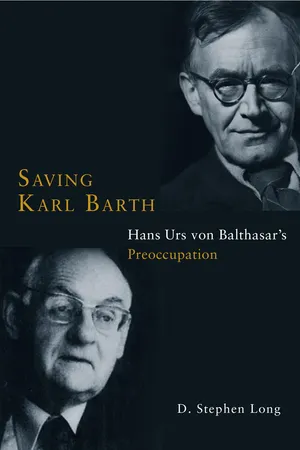
Challenging recent rejections of Hans Urs von Balthasar's groundbreaking study of Karl Barth's theology, Stephen Long argues that these interpreters are myopically impatient with the nuances of Balthasar's reading of Barth and fail to appreciate the longstanding theological friendship that perdured. Even more, current readings threaten to repristinate the embattled divide hallmarking Protestant-Catholic relations prior to Vatican II. Long contends against these contemporary trajectories in a substantial defense of Balthasar's theological preoccupation with Barth's thought. This book offers one of the first full contextualizations of the friendship that developed between Balthasar and Barth, which lasted from the 1930s until Balthasar's death in the 1980s. Re-evaluating Balthasar's theological work on Barth, the present volume provides a critical new reading of not only Balthasar's original volume but a wider account of the systematic engagement Balthasar carried on throughout his career. Within this, a paradigm for fruitful, generous ecumenical dialogue emerges.
Information
Topic
Theology & ReligionSubtopic
Christian Theology5
The Realm of Ethics
The previous chapter addressed the “burning matter of dispute” between Balthasar and Barth on the “realm” within which theologians pursue knowledge of God. On this matter, Balthasar was both for and against Barth. He was for him in that the de deo uno cannot condition the de deo trino without losing the divine economy. He was against him in that the crucial identity between them did not entail abandoning a version of the analogia entis. This chapter addresses the other “burning matter of dispute,” the realm within which theologians and Christians should reflect upon, and practice, “ethics.”[1] Much like Balthasar’s recognition that our natural knowledge of God should not work against God’s Triune economy, he also found in Barth a way to think about ethics that overcame stale divisions between nature and grace. Ethics and theology are no more a two-tiered relation than are nature and grace. Ethics should be interspersed within dogmatic loci, and not a separate treatise grounded in nature qua nature.
Barth and Balthasar interspersed ethics throughout dogmatic loci, and generated a very different approach to ethics than that found among either the neoscholastic or the liberal Protestants. Their approach is worthy of emulation, which is to suggest neither that they produced an ethical theory or practice free of problems, nor that their work was in complete agreement. Their differences take place, however, within substantive agreements. The first is that “ethics” poses a temptation and crisis for modern theology. The second is that the remedy for this temptation is to intersperse ethics throughout dogmatic loci. The third is that dogma entails human agents capable of performing God’s goodness in the world, both within and without the church. The latter comes as a surprise to many, but it is one of the most important discussions Barth and Balthasar held over the years. They came to agreement that human agents do perform God’s goodness, but the how of it remains a source of disagreement. If Barth’s ethics potentially collapsed nature into grace, creating difficulties for human action in the realm of grace, and thus abandoning human action only to a realm of nature, Balthasar’s ethics so emphasized mission and the evangelical counsels (poverty, celibacy, obedience) that it could lead to a valorization of sacrifice.
Another key difference between them is one they never resolved—what role does the church play in the human agency Christ makes possible? They differ on the following points. First, for Barth, election is of Christ and all are elected only in his election. Each Christian is equidistant from the Elect One. Balthasar’s doctrine of election also finds election primarily in Christ, but some are elected to specific missions to live out obedience to him and nonidentically represent his life in ways others are not. Mary primarily fulfills this representation. She is the only person, except Jesus, whose idea and existence are united on earth, but others can approximate this unity, and the church’s mission depends upon them. Second, for Balthasar, Christ and his church are differentiated, but they are one body; for Barth they are one body as well, but the Church is a form of Christ’s earthly body such that it can never assume his unique singular agency into itself. Third, albeit related to the second point, Barth denounced the doctrine of the church as the prolongation of the incarnation as blasphemy. Balthasar’s sense of mission depends upon that teaching. Fourth, Balthasar affirmed that some Christians were called to “go outside the camp,” and be with Christ so that they become a sacrifice for others. Barth had little place for this repetition of sacrifice, even though he was open to monastic obedience, but for him, Christ alone was the prodigal Son who went into the far country. No one goes with him. Fifth, Barth always sharply distinguished justification and sanctification. The latter made no contribution to the former. Balthasar did not adhere to such a strong demarcation. Human merit in a state of grace contributed to salvation.
This chapter unfolds the above agreements and disagreements. It begins noting how Barth and Balthasar shared a sense of crisis and related it to ethics. They both addressed this crisis theologically. Theological doctrines are not somehow more particular and specific than putative universal ethical principles. Theology neither gains meaning nor justification because doctrines can be intelligible through ethics. Such a move is the modern crisis, its “anthropological reduction.” For Barth and Balthasar theology, especially dogmatics, renders ethics intelligible, but they differed on which dogmas provide the context for ethics. Barth continues to suffer Catholicism by seeking to provide a Protestant dogmatics that can accomplish as much as a Catholic dogmatics, including an account of agency that is christological rather than mariological, an affirmation of evangelical counsels without their institutionalization, and an affirmation of Christ’s victory that has ethical significance even if there were no church. Balthasar disagreed, and developed his own ethics accordingly.
The Crisis of Ethics: What Shall We Do?
Since his earliest work, Barth’s theology was preoccupied with ethical matters. In fact, any account of Barth’s theology that fails to acknowledge how tightly he wove dogma and ethics together, and the reason he did so, could only be viewed as woefully inadequate.[2] Early on, Barth recognized “ethics” could not address the crisis of modern theology. In fact ethics precipitated the crisis. Balthasar made a similar argument.
Prior to Barth’s publication on Anselm (1931), he spent several summers putting together lectures on ethics (1928–1929). Those lectures, along with the 1927 Die christliche Dogmatik, are something of a template for what would then become the Church Dogmatics. Barth included whole portions of his lectures on ethics in the Dogmatics, sometimes with little revision. Barth never developed an independent ethics, but interspersed ethics throughout dogmatics, which is an important shift (or retrieval) that Barth produced within Christian theology. This shift is best characterized by his own words: “dogmatics is ethics.”[3] Ethics is the affirmation of Christ’s odd victory, declaring and witnessing to it. On December 12, 1930, Barth wrote a letter to Karl Stoevesand, in which he first noted his plan to develop a “five part work that includes an ethics dispersed over the doctrinal loci.”[4] Since 1930, he envisioned a dogmatics that incorporated ethics across the loci. He began that project in all earnestness in 1931, but the foundations were laid in the 1920s, both in what Barth would reject and affirm. What shifted were the dogmatic loci within which ethics made sense.
Dogmatics Placing Ethics in Crisis: “The Righteousness of Faith”
The central doctrine of Barth’s theological ethics from his early to his later work can be found in the expression, “The Righteousness of Faith,” or its correlate, “The Righteousness of God,” which is also the title of one of his earliest essays (1916). In this work, God’s righteousness primarily produces a “crisis” that calls into question any security we think we might find in ethics. The 1916 essay develops a theme that bears great similarity to Barth’s work in his Romans commentaries. “Ethics” is how we protect ourselves from God’s righteousness. We do so by building “towers,” an obvious reference to the tower of Babel. Barth writes, “We are fundamentally fearful of the stream of God’s righteousness which seeks entrance into our life and our world.”[5] The first tower we build to ward off God’s righteousness is the “righteousness of our morality.” The second is “the righteousness of the state and of the law,” followed by a third and fourth: “religious righteousness” and “civilization.”[6] Through these towers, “we have made ourselves a god in our own image.”[7] God’s righteousness does not work in cooperation with these towers. It doesn’t perfect or even correct them. “His Will is not a corrected continuation of our own. It approaches ours as a Wholly Other.”[8] As we have seen, by the time Barth writes Church Dogmatics 2.1, he criticizes this language of the “wholly other,” but here in this early essay, written only five years into his ten-year pastorate at Safenwil, Barth refers to God as “wholly other” in order to generate some important themes for his theological ethics, which are grounded in his dialectical approach. The most important of which is this: God’s righteousness approaches us as a “wholly other,” tearing down the towers we would build, especially by way of ethics, in order to secure ourselves from that righteousness. This central theme has the following correlates, which return again and again in different variations in Barth’s work:
- Dogma and ethics approach each other under a “crisis,” where the former undoes, and establishes, the latter.
- Ethics is placed under the doctrinal loci of the Reformation’s doctrine of predestination, “justification by faith alone,” and God’s sovereign freedom. At first this sovereignty is God’s freedom to be “wholly other.” Later it will be God’s freedom to love, defined by God’s Triunity.
- Once Barth situates ethics within the doctrine of the Trinity, then rather than evacuating theological ethics of all content, of all goodness, truth, and beauty, the crisis of ethics has a salutary purpose: the inculcation in human creatures of faith, hope, and charity.
Perhaps the most controversial of the above three statements is the third. For the “crisis” in Barth’s early ethics raises the question whether he is able to offer a positive theological ethic at all.[9] Does his theological ethics do anything other than tear down previous towers?[10] God confronts us as a sovereign, apocalyptic power, whose actions yesterday bear little to no continuity with today or tomorrow such that ethical norms could be trusted. There is no stable, unified relationship between divinity and humanity capable of generating faith, hope, and love as a human activity.[11] As we have seen, Balthasar raised this very question about the early, cacophonous Barth. He found Barth moving beyond it, and one path through that movement was the inadequacy of Barth’s early theology as it bore on ethics.
Barth’s initial approach appears to make ethical action almost impossible. Barth repeatedly asks the question, “What shall we do?,” but in his early work he is much better at asking it and having it elicit a crisis than he is at answering it. The radicality of his work should not be underplayed. From the 1920s into the 1940s, the crisis of ethics calls nearly every distinction between good and evil into question. As Balthasar noted, his position nearly capitulates to Ni...
Table of contents
- Cover
- Title Page
- Copyright
- Dedication
- Table Of Contents
- Introduction
- An Unlikely Friendship: Balthasar’s “Conversations” with Barth
- Presenting and Interpreting Karl Barth
- Collapse of Balthasar’s Interpretation
- The Realm of God
- The Realm of Ethics
- The Realm of the Church: Renewal and Unity
- Conclusion
- Bibliography
- Index of Names and Subjects
Trusted by 375,005 students
Access to over 1.5 million titles for a fair monthly price.
Study more efficiently using our study tools.
Frequently asked questions
Yes, you can cancel anytime from the Subscription tab in your account settings on the Perlego website. Your subscription will stay active until the end of your current billing period. Learn how to cancel your subscription
No, books cannot be downloaded as external files, such as PDFs, for use outside of Perlego. However, you can download books within the Perlego app for offline reading on mobile or tablet. Learn how to download books offline
Perlego offers two plans: Essential and Complete
- Essential is ideal for learners and professionals who enjoy exploring a wide range of subjects. Access the Essential Library with 800,000+ trusted titles and best-sellers across business, personal growth, and the humanities. Includes unlimited reading time and Standard Read Aloud voice.
- Complete: Perfect for advanced learners and researchers needing full, unrestricted access. Unlock 1.5M+ books across hundreds of subjects, including academic and specialized titles. The Complete Plan also includes advanced features like Premium Read Aloud and Research Assistant.
We are an online textbook subscription service, where you can get access to an entire online library for less than the price of a single book per month. With over 1.5 million books across 990+ topics, we’ve got you covered! Learn about our mission
Look out for the read-aloud symbol on your next book to see if you can listen to it. The read-aloud tool reads text aloud for you, highlighting the text as it is being read. You can pause it, speed it up and slow it down. Learn more about Read Aloud
Yes! You can use the Perlego app on both iOS and Android devices to read anytime, anywhere — even offline. Perfect for commutes or when you’re on the go.
Please note we cannot support devices running on iOS 13 and Android 7 or earlier. Learn more about using the app
Please note we cannot support devices running on iOS 13 and Android 7 or earlier. Learn more about using the app
Yes, you can access Saving Karl Barth by D. Stephen Long in PDF and/or ePUB format, as well as other popular books in Theology & Religion & Christian Theology. We have over 1.5 million books available in our catalogue for you to explore.