eBook - ePub
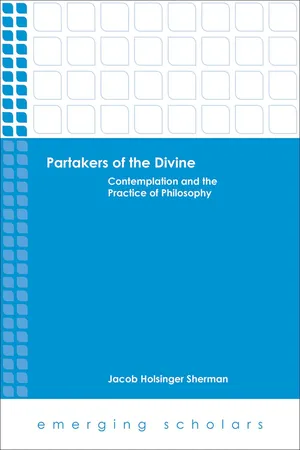
Partakers of the Divine
Contemplation and the Practice of Philosophy
- 242 pages
- English
- ePUB (mobile friendly)
- Available on iOS & Android
eBook - ePub
About this book
One of the important ecclesial developments over the last century has been the extraordinary rediscovery, retrieval and reinvigoration of the Christian contemplative tradition, a recovery that has been extraordinarily influential Theologians have begun to explore how aspects of the Christian contemplative tradition challenge certain prevalent views about the nature of God, the world, and persons, but this contemplative renaissance also raises crucial questions about a variety of more philosophical arenas such as how we construe the relationship between faith and reason, religious epistemology, theological metaphysics, philosophical hermeneutics and so forth. How might the theological and ecclesial renewal of the Christian contemplative tradition augment, challenge, and transform the practice not only of theology but also of philosophy itself? This book is an extended essay in 'contemplative philosophy,' the meeting of mystical and philosophical theology, of Christian contemplation and the philosophy of religion. It shows that, within the Christian tradition, philosophical and contemplative practices arose together and that throughout much of Christian history philosophy, theology and contemplation remained internal to one another. Contemplation was not something to be studied from the outside but rather transformed philosophical and theological inquiries from the inside. The relation of philosophy, theology, and contemplation to one another is of more than antiquarian interest, for it provides theologians and philosophers of religion today with a way forward beyond many of the stalemates that have beset discussions about faith and reason, the role of religion in contemporary culture, and the challenges of modernity and postmodernity.
Information
Topic
Theology & ReligionSubtopic
Christian Theology2
The Adorative Intellect
On Anselm’s Integration of Contemplation and Philosophy
Amor ipse notitia est [Love itself is a sort of knowledge].
—Gregory the Great
In chapters 2 and 3 of his Proslogion, Anselm argues that the name of God—that than which nothing greater can be thought, id quo maius cogitari necquit—constrains us to think the necessity of God’s existence. “Surely,” he says, “that-than-which-a-greater-cannot-be-thought cannot exist in the mind alone. For if it exists solely in the mind even, it can be thought to exist in reality also, which is greater.”[1] By all accounts, Anselm and this most famous of his arguments occupy a crucial and contested place in the dispute between faith and reason. Alternatively lauded and bemoaned as the father of philosophical rationalism or the champion of fideist theological autonomy, how one relates to Anselm is a sort of litmus test for how one will conceive the very projects of philosophy and theology. But, when we talk about the relationship between theology and philosophy, and assign Anselm to one side or the other, are we so sure we know what these terms mean? Do we already know where grace begins and human rationality ends? Do we even know what a mind is capable of or how human thought is able to transcend its own proper boundaries?
In what follows, I will argue that Anselm’s Proslogion forces such questions upon us by initiating its readers into a contemplative practice of sacred rationality that alone yields the conclusions that have made the text famous. The Proslogion cannot be reduced to two of its twenty-six chapters, nor isolated from the monastic and spiritual milieu within which it was conceived. Indeed, it is precisely when considered in its integral fullness that the Proslogion arguments achieve their greatest probative success. The vitality and efficacy of the Proslogion is inseparable from a contemplative elevation of the reader’s mental capabilities, a noetic transformation that Anselm understood as thinking with the heart and that I will call the adorative intellect. First, I introduce the context and scope of this question by briefly considering a number of extant interpretations of Anselm. Although there have been rumors of war between Athens and Jerusalem for millennia, the most common interpretations of the Proslogion err inasmuch as they read the peculiarly strident division of faith from reason that constitutes modernity back into Anselm’s decisively pre-modern text. In this vein, I note especially the way that even the most postmodern and radical interpretations of Anselm fail to do justice to his alternative contemplative rationality and so end not by challenging modernity in any sense but by reinscribing modernity’s terms in a new, more impervious manner. Next, I expand this picture by showing the role the adorative intellect plays in the Proslogion and how it becomes the key to our holding together central but seemingly disparate features over which critics otherwise stumble. Finally, I contend that attention to the adorative intellect enables us to reevaluate and defend the central philosophical claims of Anselm’s meditative text.
The Juxtaposition of Faith and Reason in Interpretations
of Anselm
In the Preface to the Proslogion, Anselm tells us that he originally left it and its predecessor, the Monologion, untitled and unsigned. On seeing that the tracts were of interest to those outside of the monastery walls at Bec, however, Anselm named the first An Example of Meditation on the Meaning of Faith, and the second Faith in Quest of Understanding. Later still, at the behest of certain magisterial figures, Anselm added his own signature to the works and gave them the names by which we know them today. The first title of the Proslogion—Fides quaerens intellectum—alerts us to the nature of the work as something equally at home in both the perspicacity of the intellect and the strivings of faith. This explicit attention to the role of faith and reason in the Proslogion is amplified by the historical context within which the work arose. Hailing from the eleventh century, Anselm is something of a twilight figure. He stands in between times, appearing, for example, as the culmination of that great flowering of monastic theology in the twelfth century, and, at the same time, as a harbinger of both the scholasticism and the devotio moderna that would follow. Indeed, there is a sense in which Anselm stands not only in the twilight of a certain middle ages and the advent of a new high medieval period, but also as a crucial figure in the transition to our own modernity.
Accordingly, interpretations of Anselm remain widely contested. At their extremes, the two dominant approaches tend to view him as either a precocious rationalist who foreshadows Duns Scotus, Baruch Spinoza, and G. W. F. Hegel, or as a theologian tout court with at most an incidental relationship to philosophy. The former interpretation is not hard to find: it is how Hegel presents the matter in his 1825–26 Lectures on the History of Philosophy; it is also the opinion of M. J. Charlesworth in his influential introduction, commentary, and translation of the Proslogion;[2] more recently, it is the negative assessment of certain Eastern Orthodox thinkers;[3] and it continues to be the de facto approach of most working philosophers and many theologians. Indeed, such philosophers, particularly but not exclusively of analytic bent, tend to treat Anselm and his Proslogion as chiefly offering one or two exceptionally interesting logical puzzles that need to be rationally teased apart. Whether the argument is approved (say, by René Descartes, Hegel, the young Bertrand Russell, or Alvin Plantinga) or contested (as in John Locke, Immanuel Kant, Gilbert Ryle, and Graham Oppy), the mode of analysis is entirely conceptual.
In response, the second school of interpretation has sought to retrieve Anselm as a vigorously theological thinker. This is most explicit in Karl Barth’s 1931 volume, Anselm: Fides Quaerens Intellectum. In this work, which Barth himself acknowledged as decisive in preparing him to write the later Church Dogmatics,[4] Barth argues that Anselm’s method always presupposes the rule of faith and is only an explication of the coherence or intelligibility of what was first given as a name of God through revelation (the name, in this case, being “That Than Which Nothing Greater Can Be Thought”). This is both a revelation of a personal name, a revelation through which we alone know God, and a prohibition against conceiving anything greater than God. Anselm’s “proof” of the divine existence never leaves the orbit of this revelation and is, instead, the working out of conclusions based upon the injunctions and axioms contained within the revealed name. Barth’s approach opened up a felicitous new reading of Anselm that allowed interpreters to pay more attention to the role of prayer and belief within the Proslogion itself. Some, such as Anselm Stolz, went so far as to claim that the saint’s text should be “trusted neither as philosophy nor as pure theology, but as a piece of mystical theology” whose aim was nothing other than “the experience of God.”[5]
To be sure, there is something to each of these various readings. Anselm is a sort of culmination of the renewal of rational dialectic that had been growing throughout the Middle Ages,[6] but, first and foremost, he was without doubt a monk for whom the vision of God was the chief end of life. How is one to hold all of these divergent strands together? Remarkably, while the various competing accounts mentioned above offer drastically different readings of Anselm’s project, they all seem to agree about the respective rules of faith and reason and merely disagree about whether Anselm plays for the former team or the latter. These common interpretations of Anselm have assumed that the proper function of reason is wholly naturalistic and that faith, by contrast, functions in an entirely gratuitous manner. One camp believes that the unaided human mind can cognize the divine, while the other claims that our theological certainty only derives from the external revelatory deposit of Scripture. Both, however, agree about the limits and scope of human intelligence.[7]
One might ask, however, What if revelation is not an external deposit of faith but an augmentation of natural intellectual capabilities that only find their consummation in supernatural elevation? If this were accepted (and we know that something like this was the view of Augustine in whose tradition Anselm stands), then the opposition between rationalism and fideism, metaphysics and theology, even apologetics and preaching would need to be radically reconsidered. This, of course, is not Anselm’s language, but I suggest that it is closer to Anselm’s vision than the peculiarly modern contest of faith and reason accepted by nearly all of Anselm’s conventional interpreters. By failing to question the fundamentally modern distinction between nature and grace—the drawing of which arguably inaugurated modernity itself—Anselm’s interpreters have failed to hear the radical challenge of the Proslogion, which is not reducible to either philosophy, theology, or mysticism, but initiates its readers into a sacred rationality that seamlessly unites all three.
Anselm and Postmodernity
It is not only analytically inclined philosophers and neo-orthodox theologians who read Anselm according to the canons of modernity, for this remains the case with even the most postmodern of Anselm’s interpreters. Consider Mark C. Taylor’s Derridean treatment of Anselm...
Table of contents
- Cover
- Additional Praise for Partakers of the Divine
- Title Page
- Copyright
- Table Of Contents
- Preface and Acknowledgements
- Introduction: Contemplation and Philosophy
- Between Theory and Theoria
- The Adorative Intellect
- A Stranger Modernity
- A Universe of Icons
- Contemplative Philosophy of Religion
- Bibliography
- Index
Trusted by 375,005 students
Access to over 1.5 million titles for a fair monthly price.
Study more efficiently using our study tools.
Frequently asked questions
Yes, you can cancel anytime from the Subscription tab in your account settings on the Perlego website. Your subscription will stay active until the end of your current billing period. Learn how to cancel your subscription
No, books cannot be downloaded as external files, such as PDFs, for use outside of Perlego. However, you can download books within the Perlego app for offline reading on mobile or tablet. Learn how to download books offline
Perlego offers two plans: Essential and Complete
- Essential is ideal for learners and professionals who enjoy exploring a wide range of subjects. Access the Essential Library with 800,000+ trusted titles and best-sellers across business, personal growth, and the humanities. Includes unlimited reading time and Standard Read Aloud voice.
- Complete: Perfect for advanced learners and researchers needing full, unrestricted access. Unlock 1.5M+ books across hundreds of subjects, including academic and specialized titles. The Complete Plan also includes advanced features like Premium Read Aloud and Research Assistant.
We are an online textbook subscription service, where you can get access to an entire online library for less than the price of a single book per month. With over 1.5 million books across 990+ topics, we’ve got you covered! Learn about our mission
Look out for the read-aloud symbol on your next book to see if you can listen to it. The read-aloud tool reads text aloud for you, highlighting the text as it is being read. You can pause it, speed it up and slow it down. Learn more about Read Aloud
Yes! You can use the Perlego app on both iOS and Android devices to read anytime, anywhere — even offline. Perfect for commutes or when you’re on the go.
Please note we cannot support devices running on iOS 13 and Android 7 or earlier. Learn more about using the app
Please note we cannot support devices running on iOS 13 and Android 7 or earlier. Learn more about using the app
Yes, you can access Partakers of the Divine by Jacob Holsinger Sherman in PDF and/or ePUB format, as well as other popular books in Theology & Religion & Christian Theology. We have over 1.5 million books available in our catalogue for you to explore.