- 192 pages
- English
- ePUB (mobile friendly)
- Available on iOS & Android
eBook - ePub
About this book
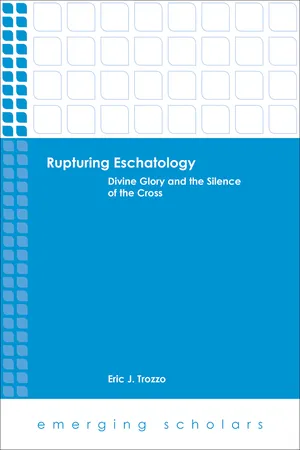
The modern and contemporary legacy of Luther's theology is a vital topic of continuing investigation, assessment, and construction. Rupturing Eschatology is Eric Trozzo's constructive retrieval of Luther's theology of the cross for the purpose of establishing a contemporary Lutheran and "emerging" account of the cross, silence, and eschatology. Seeking to overcome a tendency toward extrinsic notions of divine glory and transformation, the author explores Luther's early construction of the theology of the cross and divine hiddenness in concert with the work of the Lutheran mystical tradition and modern Lutheran theology, such as Jürgen Moltmann, Paul Tillich, and John Caputo. Trozzo argues for an intra-historical and intra-worldly account of divine possibility oriented around a contemporary theology of the cross marked by reclamation of the biblical and mystical practice of silence as the space that creates hope.
Information
Topic
Teologia e religioneSubtopic
Denominazioni cristiane1
Whither Glory?
Martin Luther’s Theologia Crucis
Martin Luther’s theology of the cross has proved to be fertile ground for creative theological reflection in recent years. It has been used to address a variety of contexts and issues, while the inversions central to it have been mobilized to challenge hierarchy and power imbalances. Indeed, part of the creative appeal of the theologia crucis rests in its capacity as a doctrinal nexus. Included within any articulation of a theology of the cross are formulations of the nature of God, humanity, faith, suffering, ethics, and revelation. In this chapter, I will lay out the basic contours of Luther’s theologia crucis in order to bring to light the theological and ethical stakes in the competing theological interpretations of this aspect of Luther’s thought. To do this, I will first review some key terms and concepts in Luther’s thought more generally before turning to several specific texts, most importantly the Heidelberg Disputation and “On the Bondage of the Will,” where Luther puts forth different aspects that fall under the umbrella term of theologia crucis. From this historical backdrop it will then be possible to understand the theological tensions stemming from Luther’s different writings and the tactics employed by contemporary theologians who are engaging Luther to address these tensions.
I would suggest that the best way to understand the issue that Luther was tackling in what is known as his theology of the cross is the question of where to find God’s glory. In his early searching, I will argue, he was keenly aware of the lack of discernable divine glory in the world. His insight at this time was that divine glory is not the same as typical human understandings of glory, where the term describes amassing strength and hierarchical power; rather, divine glory is expressed through being with those suffering and in need. Thus his formulation of a theology of the cross in the Heidelberg Disputation, the articulation most often intended when his theologia crucis is referenced, is a critique of human pretensions to glory and a presentation of an alternate view of how to recognize divine glory. In “On the Bondage of the Will,” meanwhile, “glory” takes on a different, more eschatological, meaning. Here he uses the term to denote a space beyond time where apparent tensions within the divine are resolved. In this, “glory” serves as a way for him to throw up his hands and evade difficult questions raised by his insight about the darkness of God’s hiddenness. Indeed, his talk of divine glory at this later time employs a logic of fulfillment in a way that foreshadows a pattern we will see in later theologians to move glory out of this world. To get at Luther’s later intuitions about the darkness of the hidden God, let us first look at his experience of being impossibly disconnected from God, and thus left longing for a taste of God’s glory.
An Experience of the Impossible
Before we can turn to talk of a theology of the cross, we must first dwell for a moment in Luther’s experience of suffering, which he calls Anfechtung in German and tentatio in Latin. It is the despair found in this experience that sets up Luther’s theological moves. This is not to say that he necessarily put it first chronologically, as for Luther Anfechtung cannot be overcome in this life but, rather, haunts each of us each day. Instead, in both his theological exposition and his own life Anfechtung marks the descriptive starting point. Indeed, Luther’s life and his theology cannot be easily separated. As venerable Luther scholar Gerhard Ebeling has noted, “[It] is simply a fact that the study of Luther’s theology involves us to a greater degree than in the case of almost any other theologian with his person.”[1] His description and experience of spiritual despair in the face of a God who appears as wrathful mark the underpinning of his theological approach.
Anfechtung is an infamously difficult word to render into English. It has been variously translated as “temptation,” “trial,” “affliction,” “tribulation,” and “suffering”; yet each of these translations only develops one facet of the term.[2] It is perhaps better understood as a theological concept that incorporates all of these dimensions. Reformation scholar Roland Bainton, for example, defines the concept as “all the doubt, turmoil, pang, tremor, panic, despair, desolation, and desperation which invades the [human] spirit.”[3] The word comes, in fact, from a middle-high German word for “bodily-struggle,” with its root, fechten, even having a connotation of “attack” or “combat.”[4]Anfechtung, then, is a kind of gut-wrenching attack on a person’s very being.
I suggest that we understand an element of Luther’s sense of despair as a perception of the apparent lack of divine glory in the world. That is, we might frame Luther’s underlying question in the experience of Anfechtung thusly: “If God is glorious, why is there so much misery in the world, and, more personally, why do I feel excluded from that glory no matter how hard I try to live worthily of it?” To be clear, Luther does not explicitly talk about God’s glory and Anfechtung together in this way, but based on other of his writings I believe it is fair to frame Anfechtung in this way. As such, Anfechtung is both an experience of hellish suffering and separation from God as well as a longing for God’s embrace. It is the impossible situation from which theology and, more importantly, faith may arise.
Anfechtung is crucial to Luther’s thought from the opening salvos of the Reformation debates. Indeed, he talks about his own experience of suffering and its relationship to the cross as early as the explanation to Thesis 15 of his Ninety-Five Theses. There he writes, “I also ‘knew a person’ [2 Cor 12:2] who asserted that he had very often suffered these punishments—to be sure over a very brief period of time.” The reference to 2 Corinthians is presumably a reference to Paul’s speaking of himself in that passage by saying he “knew a person.” Thus Luther is emphasizing that he is speaking of his own experience. He says that these experiences of suffering “were so great and so much like hell that no tongue could adequately express them, no pen could describe them, and no inexperienced person could believe them. . . . In such a situation, God appears terribly angry . . .” The sense of despair emanating from this experience is so great that “the soul cannot believe that it can ever be redeemed.” The soul is in such agony in this experience that “[it] is stretched out with Christ so that all of its bones may be counted [Ps 22:17]. Nor is any corner of the soul not filled with the greatest bitterness, with dread, trembling, and sorrow—and all only in an eternal way.”[5] Thus, early on, Luther paints a picture of an intense personal experience of agony that is foundational to his theology. It is into this agony and longing for relief that God’s grace can be most profoundly experienced. It is through such an experience of both Anfechtung and grace, for Luther, that a Christian is formed. As Reformation scholar Timothy Wengert points out, “For Luther, the theology of the cross is strictly a matter of experience.” Yet, he hastens to add, “It is not any old experience that makes a theologian, but precisely the experience of having been stretched out on Christ’s cross.”[6] There is a cycle, then, of suffering and grace. For Luther, both were never-ending realities of Christian life.
In the soul-crushing experience of hell, the impossibility of justification before God becomes clear. In this moment, for Luther, a theologian is born. As Luther famously wrote in what comes across as fractured English, “It is in living—no rather dying and facing damnation, not thinking, reading and speculating that makes a theologian.”[7] In coming through the experience of God being so utterly hidden, and thus being laid out to receive the grace of the cross, one becomes armed with the experiential tools to become a theologian. This is, in a nutshell, Luther’s hermeneutic of the cross. The hidden God, faith, and the cross are interwoven components of his theologia crucis, or “theology of the cross.” Together, I contend, they speak of an experience of impossibility that is broken open by God to reveal new possibility.
Luther reads all of Scripture through the lens of the cycle of Anfechtung and grace, seeing each story as one of the figures working through various forms of Anfechtung. Religion historian C. Warren Hovland contends that “In seeking to understand his own spiritual problems Luther came to see the Bible as a collection of biographies of those who were suffering Anfechtung and a record of how God permitted the pious to fall into this state and how [God] helped them out again.”[8] Luther himself confessed, “I find in the Scriptures that Christ, Abraham, Jacob, Moses, Job, David and countless others have tasted of hell even in this life.”[9] Different figures experienced Anfechtung in different ways, or different types of Anfechtung, even. Luther projected his spiritual struggles into his reading of the biblical narratives and so found a litany of souls hanging on to faith in the midst of hellish struggles.
Luther’s encounters with Anfechtung persisted throughout his life. Luther struggled with the onslaught of doubt besieging faith and with his understanding of his vocation. While some have framed Luther as overcoming the Anfechtung of his youth through an awakening of faith in 1513, as the explanation to Thesis 15 of the Ninety-Five Theses that we have already encountered might be read to indicate, it seems clear that Anfechtung was a necessary and continuing aspect of the experience of faith throughout life for Luther.[10] Indeed, during one of his table discussions, the mature Luther said: “If I should live a little while longer, I would like to write a book about Anfechtung. Without it no man can rightly understand the Holy Scriptures or know what the fear and love of God is all about. In fact, without Anfechtung one does not really know what the spiritual life is.”[11] This experience of struggle thus continued to be essential to Luther’s theological enterprise. As long as Anfechtung was a key part of his theological understanding, so too must his theologia crucis be.
While it is tempting to understand Anfechtung as a psychological issue that Luther was working through, Hovland is adamant that for Luther Anfechtung was not a psychological issue but, rather, a theological one: How do I stand before God? All experiences of Anfechtung deal directly with God.[12] It is an experience of despair in the face of the impossibility of standing righteously before God. For Luther, everything is at stake in this encounter: “The soul hangs precariously on a thin thread dangling between eternal life and eternal damnation.”[13] With so much on the line, the soul is ferociously attacked, whether by an uneasy conscience or by Satan in the form of doubt, and brought to despair through the encounter with the wrathful and, as we shall see later, mysteriously arbitrary God.
Tellingly, Hovland gives his own definition of Anfechtung as “the terror the individual feels in the moment he is confronted with some dark aspect of God.”[14] It is the encounter with the darkness of God that gives Anfechtung its painful depth. Anfechtung is always related to God being hidden. God in these times is experienced as absent, wrathful, capricious, or even pernicious, and in the throes of Anfechtung evidence to the contrary is scant. Yet at the sam...
Table of contents
- Cover
- Title Page
- Copyright
- Table Of Contents
- Acknowledgments
- Introduction
- Whither Glory?
- Hope and the Cross
- Tremulous Abyss
- Encountering the Im-Possible
- The Rest Is Silence
- Index of Names
Trusted by 375,005 students
Access to over 1.5 million titles for a fair monthly price.
Study more efficiently using our study tools.
Frequently asked questions
Yes, you can cancel anytime from the Subscription tab in your account settings on the Perlego website. Your subscription will stay active until the end of your current billing period. Learn how to cancel your subscription
No, books cannot be downloaded as external files, such as PDFs, for use outside of Perlego. However, you can download books within the Perlego app for offline reading on mobile or tablet. Learn how to download books offline
Perlego offers two plans: Essential and Complete
- Essential is ideal for learners and professionals who enjoy exploring a wide range of subjects. Access the Essential Library with 800,000+ trusted titles and best-sellers across business, personal growth, and the humanities. Includes unlimited reading time and Standard Read Aloud voice.
- Complete: Perfect for advanced learners and researchers needing full, unrestricted access. Unlock 1.5M+ books across hundreds of subjects, including academic and specialized titles. The Complete Plan also includes advanced features like Premium Read Aloud and Research Assistant.
We are an online textbook subscription service, where you can get access to an entire online library for less than the price of a single book per month. With over 1.5 million books across 990+ topics, we’ve got you covered! Learn about our mission
Look out for the read-aloud symbol on your next book to see if you can listen to it. The read-aloud tool reads text aloud for you, highlighting the text as it is being read. You can pause it, speed it up and slow it down. Learn more about Read Aloud
Yes! You can use the Perlego app on both iOS and Android devices to read anytime, anywhere — even offline. Perfect for commutes or when you’re on the go.
Please note we cannot support devices running on iOS 13 and Android 7 or earlier. Learn more about using the app
Please note we cannot support devices running on iOS 13 and Android 7 or earlier. Learn more about using the app
Yes, you can access Rupturing Eschatology by Eric J. Trozzo in PDF and/or ePUB format, as well as other popular books in Teologia e religione & Denominazioni cristiane. We have over 1.5 million books available in our catalogue for you to explore.