Resources for Spiritual Narratives
Key Terms
- Collective narrative ministry. Narratively influenced ministry based on Denborough and Cheryl White’s collective narrative practice, which emphasizes building unity with diversity, thus avoiding a false bifurcation between individual and group practices. Collective narrative ministry uses the re-storying of spiritual narratives through the collective practices of caring, leading, worshipping, and teaching.
- Formative spiritual experience. A spiritual experience that you know is true for you and serves as a source of strength.
- Spiritual narrative. Stories of faith that, over a period of time, extend into the future in ways that generate rich spiritual experiences, resulting in thickened faith for the believer.
- Staff of Spirit. A group spiritual practice that implements collective narrative methodology in a theological format influenced by liberation theology.
Websites
- Dulwich Centre (www.dulwichcentre.com.au). Internationally focused website sponsored by the Dulwich Centre, co-founded by Michael and Cheryl White. The site includes a search engine linked to a comprehensive bibliography of narrative books and articles around the globe. Video podcasts are available from Friday Afternoons at Dulwich Centre (narrativetherapyonline.com) with a variety of presenters and topics.
- Spiritual Narratives (www.spiritualnarratives.com). This website, launched by this book’s author, serves as a source for updates to this book. Resources include a blog, podcasts, PowerPoint and Prezi presentations, links, and the Staff of Spirit.
- Narrative Approaches (www.narrativeapproaches.com). David Epston’s training events can be found on this website as well as other narrative training around the globe.
- Narrative Therapy Online (www.narrativetherapyonline.com). This goes directly to the video presentations of Friday Afternoons at Dulwich Centre on the Dulwich Center website. Persons can sign up to participate in this experience through postings.
Recommended Books
Bidwell, Duane. 2013. Empowering Couples: A Narrative Approach to Spiritual Care. Minneapolis: Fortress Press.
Coyle, Suzanne. 2013. Re-storying Your Faith. Winchester, UK: Circle Books.
Denborough, David. 2014. Retelling the Stories of Our Lives: Everyday Narrative Therapy to Draw Inspiration and Transform Experience. New York: W.W. Norton and Company.
Hester, Richard, and Kelli Walker-Jones. 2009. Know Your Story and Lead with It: The Power of Narrative in Clergy Leadership. Herndon, VA: Alban Institute.
Golemon, Larry, ed. 2010. Finding Our Story: Narrative Leadership and Congregational Change. Herndon, VA: Alban Institute.
____. 2010. Living Our Story: Narrative Leadership and Congregational Culture. Herndon, VA: Alban Institute.
____. 2010. Teaching Our Story: Narrative Leadership and Pastoral Formation. Herndon, VA: Alban Institute.
Neuger, Christie. 2001. Counseling Women: A Narrative, Pastoral Approach. Minneapolis: Fortress Press.
Staff of Spirit Spiritual Practice
Permission is granted for reproduction of this Staff of Spirit logo and spiritual practice guide for personal use in electronic form or hard copy. The Staff of Spirit logo can be reproduced for group members as well as used as a cover to create a booklet.
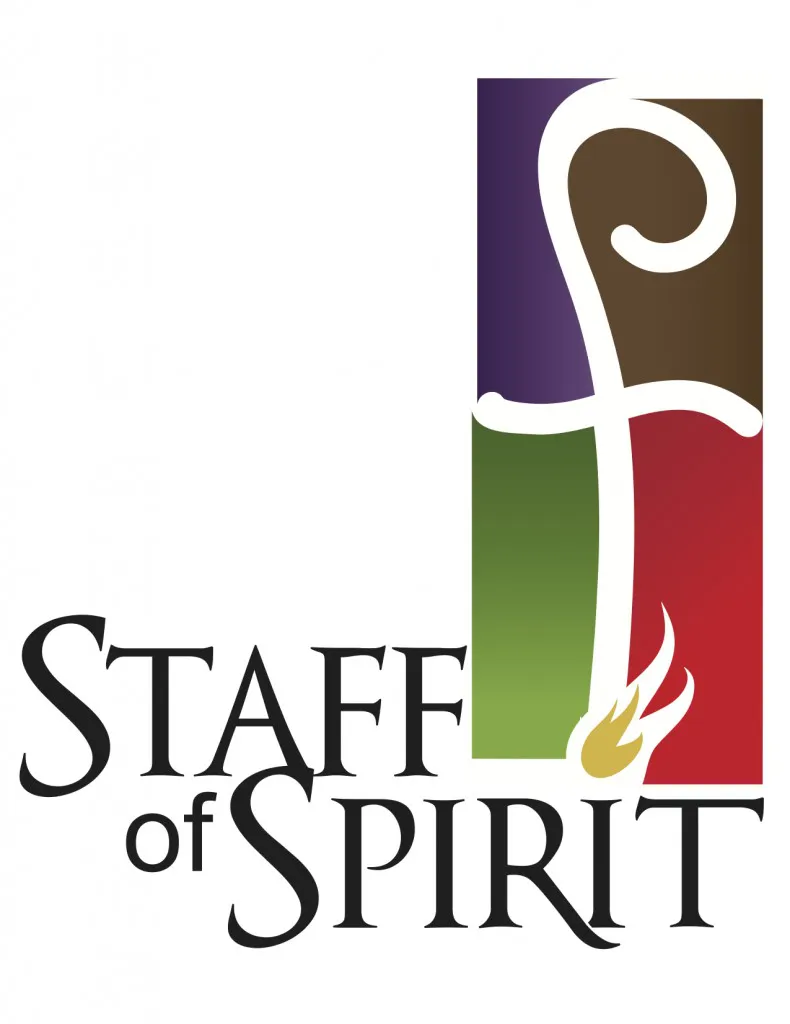
The crook of the Staff of Spirit represents qualities of spirituality for the participant that are connected through relationships with self and others. The cross on the Staff of Spirit represents qualities of spirituality relating to God through Jesus Christ. As participants use the Staff for telling their stories, their present spiritual experiences with significant others and God will be identified. Then, through telling and retelling with other group members functioning as outsider witnesses, the stories will be re-authored and doubly listened to. Stories of sustenance from the past can thus be used as a staff of strength for the future. A believer can choose a different staff for each journey. As a community of faith, we can also share our shepherd’s staff with others on the journey. The Staff of Spirit is described as a way to develop storytelling into a spiritual practice that can enrich the participants’ faith. Stories can be noted and reflected on in the future. Before beginning the process around the Staff of Spirit, participants are given the primary question the Staff invites: What sustains you on your journey of faith?
Participants are given a sheet with the Staff of Spirit logo on it so they can write down their stories and the stories of others, along with significant phrases for the outsider witness and definitional ceremony at the end of the process. With either silence or quiet music playing, each participant is asked to identify a formative spiritual experience to tell the other members of the group. A formative spiritual experience is defined as a spiritual experience that you know is true for you and serves as a source of strength. Taking turns, each participant tells the story of the formative spiritual experience to the group.
Spiritual Practice 1: Telling Your Spiritual Story
After telling the story, each participant is to write on the crook of the staff, beginning with the lower left quadrant, responses to the following questions:
- What spiritual qualities does that story call forth in you? (Lower left quadrant) This question is created to discover the absent but implicit. It is my experience that believers often miss those aspects or “spiritual qualities called forth” of their spiritual stories. It is implicit in Christian faith to be meek and modest, not calling attention to those significant qualities that may nurture a spiritual story.
- What other significant people have a relationship with you through these spiritual qualities? (Upper left quadrant) This question is created to engage the participant in remembering people who relate with them through these spiritual qualities. Some people may no longer remain in relationship with those qualities while other new people may be admitted to the club of associations. This is also a question where histories of commitments can be explored.
- What places and contexts do these spiritual qualities take you to? (Upper right quadrant) This question focuses on the sometimes-ignored dimension of place in narrative practice. Recent literature focusing on place can give this question a firmer foundation. Spiritual experience is often focused within a place of worship or meditation. So, remembering can occur here both with people and places.
- What spiritual qualities draw you closer to God? (Lower right quadrant) This question reminds participants of God, who can be the ultimate “absent but implicit” even for believers. Many times explicit religious language can miss God, and implicit language and experience can draw God more vividly into the spiritual experience of the believer.
Participants in the four-week group are instructed to reflect daily, during their devotional time, on their story and written responses on the Staff of Spirit. Thoughts, prayers, phrases, biblical stories, and Bible passages that are evoked for them are to be written down and shared at the next meeting. Those who participate in the retreat are to do this practice after the completion of the retreat and then share with a fellow believer.
Spiritual Practice 2: Retelling and Responding
Each participant retells a fellow believer’s story of faith and the believer responds to his or her experience of that retelling.
The retelling of the story takes the form of outsider witnesses as each person responds to the story with four q...