- 192 pages
- English
- ePUB (mobile friendly)
- Available on iOS & Android
eBook - ePub
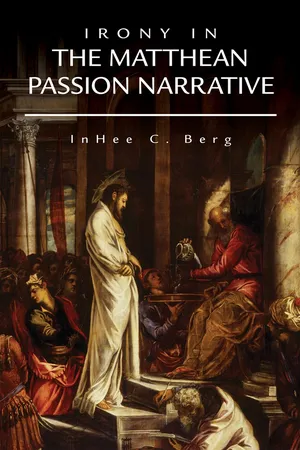
Irony in the Matthean Passion Narrative
About this book
Irony (as used here) is a rhetorical and literary device for revealing "what is hidden behind what is seen." It thus offers the reader a superior understanding by means of the distinction between reality and its shadow. The book provides a history of different definitions of irony, from Aristophanes to Booth; discusses the constitutive formal elements of irony and the functions of irony; then studies particular aspects of the Matthean Passion Narrative that require the reader to recognize a deeper truth beneath the surface of the narrative.
Information
4
Irony of the Matthean Passion Narrative
The Matthean passion narrative is a distinct literary unit and the telos of the entire narrative because the literary-rhetorical dimension of the Gospel points to its culmination in the Matthean passion narrative (26:1—27:66). The major event, the death of Jesus, serves as an integral part of the Gospel. Narrative criticism requires that this unit be expounded upon in close connection to the progression and emphases of other parts of the story. For instance, in the Matthean birth narrative an angel (1:20) discloses the meaning of the name of Jesus and notes that he will save his people from their sin (1:21). This revelation is a principal kerygma that will function as a driving force of Jesus’ life and death like an automobile engine generating power. He will accomplish this divinely-willed salvation by giving his life as a ransom for many (20:28), more specifically through shedding his innocent blood (27:4, 19, 24) of the covenant (26:28). This central theme of the Matthean passion narrative is presented through the lens of irony.
The first half of chapter 4 will delineate the Matthean passion narrative (26:1—27:66) from the stance of the literary-rhetorical indicators of the text and include a brief examination of the Matthean scholarship trying to limit the Matthean passion narrative. The foremost goal of limiting the Matthean passion narrative is to circumscribe the immediate context for the Matthean passion narrative’s conventional ironies. The second half of chapter 4 will focus on the Matthean passion narrative’s use of irony, specifically on how irony contributes to the theological significance of Jesus’ death. Both these dimensions of the investigation of the Matthean passion narrative will highlight several aspects of the First Gospel’s passion story: first, the Matthean passion narrative interacts frequently with other parts of the Gospel, second, the Matthean passion narrative is purposefully crafted by the implied author-ironist, and third, the interpretation of the Matthean passion narrative’s conventional ironies requires the kind of comprehensive and holistic reading of the story which narrative criticism can offer.
Limits of the Matthean Passion Narrative (26:1—27:66)
The Gospel of Matthew is a story about Jesus’ life, death and resurrection. Although there are debates over the original use of Matthew as an ancient bios,[1] a catechism,[2] a lectionary,[3] an administrative manual or an apologetic-polemical treatise,[4] Jack Dean Kingsbury and Mark Alan Powell, both proponents of narrative criticism, suggest that Matthew is primarily a story of Jesus.[5] Kingsbury finds three storylines in Matthew: the story of Jesus, of the Jewish religious leaders who opposed Jesus.[6] The story of Jesus is inseparable from the stories of the disciples and of his opponents.
The Gospel of Matthew is a narrative dealing the life and mission of Jesus. Technically, a story is narrated sequence of events in their temporal and causal connections,[7] namely, the what of the narrative.[8] The story of Jesus consists of various events, arranged in roughly chronological order from his birth to death. Such events have been described as “kernels and satellites.”[9] These events are linked to each other under an overarching theme rather than from a strictly cause and effect relationship. Characteristically, a story is a teaching and learning tool attempting to communicate with and impact the reader. In this regard, the voice of the narrator or the mode of presentation, that is, the how of the narrative[10] is also an indispensible element for interpretation. This work considers the what and the how of the Matthean passion narrative, and assumes that the implied author of the Matthean passion narrative and his voice projected by the story wrought a meaningful story of Jesus. This story culminates in Jesus’ death which is shown by a consistent perspective and corresponding plot which the author intended the reader to find in the deep innards of the story.
Since the relationship between the kernels and satellites of the Matthean passion narrative implies a logical hierarchy, the issue of the design of the implied author, known as plot, comes to the fore. The plot is the implied author’s plan for the narrative to advance the story with continuity between episodes while maintaining rhetorical patterns and overarching logic of the story.[11] Taken as a whole, the plot of the Matthean passion narrative not only reflects this unit as a distinctive literary unit but also testifies to its logical connection to other parts of Matthew.[12] The temporal and causal sequence of the Matthean passion narrative is by no means a random occurrence, but rather a carefully thought-out creation of the implied author.
The plot of a story reflects the temporal and causal connection of the events and this makes addressing the implied author’s point of view unavoidable. The arrangement of events has an inevitable link to the central narrative logic, that is, the authorial point of view. In short, the point of view refers to “the norms, values, and general worldview that the implied author establishes as operative for the story.”[13] The point of view and the plot of a story interact closely. Though Frank Matera identifies the foremost feature of a plot as “an organizing principle” which confers logic and meaning to disparate events,[14] Kevin Smyth explains that a plot itself is an outcome or manifestation of the ruling idea which causes and governs the formation of a story.[15] In my view, both Matera’s “organizing principle” and Smyth’s “ruling idea” mean the same thing: the implied author’s point of view gives a story both organization and meaning. In other words, understanding the point of view that governs the story is the best way for the reader to gain a bird’s eye view of the story’s integral plot which will eventually allow the reader to recognize kernels key to its interpretation. Reading a story is a creative act in the sense that the reader engages the story-world and experiences being the implied reader envisioned by the text, but not in the sense that he may replace the implied author’s evaluative point of view. Therefore, as an analogy, the plot and the point of view are like a pair of horses pulling a chariot, that being the story, driven by the implied author.
The Gospels suggest their implied authors’ points of view align with God’s perspective,[16] which is true and normative for their works.[17] Likewise, the implied author of Matthew is faithful to the particular perspective which he adopts from God. Accordingly, in his effort to maintain God’s point of view, the Gospel’s implied author selects events necessary for an informative story, decides their relevance, and arranges them in a congenial manner in order to keep their thematic connection as coherent as possible.
The Gospel of Matthew presents the divinely-willed salvation in Jesus (1:21; 20:28; 26:39, 54) as the key perspective of the implied author through which he meaningfully organizes the events of the story. In essence, the story of Matthew is the story of Jesus the Jewish Messiah, as the genealogy indicates (1:1). The Matthean genealogy of Jesus reveals that God is in control and purposefully measures human history. It is the message of Jesus’ genealogy in Matthew that though history seems to flow aimlessly, it is God who is sovereign over it and intends to redeem it through his chosen agent, his Son. The implied author’s simplification of the genealogy underlines the unique Father-Son relationship between God and Jesus which is itself a constant theme of Matthew.[18] Jesus’ filial relationship to God is significant for the development of the story because such a relationship explains the Son’s authority in revealing and doing his heavenly Father’s will which is none other than saving men (1:21). In other words, the person and mission of Jesus are the manifestation of this divine saving will about which the Gospel’s author is explicit from the very inception of the Gospel.
The narrative segment of 1:1—4:11 describes God as the director of salvation history.[19] The most important kernel for the whole Gospel is found in 1:18-25 and it answers two questions: first, “who is Jesus ?”: the issue of the identity of Jesus, and second, “why has he come?”: the basis of his ministry in relation to the divine will. This first kernel of the Gospel, 1:18-25, functions as the bedrock on which the entire story of Jesus is founded. It characterizes the whole story of Matthew as God’s involvement in human history with the specific goal of salvation for mankind which begins with the Jewish people. Once again the crux of the idea of the Gospel is that Jesus, the Christ Savior came among his people to save them from their sins (1:21) according to the divine master plan .God bestows the name, Jesus on his Son and with it God’s saving will toward men is reflected[20] since the person of Jesus represents the presence of Emmanuel (1:23, 28:20). Jack D. Kingsbury emphasizes the significance of the name of Jesus for the saving story of Matthew. He expounds:
“Jesus” is the personal name of the protagonist of Matthew’s story. Although Joseph is the one who gives Jesus his name (1:25), he does so on instructions from the angel of the Lord (1:20). Ultimately, therefore, God himself is the source of Jesus’ name. As to meaning, “Jesus” denotes that “God [is] salvation,” and the angel touches on this as he tells Joseph that Jesus “will save his people from their sins” (1:21). Accordingly, the force of the name “Jesus” is that in the one thus called, God is active to save. Hence, of all the traits Matthew ascribes to Jesus in the course of his story, the one most fundamental is that he is “saving.”[21]
In essence, a red thread weaving through reoccurring thematic dots of Matthew begins from 1:21. As previously mentioned, this key verse functions as the epicenter of the story of Jesus’ life and death for the First Gospel. Meanwhile, a crucial question in relation to Jesus and his name lingers unanswered in the mind of the reader. The question is not about “who Jesus is,” given that this is answered in the Gospel’s first chapter, but about “how Jesus will save his people.”
The Gospel of Matthew presents the two stages of Jesus’ life in 4:17 and 16:21 with a distinctive temporal phrase, “from that time Jesus began to.” The former of these two passages indicates the inception of Jesus’ public ministry with an eschatological proclamation of the kingdom of heaven and the latter passage marks the intensification of the conflict between Jesus as protagonist and his opponents, and its resolution in his death on the cross. In the opening of the second stage of Jesus’ public ministry, Peter’s confession of Jesus (16:16) finally establishes a proper time for Jesus to begin to predict the reality of his death openly (16:21) which is in fact Jesus’ way of forecasting how he will achieve his saving ministry (1:21). This theme grows steadily as Jesus’ ministry goes through the phases of conflict brought to Jesus by his various opponents such as Satan, the religious leaders, and even his disciples. As the crisis caused by conflict between Jesus and his opponents intensifies, the reader’s expectation of how divine salvation will be accomplished through Jesus gets stronger. It is the author’s intent that the reader finds the answer in the Matthean passion narrative, where Jesus’ cross, a most unlikely place for victory, serves as the termination to the conflict and the ironic disclosure of how.
As early as Matthew chapter 2 Jesus is identified as the Christ Savior (1:1, 17-18, 21) and as the King of the Jews (2:2). Yet oddly enough, the King of the Jews is recognized and worshipped for the first time by the Gentiles (2:8), the magi from the East (2:1-2), and not...
Table of contents
- Cover
- Title Page
- Copyright
- Table Of Contents
- Preface
- Abbreviations
- Irony and the Matthean Passion Narrative
- A General Overview of Irony
- Conventional Ironies
- Irony of the Matthean Passion Narrative
- Theology of the Matthean Passion Narrative: The Meaning of the Death of Jesus through the Lens of Irony
- Bibliography
- Index of Names
- Index of Subjects
Trusted by 375,005 students
Access to over 1.5 million titles for a fair monthly price.
Study more efficiently using our study tools.
Frequently asked questions
Yes, you can cancel anytime from the Subscription tab in your account settings on the Perlego website. Your subscription will stay active until the end of your current billing period. Learn how to cancel your subscription
No, books cannot be downloaded as external files, such as PDFs, for use outside of Perlego. However, you can download books within the Perlego app for offline reading on mobile or tablet. Learn how to download books offline
Perlego offers two plans: Essential and Complete
- Essential is ideal for learners and professionals who enjoy exploring a wide range of subjects. Access the Essential Library with 800,000+ trusted titles and best-sellers across business, personal growth, and the humanities. Includes unlimited reading time and Standard Read Aloud voice.
- Complete: Perfect for advanced learners and researchers needing full, unrestricted access. Unlock 1.5M+ books across hundreds of subjects, including academic and specialized titles. The Complete Plan also includes advanced features like Premium Read Aloud and Research Assistant.
We are an online textbook subscription service, where you can get access to an entire online library for less than the price of a single book per month. With over 1.5 million books across 990+ topics, we’ve got you covered! Learn about our mission
Look out for the read-aloud symbol on your next book to see if you can listen to it. The read-aloud tool reads text aloud for you, highlighting the text as it is being read. You can pause it, speed it up and slow it down. Learn more about Read Aloud
Yes! You can use the Perlego app on both iOS and Android devices to read anytime, anywhere — even offline. Perfect for commutes or when you’re on the go.
Please note we cannot support devices running on iOS 13 and Android 7 or earlier. Learn more about using the app
Please note we cannot support devices running on iOS 13 and Android 7 or earlier. Learn more about using the app
Yes, you can access Irony in the Matthean Passion Narrative by InHee C. Berg in PDF and/or ePUB format, as well as other popular books in Theology & Religion & Biblical Criticism & Interpretation. We have over 1.5 million books available in our catalogue for you to explore.