That Christian missionary efforts have long gone hand-in-hand with European colonization and American imperialist expansion in the nineteenth and twentieth centuries is well recognized. The linchpin role played in those efforts by the Great Commissionthe risen Christs command to go into all the world and teach all nationshas more often been observed than analyzed, however. With the rise of European colonialism, the Great Commission was suddenly taken up with an eschatological urgency, often explicit in the founding statements of missionary societies; the differentiation of teachers and nations waiting to be taught proved a ready-made sacred sanction for the racialized and androcentric logics of conquest and civilization.
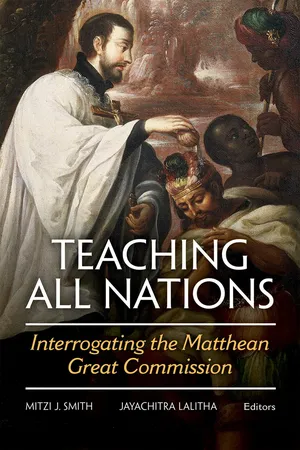
eBook - ePub
Teaching All Nations
Interrogating the Matthean Great Commission
- 240 pages
- English
- ePUB (mobile friendly)
- Available on iOS & Android
eBook - ePub
Teaching All Nations
Interrogating the Matthean Great Commission
About this book
Information
1
Colonial Missions and the Great Commission: Re-Membering the Past
1
Colonial Mission and the Great Commission in Africa
Beatrice Okyere-Manu
Introduction
Several studies that have been carried out on the Great Commission argue that the call of Christ in Matt. 28:18-20 was not only for the early disciples but rather for all followers to come, to extend the gospel to all nations, thus the command: “Go therefore and make disciples of all nations, baptizing them in the name of the Father and of the Son and of the Holy Spirit, and teaching them to obey everything that I have commanded you.” The Great Commission according to Joe Kapolyo “is given by the highest authority in the Universe, and it is binding on all disciples for all times. No other task comes with the same authority, the same universal scope or the same eternal consequence.”[1] This universal mandate given by Jesus prompted the early Christians long before the nineteenth century to embark on mission. This mission was intended to extend the gospel to all nations, including Africa, in order to make more converts, expand the church, and thus hasten the coming of Jesus Christ. Although the command of Jesus is clear, it has been argued that the same command was misinterpreted and used as the explanation for opening the way and instigating imperialism in most foreign lands.[2] Specifically to Africa, the command motivated missionaries such as David Livingstone (1813–73), “to ‘open up’ the continent for Western Christianity, commerce and civilization.”[3] The period following Livingstone’s expedition saw many missionaries and traders continue on the road he paved into the continent, and this eventually led to the colonization of Africa. This raises a number of questions such as:
- What did the missionaries who came to Africa inevitably overlook that resulted in the exacerbating of inequality, injustice, and human suffering?
- What prompted them to choose a focus on teaching over addressing human suffering?
- Was this the intention of Jesus when he mandated his disciples to go?
These are a few of the questions that this chapter seeks to answer. I intend to do a reflection on the activities of the missionaries in Africa driven by the Great Commission. While accepting their contributions as necessary and in some ways appropriate, I intend to explore the missionaries’ role of silence in influencing the injustices and inhumane activities exacted against the indigenous Africans. This contribution, therefore, is a critique of missionary activities under the guise of the Great Commission. It is divided into four sections: first, it shows that colonial missions to Africa were intertwined with the Great Commission. Second, it looks at the activities of the missionaries in particular and the positive impact of their activities on the indigenous people and on the continent as a whole. Third, this chapter will critically assess the negative impact of the role played by the missionaries contributing to issues of inequality, traumatic experience, and injustice as well as the influence of these factors on the indigenous African people. Finally, the chapter discusses the ethical implication of the Great Commission for postcolonial mission in Africa.
The Relationship between Colonial Missions and the Great Commission
It is not the intention of this section of the chapter to give a comprehensive history of colonial missions in Africa; this has been done by a number of scholars. Rather, it seeks to explain the existence of a relationship between the missionaries and European colonists and the impact of said relationship on the missionaries’ agenda. It must be noted that the actual date when Christianity came to Africa has been contested by a number of scholars. Edwin Smith believes that in “the early period of her [African] history, the church has never been absent from Africa. Christian communities existed in Africa long before they were found in the British Isles and Northern Europe.”[4]In the same vein, Labode Modupe has also argued that Christianity already existed in Egypt as far back as the third century.[5]However, most historians attribute the introduction of Christianity in Africa to the Portuguese expedition around the fifteenth century.[6] During this time, Islamic activity on the west coast of Africa was expanding. In order to explore the extent of this activity (with the aim of bringing it to an end) and at the same time to fulfill the Great Commission, Prince Henry of Portugal trained men and sent them to Africa.[7] It was through that expedition that most cities in the coastal region of Africa, such as Cape Verde, Elmina, Sao Tome and Mombasa, came under Catholicism, which was then the state religion in Portugal. Commenting on the Portuguese activities in the early history Modupe argues that
The case of the Portuguese exemplifies the close relationship between Crown and Church. In the treaty of Tordesillas (1494), the pope recognized Portuguese claims to Africa. The crown was also responsible for attempting to convert the indigenous people to Christianity. Much of the missionary effort over the next two and half centuries was conducted under Portuguese authority.[8]
The Spanish, German, and Dutch nations were also exploring the continent around the same period. It was believed that their attempts were unsuccessful. Charles Grooves attributes their unsuccessful attempts to the following reasons:
- The missionaries only concentrated on the coastal populations especially the ruling elites;
- They were a few in number with limited financial resources; most of them could not cope with the harsh local weather and politics;
- There was the belief in some quarters in Europe that it was not necessary to convert Africans;
- and most importantly economic interest was more prominent.[9]
Eventually with the abolition of the slave trade and the revival of missionary work in Europe, there was a renewal of missionary work on the African continent.[10]Musa Dube is of the opinion that “it was not until the modern European imperial movements of the eighteenth to nineteenth century that a more forceful agenda was undertaken to Christianize sub-Saharan Africa.”[11] The success of the missionaries this time was attributed to the new strategies they employed, which include strategies such as changes in the evangelization method, employment of more missionaries and indigenous people to preach the gospel, availability of funds, and cooperation between the different denominations in the continent.[12] In the past, scholars of African Christianity separated church from mission and mission from empire. But nowadays various scholars are arguing for the interconnectedness of these three entities.[13]It is for this reason that scholars of history have argued that colonial mission was intertwined with the Great Commission. While the spread of the gospel ensued, the colonial mission had another agenda that in several ways impacted on missionary work in Africa. For example, Robert Woodberry posits that “the British were the most powerful Colonizers in the nineteenth and the twentieth century and thus were presumably able to impose their will and extract resources from colonial subjects.”[14] It is believed that most of the missionaries in the colonies, especially the British colonies, could not challenge colonial leaders because they lacked the necessary power to do so; therefore, they had to compromise with the whims and caprices of the colonial leaders.[15]For example, the missionaries had to travel with the European merchants to the mission field in order to enjoy the protection of the colonial official on their journey. Even in the mission field, the European merchants and the colonial officials were the only people the missionaries could associate with.[16] Hence their relationship was cemented to the point that in most cases the “missionaries acted as intermediaries in the early years of colonial rule between Africans and the Europeans for they served as advisors to the indigenous rulers. In this role, their influence was usually biased towards colonial government and the rapid cultural ‘Europeanisation’ of the African population.”[17] Thus, the closed nature of their relationship influenced...
Table of contents
- Cover
- Title Page
- Copyright
- Table Of Contents
- Contributors
- Foreword
- Introduction
- Colonial Missions and the Great Commission: Re-Membering the Past
- Womanist, Feminist, and Postcolonial Criticisms and the Great Commission
- Theology, Art, and the Great Commission
- The Great Commission and Christian Education: Rethinking Our Pedagogy
- Interrogating the Commission from Beyond the Academy
- Index of Subjects and Names
- Index of Biblical References
Trusted by 375,005 students
Access to over 1.5 million titles for a fair monthly price.
Study more efficiently using our study tools.
Frequently asked questions
Yes, you can cancel anytime from the Subscription tab in your account settings on the Perlego website. Your subscription will stay active until the end of your current billing period. Learn how to cancel your subscription
No, books cannot be downloaded as external files, such as PDFs, for use outside of Perlego. However, you can download books within the Perlego app for offline reading on mobile or tablet. Learn how to download books offline
Perlego offers two plans: Essential and Complete
- Essential is ideal for learners and professionals who enjoy exploring a wide range of subjects. Access the Essential Library with 800,000+ trusted titles and best-sellers across business, personal growth, and the humanities. Includes unlimited reading time and Standard Read Aloud voice.
- Complete: Perfect for advanced learners and researchers needing full, unrestricted access. Unlock 1.5M+ books across hundreds of subjects, including academic and specialized titles. The Complete Plan also includes advanced features like Premium Read Aloud and Research Assistant.
We are an online textbook subscription service, where you can get access to an entire online library for less than the price of a single book per month. With over 1.5 million books across 990+ topics, we’ve got you covered! Learn about our mission
Look out for the read-aloud symbol on your next book to see if you can listen to it. The read-aloud tool reads text aloud for you, highlighting the text as it is being read. You can pause it, speed it up and slow it down. Learn more about Read Aloud
Yes! You can use the Perlego app on both iOS and Android devices to read anytime, anywhere — even offline. Perfect for commutes or when you’re on the go.
Please note we cannot support devices running on iOS 13 and Android 7 or earlier. Learn more about using the app
Please note we cannot support devices running on iOS 13 and Android 7 or earlier. Learn more about using the app
Yes, you can access Teaching All Nations by Mitzi J. Smith, Jayachitra Lalitha, Mitzi J. Smith,Jayachitra Lalitha, Mitzi J. Smith, Jayachitra Lalitha in PDF and/or ePUB format, as well as other popular books in Theology & Religion & Biblical Criticism & Interpretation. We have over 1.5 million books available in our catalogue for you to explore.