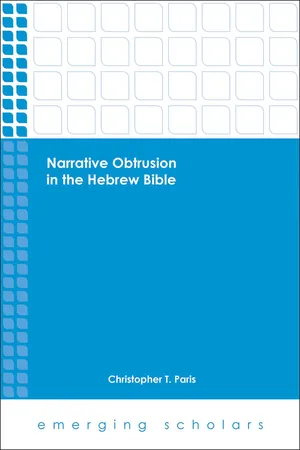
Christopher T. Paris calls attention to just these narrative interruptions, in which the story teller “breaks frame” to provide information about a character or even in order to direct reader understanding and, Paris argues, to prevent undesirable construals or interpretations of the story.
- 176 pages
- English
- ePUB (mobile friendly)
- Available on iOS & Android
eBook - ePub
Narrative Obtrusion in the Hebrew Bible
About this book
Narrative critics of the Hebrew Bible often describe the biblical narrators as “laconic,” “terse,” or “economical.” The narrators generally remain in the background, allowing the story to proceed while relying on characters and dialogue to provide necessary information to readers. On those occasions when these narrators add notes to their stories, scholars may characterize such interruptions as “asides” or redactions.
Information
5
Selected Examples of Omniscience and Obtrusiveness in Ancient Near Eastern Literature
In most literary studies, the concept of an omniscient narrator is taken for granted. Scholars rarely feel the need to explain or define the term since the idea of an all-knowing God serves as a convenient model for such a narrator. While some biblical scholars might question the extent of this deity’s knowledge, the majority of literary critics define omniscience based on the totality of knowledge possessed by the infinitely wise God of Jewish and Christian tradition.[1] Although philosophers and theologians may wrangle over definitions of omniscience, most narrative critics accept the literary presence of (1) the omniscient narrator and (2) God as an omniscient director.[2] Infinite knowledge may be ascribed to this omniscient director. The omniscient narrator often appears to possess such knowledge, as the narrator controls characters, actions, information, and time in the narrative. Ironically, the omniscient narrator of the Hebrew also controls the divine in narratives where God appears as a character and even knows the thoughts of God in primordial time (for example, Genesis 1). In spite of this power, the so-called omniscient narrator may have limitations. The fact that this narrator sometimes provides incorrect data or proves to have insufficient knowledge opens up the question of whether “omniscient” is a consistently appropriate label for this figure.
In the literature of the ancient Near East, deities seem to lack the complete knowledge of this idealized God.[3] At times, ancient Near Eastern gods appear all-knowing as they claim to read the thoughts of others and foretell coming events. At other times, these same gods display ignorance or “limited omniscience.” While “limited omniscience” may seem like an oxymoron, the term accurately reflects the restricted knowledge of ancient Near Eastern gods.
Like ancient Near Eastern deities, narrators fluctuate between commanding hidden knowledge and displaying their lack of power.[4] Indeed, a god or narrator’s greatest display of omniscience comes from the ability to know the thoughts of others.[5] Knowledge of the inner life of characters is a prime example of omniscience since it represents the most hidden of knowledge. A narrator often moves the plot forward in pivotal ways by sharing a character’s thoughts with readers. These omniscient comments prove more significant than simple asides that relate basic information to readers. The plot-moving impact of relating a character’s thoughts through an omniscient comment reveals the power that narrators wield.
The narrator’s voice manifests itself in different ways in ancient Near Eastern narrative traditions, including neutral omniscience, indirect free speech, general omniscience, first-person asides, and obtrusions. These traditions reveal that obtrusions represent a significant stage in the development of omniscient thought. In neutral omniscience, the narrator assumes that the reader will follow the plot and, therefore, offers few explanations. In indirect free speech, the narrator’s speech merges with the voice of a character. Narrators employ general omniscience to relate information to readers. First-person narrators often provide asides, sharing information with readers that is hidden from characters in the narrative. In narrative obtrusions, the thoughts of the narrators—not characters—appear on the page, affecting reader response. Just as the plot cannot continue without the narrator revealing the thoughts or intents of a character, narrators sometimes feel uncomfortable moving forward without making an obtrusive comment.[6]
In this presentation on omniscience and obtrusiveness in ancient Near Eastern literature, I connect the narrator with the gods by arguing three main points: (1) The limited omniscience of ancient Near Eastern deities may serve as a better paradigm for the narrator since these storytellers are not all-knowing. (2) Ancient Near Eastern narrators display different levels of omniscience and obtrusiveness, regulating the presence of their voice in the narrative based on how they envision themselves and their readers. (3) The narrator can behave obtrusively by invoking divine favor, protecting a divine character or other celebrated figures, and in rare instances by challenging the gods.
Objectives
This chapter builds on my previous work on biblical omniscience and obtrusiveness by studying these features in the literary world of the ancient Near East. The selected examples from diverse cultures can only be representative of this rich literature. Other and perhaps better instances of omniscience and obtrusiveness may lie in the vast volumes of this literature as well as in texts awaiting translation or discovery. This sampling of ancient Near Eastern literature begins with an analysis of the scribal culture of Hurro-Hittite literature; in particular, I examine the way in which these narrators hide behind neutral omniscience because they assume that the reader will readily follow the story being presented. Next, I turn to Ugarit, where an emerging type of indirect free style evidences development of the narrator’s voice as the narrator takes on the perspective of a character in a story. Because they wrote to a scholarly audience of insiders, Ugaritic narrators offered few explanations from an omniscient perspective. In both Hurro-Hittite and Ugaritic myths, the narrators shared the thoughts of the gods with readers, using the omniscient perspective to move the plot. Hebrew and Mesopotamian narrators did the same; but these narrators went further, creating obtrusions for a variety of reasons, including the following: (1) the divine became vulnerable and needed to be defended from a reader’s unwelcome interpretations such as in Genesis 22; (2) narrators of ancient Mesopotamian literature, such as Kabti-ilāni-Marduk of the Erra Epic, disagreed with the plan of the gods and openly challenged it through an obtrusion. The Mesopotamian narrators’ belief that they had access to the secret knowledge of the gods led innovative scribes like Kabti-ilāni-Marduk to meld his voice with that of the gods and to act obtrusively. To finish this study, I turn to the autobiographical narrators of ancient Egypt and examine the first-person asides they use to give insider status to the reader. These narrators cannot be considered obtrusive because of their first-person perspective; however, they often behave similar to obtrusive narrators by breaking frame and invoking the gods in order to manipulate the reader.[7]
Hurro-Hittite Myths
Hittite Deities
Hittite and Hurrian myths reveal the restricted potential for omniscient and obtrusive comments in ancient narrative.[8] Although wise, Hittite and Hurrian deities possessed limited omniscience:
the gods of the Hittites were conceived of in human terms. . . . The gods were neither omniscient nor omnipotent but made mistakes and were capable of being deceived. Still, they possessed a wisdom and power that was far above that of humans. The level of wisdom and power varied widely depending on each deity’s status within the pantheon, which itself depended on the importance of the natural phenomenon that the deity ...
Table of contents
- Cover
- Title Page
- Copyright
- Dedication
- Table Of Contents
- List of Figures
- Abbreviations
- Introduction
- Narrative Economy, Artistry, and the Literary Imagination
- Omniscience and Obtrusiveness
- The Narrative Obstrusion of Judges 14:4
- Reader Response, Narrator Foresight, and Foreclosure
- Selected Examples of Omniscience and Obtrusiveness in Ancient Near Eastern Literature
- Conclusion
- Appendix A: Selected Obtrusions from the Hebrew Bible
- Appendix B: Some More Obtrusions Not Covered In This Study
- Bibliography
- Index
Trusted by 375,005 students
Access to over 1.5 million titles for a fair monthly price.
Study more efficiently using our study tools.
Frequently asked questions
Yes, you can cancel anytime from the Subscription tab in your account settings on the Perlego website. Your subscription will stay active until the end of your current billing period. Learn how to cancel your subscription
No, books cannot be downloaded as external files, such as PDFs, for use outside of Perlego. However, you can download books within the Perlego app for offline reading on mobile or tablet. Learn how to download books offline
Perlego offers two plans: Essential and Complete
- Essential is ideal for learners and professionals who enjoy exploring a wide range of subjects. Access the Essential Library with 800,000+ trusted titles and best-sellers across business, personal growth, and the humanities. Includes unlimited reading time and Standard Read Aloud voice.
- Complete: Perfect for advanced learners and researchers needing full, unrestricted access. Unlock 1.5M+ books across hundreds of subjects, including academic and specialized titles. The Complete Plan also includes advanced features like Premium Read Aloud and Research Assistant.
We are an online textbook subscription service, where you can get access to an entire online library for less than the price of a single book per month. With over 1.5 million books across 990+ topics, we’ve got you covered! Learn about our mission
Look out for the read-aloud symbol on your next book to see if you can listen to it. The read-aloud tool reads text aloud for you, highlighting the text as it is being read. You can pause it, speed it up and slow it down. Learn more about Read Aloud
Yes! You can use the Perlego app on both iOS and Android devices to read anytime, anywhere — even offline. Perfect for commutes or when you’re on the go.
Please note we cannot support devices running on iOS 13 and Android 7 or earlier. Learn more about using the app
Please note we cannot support devices running on iOS 13 and Android 7 or earlier. Learn more about using the app
Yes, you can access Narrative Obtrusion in the Hebrew Bible by Christopher T. Paris in PDF and/or ePUB format, as well as other popular books in Theology & Religion & Biblical Criticism & Interpretation. We have over 1.5 million books available in our catalogue for you to explore.