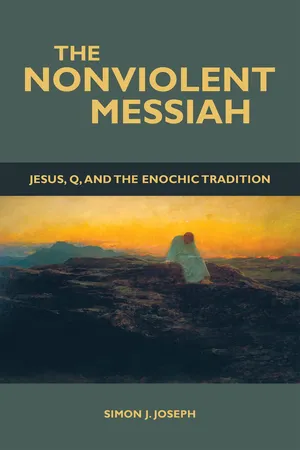
When scholars have set Jesus against various conceptions of the messiah and other redemptive figures in early Jewish expectation, those questions have been bound up with the problem of violence, whether the political violence of a militant messiah or the divine violence carried out by a heavenly or angelic figure. Missing from those discussions, Simon J. Joseph contends, are the unique conceptions of an Adamic redeemer figure in the Enochic materialconceptions that informed the Q tradition and, he argues, Jesus own self-understanding.
- 240 pages
- English
- ePUB (mobile friendly)
- Available on iOS & Android
eBook - ePub
About this book
Information
2
5
Jesus Christos
The proclamation of Jesus as messiah is a central tenet of the Christian faith,[1] yet Jesus did not seem to fulfill what many Jews appear to have expected of a Davidic king: he did not mount a political throne and defeat Israel’s enemies. He did not “destroy the power particularly of Rome . . . inaugurate a dynasty of the proper line . . . spur and enable the exiles to return to Palestine . . . (and) usher in the long-awaited final judgment of God.”[2] He did not gather in the exiles,[3] put an end to evil, sin,[4] disease, and death,[5] or inaugurate a new age of peace, harmony,[6] fertility, or abundance.[7]
Nonetheless, a considerable number of ancient Jews evidently found Jesus’ “messianic” credentials more than acceptable.[8] So why was Jesus first identified as “messiah?”[9] Some scholars hold that Jesus himself never claimed to be a messiah: the early Church did it for him.[10] Some have argued that Paul’s use of Χριστός can be explained as more of a proper name or nickname than a title.[11] Some are reluctant even to use the term “messiah” for Jesus.[12] Some argue that the Jewish crowds proclaimed Jesus as messiah, but that he rejected the title.[13] Others claim that Jesus neither claimed nor rejected the title.[14] Still others argue that Jesus revised the meaning of the role.[15]
The idea that Jesus avoided the term “messiah” because of its politico-military connotations is accepted by many as an historically plausible explanation within the context of first-century Judaism.[16] E. P. Sanders, for example, identifies Jesus as a prophet but claims that he saw himself as God’s eschatological “viceroy,” the “head of the judges of Israel, subordinate only to God himself,”[17] although he had neither political nor military ambitions. Nonetheless, Jesus had an exalted self-conception, which can be seen by Jesus’ arrival in Jerusalem on a donkey, presumably in fulfillment of Zechariah’s “messianic” prophecy: a “‘king,’ yes, of a sort; military conqueror no.”[18] Similarly, Ben Witherington concludes that Jesus thought of himself as having a unique relationship with God as his Son “anointed” with the Spirit,[19] but cautions that the term “messiah” is “not wholly adequate to express how Jesus viewed himself . . . the possibility of misunderstanding was indeed great, especially in view of the nationalistic expectations that existed in Jesus’ day.”[20]
The problem with many scholarly reconstructions of Jesus’ messianic identity is that various messianic roles and functions are uncritically conflated in order to construct a composite portrait of Jewish messianism. For example, Marinus de Jonge rightly notes that “Jesus is at the center of all early (and later) Christology. This presupposes some degree of continuity between what he said and did and people’s reactions.”[21] So far, so good. De Jonge is on secure ground when he finds evidence for Jesus as a prophet sent by God but rejected by Israel, but he then asserts that Jesus “believed himself to have been sent as God’s final envoy, as the inaugurator of God’s rule on earth,”[22] that Jesus saw himself as “the suffering righteous Servant” whose death had “redemptive” power, and that Jesus proclaimed himself both messiah and son of man, a “cryptic self-designation” which “implied obscurity, homelessness and rejection, humility, service, suffering, and ultimately death.”[23] In a similar vein, N. T. Wright affirms Jesus’ Davidic messianic identity and concedes that while there was no pre-Christian expectation for a Jewish messiah to suffer, this was Jesus’ distinctive innovation. Clearly, the challenge of properly assessing Jesus’ “messianic” self-understanding is not a new one.
In the following chapters we will reassess the historical and literary evidence for the messianic identification of Jesus. This topic is problematic for several reasons: first, because the uncritical conflation of various messianic roles, functions, and attributes into a single title projected onto Jesus collapses the complex phenomenon of first-century Jewish messianism and fails to isolate the distinctive ways in which “messiah-language” might accurately describe Jesus; second, because the historical problem of Jesus’ identity continues to be framed in dichotomous terms, that is, Jesus either was “the messiah” (with the definite article) or he was not. The problem with this framing is that there is no such thing as “the messiah.” Second Temple Judaism produced a plurality of messianic ideas, expectations, typologies, titles, attributes, motifs, traditions, and prospective candidates, and any attempt to pronounce a definitive, exclusive identification of Jesus as “the messiah” is more at home in religious and theologically apologetic debates than in historical Jesus studies. A third problem associated with this complex topic is that Jewish messianism itself was a developing tradition. In some cases rabbinical messianic traditions developed in order to counter Christian claims about the legitimacy of Jesus’ messianic identity.[24] It is not methodologically appropriate, therefore, to appeal to post-70 c.e. rabbinical Jewish messianic traditions to prove or disprove Jesus’ early first-century messianic identity. Christianity began as a Jewish messianic movement, not a Christian movement rejected by Jews. We will proceed, therefore, by first establishing the historical and theological origins of first-century Jewish messianism.
There are numerous methodological problems associated with the study of ancient Jewish messianism.[25] The word messiah is derived from the Hebrew משיח (“anointed”) or Aramaic משיחא, and can be used adjectivally and/or as a noun or title, to refer to a king, priest, or prophet divinely appointed to fulfill a particular task.[26] The term is also used to refer to figures not explicitly identified as “messiahs.”[27] One can be “anointed” without actually being identified as a “messiah” in a titular sense.[28] “The messiah” as a proper title and role does not even occur in the Hebrew Bible.[29] When eschatological messianism does begin to appear (c. 200 b.c.e.) it does not take the form of a coherent theology. Rather, “messiahs” appear as nebulous figures in different texts with conflicting portraits. Moreover, the emergence of eschatological messianism in the second century b.c.e. follows the post-exilic period: messianism seems to be a relatively late development in post-exilic Judaism,[30] even if the origins of the “messianic idea” have their roots in the royal ideology of kingship in the ancient Near East, where the king was often regarded as the living embodiment of the human and the divine.[31]
The covenant with Da...
Table of contents
- Cover
- Title Page
- Copyright
- Dedication
- Epigraph
- Table Of Contents
- Preface
- Bibliography
- Index of Names
- Index of Ancient Sources
Trusted by 375,005 students
Access to over 1.5 million titles for a fair monthly price.
Study more efficiently using our study tools.
Frequently asked questions
Yes, you can cancel anytime from the Subscription tab in your account settings on the Perlego website. Your subscription will stay active until the end of your current billing period. Learn how to cancel your subscription
No, books cannot be downloaded as external files, such as PDFs, for use outside of Perlego. However, you can download books within the Perlego app for offline reading on mobile or tablet. Learn how to download books offline
Perlego offers two plans: Essential and Complete
- Essential is ideal for learners and professionals who enjoy exploring a wide range of subjects. Access the Essential Library with 800,000+ trusted titles and best-sellers across business, personal growth, and the humanities. Includes unlimited reading time and Standard Read Aloud voice.
- Complete: Perfect for advanced learners and researchers needing full, unrestricted access. Unlock 1.5M+ books across hundreds of subjects, including academic and specialized titles. The Complete Plan also includes advanced features like Premium Read Aloud and Research Assistant.
We are an online textbook subscription service, where you can get access to an entire online library for less than the price of a single book per month. With over 1.5 million books across 990+ topics, we’ve got you covered! Learn about our mission
Look out for the read-aloud symbol on your next book to see if you can listen to it. The read-aloud tool reads text aloud for you, highlighting the text as it is being read. You can pause it, speed it up and slow it down. Learn more about Read Aloud
Yes! You can use the Perlego app on both iOS and Android devices to read anytime, anywhere — even offline. Perfect for commutes or when you’re on the go.
Please note we cannot support devices running on iOS 13 and Android 7 or earlier. Learn more about using the app
Please note we cannot support devices running on iOS 13 and Android 7 or earlier. Learn more about using the app
Yes, you can access The Nonviolent Messiah by Simon J. Joseph in PDF and/or ePUB format, as well as other popular books in Theology & Religion & Biblical Criticism & Interpretation. We have over 1.5 million books available in our catalogue for you to explore.