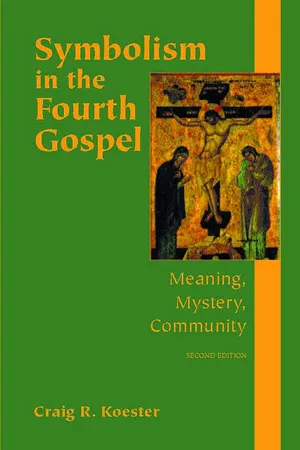
Craig Koester's respected study uses the symbolic language of the Gospel of John as a focus to explore "the Gospel's literary dimensions, social and historical context, and theological import." This edition is fully revised and updated and includes a number of new sections on such topics as Judas and the knowledge of God. Fresh treatments are given on a number of issues, including the Gospel's Christology. This new edition offers both new insights and proven worth for students and scholars alike.
THESTUDYOF JOHANNINESYMBOLISMTAKESUSTOAPROBLEMTHATLIES at the heart of all theological reflection: How do people know God? In the language of the Fourth Gospel, God is “from above” and people are “from below,” and to ordinary human eyes God’s presence is veiled, his activity elusive. John’s prologue says that “no one has ever seen God” (1:18a), a comment on the human condition that provides no exceptions. Throughout the Gospel Jesus will address listeners who do not know God, who have never heard God’s voice and have never seen God’s form (5:37; 7:28; 8:19). A cleft separates the human from the divine. Yet the Gospel also says that Jesus made God known (1:18b). He could reveal God because he came from heaven and did not speak on his own authority, but uttered the words of God in God’s own name (3:34; 5:43; 8:28).1
The Son of God descended to bear witness to what he had seen and heard above, but when he crossed the chasm and entered the world he spoke with human beings who found him to be as inscrutable as God himself. The prologue acknowledges that “the world knew him not” (1:10), and the first scene ends with John the Baptist’s unsettling declaration that the one God has sent now stands in your midst “and him you do not know” (1:26). Jesus’ divine origin was hidden from human eyes; it could not be discerned “by appearances” (7:24). In the peculiar economy of the Gospel, Jesus must make God known, but God must also make Jesus known. No one comes to the Father except through Jesus (14:6) and no one comes to Jesus without being drawn by the Father (6:44).
According to the Fourth Gospel, people are drawn to Jesus, and so to God, through testimony.2 The words spoken by and about Jesus, together with the actions he performed, are the vehicles through which revelation is given. Jesus came from above, but he could not reveal divine truths in heavenly language. Human beings belong to the earth and speak in worldly terms (3:31); therefore Jesus used familiar earthly images to convey his message. A teacher named Nicodemus slipped along the shadowed streets of Jerusalem to meet Jesus, and Jesus told him that entry into the kingdom of heaven was “birth” and that the Spirit was a wind blowing across the human landscape (3:3–8). Nicodemus stammered his incredulity, but Jesus responded, “If I have told you earthly things and you do not believe, how can you believe if I tell you heavenly things?” (3:12). The question goes to the crux of the issue: Those who belong to the world cannot comprehend unmediated heavenly truths. But as the Gospel unfolds we see that people can come to know Jesus and God when their own language, the language of the world, becomes a vehicle for divine communication.
Earthly images could be used to bear witness to divine realities because the earth is God’s creation. This is one of the main theological underpinnings of Johannine symbolism. In the beginning, God uttered the Word that brought all things into being, and without this Word “was not anything made” (1:3).3 To be sure, the creation itself yielded no sure knowledge of God, and when the creative Word became flesh in Jesus, people refused to receive him (1:10). Yet once in the world, Jesus called upon things that could be heard, seen, touched, and tasted to bear witness to the unseen God who sent him, so that the commonplace—bread made from barley meal, streams of cool water, and a glimmer of light—became vehicles of revelation. The Gospel declares that “no one has ever seen God,” but that the only Son “has made him known” (1:18) by using images from the creation to bear witness to the Creator; that is, through symbolic speech and actions.
A second and related problem is how revelation given at particular times and places can have broader, even universal, significance. The agent of revelation was Jesus, an individual who encountered a limited number of people in Roman Palestine during a career that lasted perhaps three years. The Gospel recounts the actions he performed and the words he spoke, while seeking to show that their significance transcends their immediate context. When Jesus fed a crowd beside the Sea of Galilee, he spoke about the bread that comes down from heaven to give life not just to his immediate listeners but “to the world” (6:33), and when he opened the eyes of one man born blind he announced that he was “the light of the world” (9:5).
The Gospel writer sought to disclose the abiding significance of what Jesus had said and done in the conviction that Jesus himself continues to abide among people through the Spirit or Advocate (14:15–17, 23). Like the belief that the world is God’s creation, a sense of the ongoing work of the Spirit undergirds Johannine symbolism theologically. The Spirit did not bring new revelation on the same order as Jesus had already given, but manifested Jesus’ presence and disclosed the significance of his words and actions to people living after his ministry on earth had ended (14:26). The Gospel presents the paradox that the divine is made known through what is earthly and the universal is disclosed through what is particular. This gives Johannine symbolism a tensive, dialectical quality that conveys transcendent reality without finally delimiting it. The Gospel’s testimony, given in symbolic language, is a vehicle for the Spirit’s work; and it is through the Spirit that the testimony becomes effective, drawing readers to know the mystery that is God.4
Johannine Symbolism in Its Literary Context
The ability of symbols to communicate things that cannot adequately be expressed by other means has attracted the interest of people working across a spectrum of scholarly disciplines. Each has its own ways of understanding what symbols are and what they do, and many would not share the fourth evangelist’s theological assumptions.5 We will draw questions and insights from various areas of research, while keeping our focus on the Fourth Gospel and trying to let our general observations about symbolism conform as much as possible to the distinctive contours of the text. Symbols can affect people with an immediacy that cannot be replicated in more discursive speech; yet as symbols capture the imagination they engage readers in an ongoing process of reflection. We begin this process of reflection by exploring patterns in the Gospel’s symbolism and their role in communicating the Gospel’s message.6
Defining Johannine Symbolism
A symbol, in the most general sense, is something that stands for something else. Here, however, we will focus the definition: A symbol is an image, an action, or a person that is understood to have transcendent significance. In Johannine terms, symbols span the chasm between what is “from above” and what is “from below” without collapsing the distinction. Images are things that can be perceived by the senses, such as light and darkness, water, bread, a door, a shepherd, and a vine. The actions that function symbolically in John’s Gospel include nonmiraculous actions, like driving merchants out of the Jerusalem temple and washing feet, as well as miraculous “signs,” like turning water into wine and raising Lazarus from the dead. The person who makes God known is Jesus, and those he meets represent types of belief and unbelief. Sometimes life and freedom have been called “symbols” because in John’s Gospel they refer to divine realities. Since, however, these concepts do not involve images that can be perceived by the senses, they will not be considered symbols here.7
Johannine symbolism is concentric, with Jesus at its heart; he has a unique role as the one who reveals God. The Gospel’s images and actions, in turn, help to show who Jesus is. These symbols, as we have defined them, include things that differ from each other in important ways.8 For example, a sign like turning water into wine brings the power of God into the realm of human experience in a manner different from a nonmiraculous action like cleansing the temple or a statement like “I am the light of the world.” Nevertheless, we will include the images, the actions, and representative figures in our study of the Gospel’s symbolism because they function similarly in the text. Each conveys something of transcendent significance through something accessible to the senses.
Given this range of symbolic elements, a useful distinction can be made between core and supporting symbols. Core symbols occur most often, in the most significant contexts in the narrative, and contribute most to the Gospel’s message.9 For example, the repeated statements identifying Jesus as “the light of the world,” (1:9; 3:19; 8:12; 9:5; 12:46) establish light as a core symbolic image with darkness as its counterpart. Elements such as day and night and sight and blindness play an important supporting role through their relationship to light. A recurring cluster of core and supporting images creates a motif. While the core symbols usually stand at the center of a narrative, the supporting images in a motif often remain in the background. For example, when Jesus proclaims, “I am the light of the world” (8:12), light is the core symbol on which attention focuses. In the passing observation that Nicodemus came to Jesus “by night” (3:2), however, the darkness is merely suggestive and its full import not readily apparent. Some core symbols, like the vine (15:1–17), appear only once and their significance is evident in a single context. The supporting elements in a motif, however, occur repeatedly and their effect is cumulative. The implications of Nicodemus’s coming “by night,” for example, unfold as images for darkness recur in the narrative.10
Transcendent realities are conveyed most clearly through core symbols. The Gospel begins by announcing that human beings receive “light” from the Word that was with God and was God (1:1–5), and later references to “the light of the world” recall Jesus’ divine origin (e.g., 3:19; 12:46). Similarly, when Jesus said, “I am the bread of life,” he added that he had “come down from heaven” and sharply distinguished himself from other forms of bread. He reminded his listeners that their ancestors ate a bread called manna in the wilderness and died but said that he was a kind of bread that would provide life everlasting (6:48–51b). Supporting symbols do not convey transcendent realities as directly as the core symbols do, but help to reveal the significance of the core symbols, as will be seen later.11 Supporting symbols also help to disclose the wider or universal dimensions of the text. Many individuals in the Gospel, for example, speak for groups of people and even humanity generally.
Some of the core symbols are expressed in the form of metaphors. To speak metaphorically is to speak of one thing in terms appropriate to another.12 A metaphor has two parts, both of which are sometimes present in a single sentence. When Jesus says, “I am the bread of life,” it is clear that he is speaking (a) of himself (b) in terms of bread. In other cases, a metaphorical statement may provide only an image without specifying what the image refers to; the referent must be supplied from the context. When Jesus invited people to come to him and drink, declaring, “out of his heart shall flow rivers of living water,” he spoke metaphorically, but only by taking his statement in its larger context can readers tell that “living water” refers to the Spirit (7:37–39).
Symbols and metaphors are not identical, but are related on a continuum. One difference is that metaphors are expressed verbally, while symbols may be either verbal or nonverbal. Bread initially functions symbolically in actions like breaking five loaves, giving them to a crowd of five thousand people, and gathering up the fragments left over. Later, bread also functions symbolically in the metaphorical statement, “I am the bread of life” (6:11–13, 35). Another difference is that symbols, as we have defined them, involve images from the realm of sense perception, while the elements of a metaphor may be more abstract. Statements like “I am the resurrection and the life” and “I am the way, the truth, and the life” are metaphorical in form, but do not include symbols in the sense used here. Bread and water can be seen and touched, but a term like the resurrection is less tangible, and truth and life as such cannot be visualized. We will focus on images that can be perceived by the senses.13
If symbols consist of an image and a referent, they also need an interpreter to make the connection. All three elements must be present for an image actually to function symbolically; the symbol must mean something for someone.14 The primary images in John’s Gospel are taken from the fabric of daily life, and in most life situations they have no special meaning. A splash of cool water on our faces helps chase sleep from our eyes in the morning, and the aroma of fresh bread wafting through a bakery door sets our mouths watering, but unless we connect the water and the bread with transcendent realities, they are simply refreshing, not symbolic. In themselves, water and bread are potential symbols; they “actually become symbolic when they are seen to point beyond themselves.”15
A challenge for interpreters is to discern which images in John’s Gospel should be understood symbolically. The text depicts the disastrous and often comic results of someone’s failure to detect the figurative nature of some of Jesus’ sayings. We can chuckle when Nicodemus is tripped up by the prospect of being “born” again, sputtering about the impossibility of entering his mother’s womb a second time. But as we make our way through the narrative we may find that our own footing is not so sure. We may be confident that a statement like “people loved darkness rather than light” (3:19) is symbolic, but does that mean that all references to darkness and night are symbolic? Mary Magdalene arrived at Jesus’ tomb in the dark on Easter morning (20:1), and Jesus appeared to his disciples later that evening (20:19). If we discern symbolic significance in the darkness in these passages, are we astute interpreters of the text or have we fallen prey to mere fantasy?
As we attempt to identify symbols in John’s Gospel, we will bear in mind that something can be both symbolic and historical. We can discern symbolic significance in images, events, or persons without undercutting their claims to historicity, and we can recognize that certain images, events, and people are historical without diminishing their symbolic value. Historically, it seems certain that Jesus died on a cross, yet the cross became the primary symbol for the Christian faith. Peter and Jesus’ mother were people who actually lived in Palestine in the first century, yet both came to have symbolic significance for the church. Accordingly, Mary Magdalene may well have come to Jesus’ tomb while it was dark; the question we will pursue is whether darkness has symbolic significance in this context.16
Recognizing Johannine Symbols
The symbols that are easiest to identify appear in the form of metaphors. Metaphors can be recognized because an incongruity or contradiction results when a person speaks of one thing in terms of another.17 For example, the statement “I am the bread of life” (6:35), taken at face value, means that Jesus is claiming to be a baked mixture of flour and water, which is absurd. This incongruity or absurdity at the literal level forces readers to make sense of the statement in a nonliteral way.18 As soon as readers realize that Jesus is no...
Table of contents
Preface to the Second Edition
Preface to the First Edition
Abbreviations
1 Symbol, Meaning, and Mystery
2 Representative Figures
3 Symbolic Actions
4 Light and Darkness
5 Water
6 The Crucifixion
7 Symbol and Community
8 Symbol and the Knowledge of God
Appendixes on Special Topics
Bibliography
Trusted by 375,005 students
Access to over 1.5 million titles for a fair monthly price.
Study more efficiently using our study tools.
Frequently asked questions
Yes, you can cancel anytime from the Subscription tab in your account settings on the Perlego website. Your subscription will stay active until the end of your current billing period. Learn how to cancel your subscription
No, books cannot be downloaded as external files, such as PDFs, for use outside of Perlego. However, you can download books within the Perlego app for offline reading on mobile or tablet. Learn how to download books offline
Perlego offers two plans: Essential and Complete
Essential is ideal for learners and professionals who enjoy exploring a wide range of subjects. Access the Essential Library with 800,000+ trusted titles and best-sellers across business, personal growth, and the humanities. Includes unlimited reading time and Standard Read Aloud voice.
Complete: Perfect for advanced learners and researchers needing full, unrestricted access. Unlock 1.5M+ books across hundreds of subjects, including academic and specialized titles. The Complete Plan also includes advanced features like Premium Read Aloud and Research Assistant.
Both plans are available with monthly, semester, or annual billing cycles.
We are an online textbook subscription service, where you can get access to an entire online library for less than the price of a single book per month. With over 1.5 million books across 990+ topics, we’ve got you covered! Learn about our mission
Look out for the read-aloud symbol on your next book to see if you can listen to it. The read-aloud tool reads text aloud for you, highlighting the text as it is being read. You can pause it, speed it up and slow it down. Learn more about Read Aloud
Yes! You can use the Perlego app on both iOS and Android devices to read anytime, anywhere — even offline. Perfect for commutes or when you’re on the go. Please note we cannot support devices running on iOS 13 and Android 7 or earlier. Learn more about using the app
Yes, you can access Symbolism in the Fourth Gospel by Craig R. Koester in PDF and/or ePUB format, as well as other popular books in Theologie & Religion & Religion. We have over 1.5 million books available in our catalogue for you to explore.