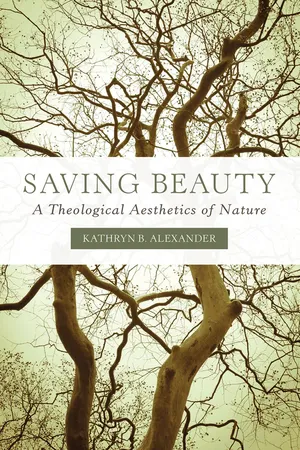
With interdisciplinary verve, engaging systematic, philosophical, and art theory systems of aesthetics, the volume fosters the cultivation of the sense of beauty through creative, religious, and sacramental experience. All three types, in fact, are critically necessary, as the author argues, in eliciting hope for ecological redemption. This volume makes a vital contribution to the systematic and philosophical framework for ecological theology, aesthetics, and theological ethics.
- 192 pages
- English
- ePUB (mobile friendly)
- Available on iOS & Android
eBook - ePub
About this book
Kathryn B. Alexander argues that natural beauty is a source of religious insight into the need and way of salvation, and this project develops a theological aesthetics of nature and beauty with an aim toward cultivating a theological and ethical framework for redeemed life as participation in ecological community.
Information
Topic
Theology & ReligionSubtopic
Christian Theology2
Nature-Beauty and Salvation
On Earth Day 2011, National Public Radio host Ira Flatow offered a segment called “Listening to Wild Soundscapes” on his show, “Science Friday.”[1] Marking the anniversary of the publication of Rachel Carson’s book Silent Spring as one of the catalysts for the first Earth Day in 1970, he recalled her argument that listening to the sounds of living creatures, or their silence, was a means to understanding the state of the environment.[2] Since then ecologists have turned on their microphones and have been recording all kinds of sounds coming from a variety of landscapes. This exciting new field is called soundscape ecology.
Flatow interviewed bio-acoustician Bernie Krause and Purdue University professor of forestry and natural resources Bryan Pijanowski to understand this new field. His guests described placing digital microphones in landscapes across the globe and capturing a symphony of sounds made by the inhabitants of those environments. The premise of soundscape ecology is that natural soundscapes are ongoing, profoundly informative narratives that can teach scientists about the relative health or decline of an ecosystem. From a jungle in Madagascar to an underwater recording of a coral reef near Fiji, listeners were treated to samples of such recordings and a cacophony of sounds made by insects, amphibians, mammals, even snapping shrimp and several species of fish. The recordings were described by host Flatow as beautiful and soothing.
Krause discussed his new book, The Great Animal Orchestra: Finding the Origins of Music in the World’s Wild Places.[3] Collecting such sounds as purring jaguars, snapping shrimp, and cracking glaciers, he explores how soundscapes can help us understand the ways in which wild soundscapes and music are connected. Interestingly, while this field of ecology seeks to capture environments untouched by human sound or development, there is also a fundamental link between such untouched environments and the inspiration for and development of human arts, a connection that is explored similarly by Andy Goldsworthy, as described in chapter three.
The interview took a somber turn when the question of diminishing soundscapes arose. The coral reef sample was contrasted with a recording taken a quarter mile away, where the reef is dying. The soundscape was greatly simplified in sound, with far fewer species represented than in the companion recording from a healthier section of the reef. Krause reported that he has been recording soundscapes since 1968. By the time of the broadcast, in 2011, a full fifty percent of his archive came from habitats that are no longer acoustically viable in a natural state. Half of those soundscapes are gone after just over forty years. With soundscape ecology being practiced around the globe now, there is a sense of urgency to record as many natural places as possible in order to preserve sounds that might disappear.[4]
This radio window into the work of soundscape ecology sheds creative light on the overarching theme of this study. In our historical moment of increasing environmental destruction—or disappearing soundscapes—what can be gleaned from the experience of beautiful and soothing soundscapes? Is there a religious dimension to such experiences, a place where the religious meets the aesthetic in the natural world? And if the workings of such a religious dimension were better understood, would we find a more sustainable motivation to preserve those soundscapes?
To investigate these questions I turn to American pragmatist Josiah Royce (1855–1916). I explore his mature philosophy of religion within the context of his larger body of work, examine in detail his understanding of the nature of religious insight, and develop his inkling that natural beauty could be such a source of insight. Finally, I consider his understanding of the Beloved Community as an Ecological Beloved Community, one that experiences natural beauty as a source of religious insight for the whole community.
Josiah Royce:
An Idealist Who Knew Sorrow
Ralph Barton Perry, Josiah Royce’s biographer and a student of Royce’s friend and rival William James, depicted Royce as essentially sentimental, quaint, outdated, and out of touch as a new century of American philosophy dawned. The horrors of World War I left little room in the public sphere for the kind of absolute idealism for which Royce was known. Gradually Royce was relegated to the sidelines of the story of American pragmatism and “The Battle of the Absolute,” with Charles Sanders Peirce as a predecessor and James as its champion.[5] Recently, however, a resurgence in Roycean scholarship has many scholars writing a different story, one that challenges assumed claims to victory in American pragmatism and insists that Royce’s hope for salvation through community is still desperately needed in the even more radically individualistic American society of the twenty-first century.
In an address at the Walton Hotel in Philadelphia in December of 1915, Royce offered his audience an autobiographical sketch of great humility and subtle wit.[6] He provided insights into his intellectual journey, which began in Grass Valley, California in 1855. A born “nonconformist” from a remote gold mining town that was new enough to still be considered a social experiment, he spoke of growing up during the Civil War but having little understanding of its effects far away in the East. His mother, Sarah Royce, was his primary (and formidable) teacher, and though he loved hearing her read Bible stories he was “greatly dissatisfied with the requirements of observance of Sundays, which stand out somewhat prominently in my memory.” He learned the art of dialectics from an older sister, and the two proved to be strong-willed and relentless debate partners. Royce had a predilection for applying these skills to preaching to the other boys in town, which, of course, made him exceedingly unpopular. This lack of social success carried over to his San Francisco days, where the country-born Royce attended grammar and high school. He writes: “My comrades very generally found me disagreeably striking in my appearance, by reason of the fact that I was redheaded, freckled, countrified, quaint, and unable to play boys’ games.” Royce would later describe his experience of ill treatment by the other boys in The Problem of Christianity as what shaped his understanding of original sin.
Royce then traced his academic career, beginning with his first degree from the new University of California. He was influenced in particular by Joseph LeConte, John Stewart Mill, and Herbert Spencer, among others. He studied in Germany next, including an exploration of Romanticism and Kantian philosophy. He then went to Johns Hopkins University, where he met and befriended William James,[7] and then headed back to the University of California for a teaching post. In 1882 he began his east coast teaching career at Harvard University with a one-year appointment during one of James’s sabbaticals. Without detailing his pursuits since that time, he ended his autobiographical sketch with the point that his intellectual pursuits had been continually permeated by the theme of community, though clarity on this developed only gradually over time. While he always felt somewhat inept at and slightly rebellious toward being an effective member of a community himself, he came to teach this central point: we are saved through community. He concluded his remarks that evening by turning the attention of the audience away from himself and toward the crisis that faced the Great Community, namely, World War I. Even amid horrors, Royce let himself be led by A. C. Swinburne’s poem, “To hope for a better dawning.”
Key Developments
At first Royce had some difficulty securing a teaching post at Harvard. He started there optimistically in 1882 with a one-year contract at half salary. In 1885 he obtained a permanent position as an assistant professor, and in that same year published The Religious Aspects of Philosophy. In that work he developed his insight that, in order for our fallible claims to truth and error to have meaning, there must be a third party: the All-Knower or Absolute Thought, a divine mind that can ultimately arbitrate our conflicting claims to truth and error. John Clendenning suggests that this idea can be seen as an early expression of Royce’s more developed triadic theory of interpretation that came to fruition in The Problem of Christianity.[8] From that point Royce established himself through lectures, books, and reviews. After slowing down due to a nervous breakdown in 1888 (presumably caused by overwork), he became professor of the History of Philosophy at Harvard in 1892 and served as department chair from 1894–1898.
Royce continued to develop his work in post-Kantian idealism, publishing a series of essays in Studies in Good and Evil in 1898. In the introduction to that work he noted that philosophical idealism, if it means anything, denotes a theory of the universe that cannot be divorced from the real-world business of life. “It is not, as many have falsely supposed, a theory of the world founded merely upon a priori speculation, and developed solely in the closet. It is, and in its best historical representatives always has been, an effort to interpret the facts of life.”[9] Time would show that such defenses of philosophical idealism could not stand up to the devastation of World War I, which must have contributed to Royce’s waning popularity in a postwar era.
In 1899–1900, Royce delivered the prestigious Gifford Lectures, which represented a culmination of years of study and were published as The World and the Individual. In this two-volume work he sought to offer a general definition of God, the world, the finite individual, and relations among all three. He analyzed the philosophical bases of religious belief and took on the problems of ontology in the first volume through a study of conceptions of being as presented by mysticism, realism, and critical rationalism. Royce offered a fourth conception of being defined in this way: “What is, or what is real, is as such the complete embodiment, in individual form and in final fulfillment, of the internal meaning of finite ideas.”[10] He explored this conception in the second volume and gave an account of his theory of knowing the world, human nature, and the moral order. According to Royce in his exploration of the relations between our finite ideas and the ultimate nat...
Table of contents
- Cover
- Title Page
- Copyright
- Dedication
- Table Of Contents
- Introduction
- Natural Beauty
- Nature-Beauty and Salvation
- Nature Revealed
- A Theological Aesthetics of Nature
- Conclusion: Saving Beauty
- Bibliography
- Index
Trusted by 375,005 students
Access to over 1.5 million titles for a fair monthly price.
Study more efficiently using our study tools.
Frequently asked questions
Yes, you can cancel anytime from the Subscription tab in your account settings on the Perlego website. Your subscription will stay active until the end of your current billing period. Learn how to cancel your subscription
No, books cannot be downloaded as external files, such as PDFs, for use outside of Perlego. However, you can download books within the Perlego app for offline reading on mobile or tablet. Learn how to download books offline
Perlego offers two plans: Essential and Complete
- Essential is ideal for learners and professionals who enjoy exploring a wide range of subjects. Access the Essential Library with 800,000+ trusted titles and best-sellers across business, personal growth, and the humanities. Includes unlimited reading time and Standard Read Aloud voice.
- Complete: Perfect for advanced learners and researchers needing full, unrestricted access. Unlock 1.5M+ books across hundreds of subjects, including academic and specialized titles. The Complete Plan also includes advanced features like Premium Read Aloud and Research Assistant.
We are an online textbook subscription service, where you can get access to an entire online library for less than the price of a single book per month. With over 1.5 million books across 990+ topics, we’ve got you covered! Learn about our mission
Look out for the read-aloud symbol on your next book to see if you can listen to it. The read-aloud tool reads text aloud for you, highlighting the text as it is being read. You can pause it, speed it up and slow it down. Learn more about Read Aloud
Yes! You can use the Perlego app on both iOS and Android devices to read anytime, anywhere — even offline. Perfect for commutes or when you’re on the go.
Please note we cannot support devices running on iOS 13 and Android 7 or earlier. Learn more about using the app
Please note we cannot support devices running on iOS 13 and Android 7 or earlier. Learn more about using the app
Yes, you can access Saving Beauty by Kathryn B. Alexander in PDF and/or ePUB format, as well as other popular books in Theology & Religion & Christian Theology. We have over 1.5 million books available in our catalogue for you to explore.