- 320 pages
- English
- ePUB (mobile friendly)
- Available on iOS & Android
eBook - ePub
About this book
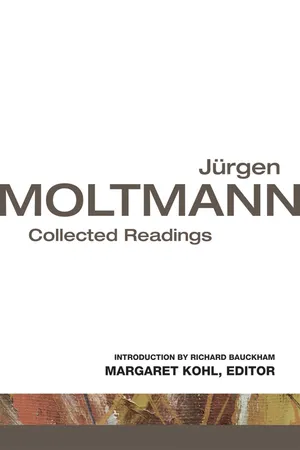
Jürgen Moltmann's life and work have marked the history of theology after the Second World War in Europe and North America like no other. He is the most widely read, quoted, and translated theologian of our time. His systematic work thrives on the cutting edge of Christian theology in the twenty-first century, challenging and stimulating a whole generation of theologians to work at theology in different and more comprehensive ways. Margaret Kohl, a translator of many of Moltmann's volumes, has chosen representative samples of Moltmann's theological writings from eight of the volumes published by Fortress Press and has written brief prefaces to each of the selections. Moltmann scholar Richard Bauckham provides an extended Introduction.
Information
Topic
Theology & ReligionSubtopic
Christian Theology8
Ethics of Hope
Although his Ethics of Hope comes at the end of his systematic contributions to theology, the topic had been in Moltmann’s mind ever since the 1970s. But for a number of reasons, at that time he did not yet feel ready. Now, following a long series of major books, he picks up this concern, making explicit and developing some of the themes touched on implicitly or in less detail in earlier books. Here again, the framework is eschatology. In the preface to his Ethics of Hope he writes: “The hope for God’s eschatological transformation of the world leads to transformative ethics which tries to accord with this future in the inadequate material and with the feeble powers of the present, and thus anticipates it.”[1]In individual sections he addresses the issues urgently confronting society—medical ethics, ecology, human rights, the criteria for a just peace, and the rest—but sets them in the context of a specifically Christian ethics. This, as the book’s title says, is an ethics of hope. “An ethics of fear sees the crises; an ethics of hope perceives the chances in the crises.”[2]And since, as the Greek philosophers already saw, the Good and the Beautiful belong together, the end of ethics is joy and doxology. The Sabbath joy over God’s creation is followed by delight in the glory of the resurrection; and the two are caught up into hope for God’s promised future.
But, as Moltmann already makes plain in earlier books, this hope implies challenge and participation. And he quotes the message already proclaimed in 1968 at the Fourth General Assembly of the World Council of Churches in Uppsala: “Trusting in God’s renewing power, we call upon you to participate in the anticipation of God’s kingdom and to allow now something of the new creation to become already visible which Christ will complete on his day.” [3]
Eschatology and Ethics
Source: Moltmann 2010; ET 2012:3–8.
Introduction
What Can I Hope For? What Can I Do? Free Action
In this first chapter we shall look at the theological connection between hope and action. The different answers to Kant’s question: “What can I hope for?” always affect the various choices of action which are open to us in response to the question: “What should I do?” We become active insofar as we hope. We hope insofar as we can see into the sphere of future possibilities. We take in hand what we think is possible. If, for example, we hope that the world will continue to be as it is now, we shall keep things as they are. If we hope for an alternative future, we shall already change things now as far as possible in accord with that. If the future is closed, then nothing more is possible; we cannot do anything more. Unlike Kant, I am talking about an acting impelled by hope, one not in the mode of “ought” but one in the mode of “can.” An action sustained by hope is a free action, not one under compulsion,
Hope is always a tense expectation and rouses the attentiveness of all our senses, so that we can grasp the chances for the things we hope for, wherever and whenever they present themselves. That distinguishes hope from mere expectation or a patient waiting. When all the senses are attentive, reason is the vehicle which conveys the knowledge of change. We then perceive things not just as they have become and now exist, but also in the different way they could be. We perceive things not only sic stantibus but also sic fluentibus, as fluid not static, and try to realize their potentialities for change in a positive direction.
Realism teaches us a sense for reality—for what is. Hope awakens our sense for potentiality—for what could be. In concrete action we always relate the potentiality to what exists, the present to the future. If our actions were directed only to the future, we should fall victim to utopias; if they were related only to the present, we should miss our chances.
In hope we link far-off goals with goals within reach. What is last of all gives meaning to the next-to-last. So in the imaginations of hope there is always a superabundance of what is hoped for. It is only when we want what is now impossible that we arrive at the limits of our possibilities. It is good to stress this added value of hope, for we generally fall short of our possibilities. Lethargy is the real enemy of every hope.
What Must I Fear? What Should I Do? Necessary Action
We become aware of the future not only in our hopes for better times in the future but also, if not even for the most part, in our fears and anxieties. We are worried by the possibility of all the things that can happen. Fear and anxiety are early warning systems of possible dangers, and are necessary for living. As long as potential dangers can be discerned and named, they give rise to fears which impel us to do what is necessary in good time, and so to avert the dangers. But if discernible threats swell into insubstantial dangers, they result in diffuse anxieties in the face of nothingness or the total write-off of the world and one’s own existence. These anxieties generally lead to despairing resignation and paralyzed inactivity or to over-reactions which only intensify the dangers.
As well as the fundamental question, “What can I hope for?” Immanuel Kant should have asked the reverse of this question, “What must I fear?” But Kant was an “Enlightened” optimist—theologically, as he himself said, a millennialist. Every answer to the question about our fear affects what we do. Our sense for the possible is roused at least as much by the fear as by the hope.[4] Anxiety is concerned for our lives—hope, for our fulfilled lives. Anxiety awakens all our senses, making them alive to imminent threats, and prepares our reason to recognize in the facts of the present “the signs of the end.” Without these abilities we would be like the people in Pompeii who didn’t notice the outbreak of Vesuvius, or couldn’t accept that it was happening. We would feel as safe as the people before the Flood, who in spite of a biblical warning did not see anything coming (Matt. 24:38-39). Humanity would long since have become extinct. An ethics of fear sees the crises; an ethics of hope perceives the chances in the crises. In the exuberance of hope, the temptation is utopianism; in fear, the temptation is alarmism.
In Ernst Bloch’s Principle of Hope, we find the foundation for an ethics of change; in The Imperative of Responsibility, Hans Jonas gives us an ethics of fear.[5] The hope for what can come is replaced by the fear for what will perhaps no longer be. So it becomes more important to retain what is old than to attain the new. Hans Jonas therefore maintained that the prediction of the bad takes precedence over the prediction of the good: “It is the rule, to put it in primitive terms, that the prophecy of disaster has to be listened to more attentively than the prophecy of salvation.” For him, general anxiety about the continuance of humanity is the foundation for the fear of the unforeseeable consequences of human technology. He uses the alarm over humanity’s threat to its own existence in order to ensure authentic human being in the present. The “heuristic of fear” awakens responsibility in the present. That is not pessimism any more than what Bloch disseminated was optimism. It is the reverse side of hope, although the two sides are not equal, since hope precedes fear: without hope there would be no fear, and without “the prophecy of salvation” there would be no “prophecy of disaster.”
In Jewish and Christian apocalyptic the endtime is announced with every conceivable catastrophe scenario, but at the same time deliverance in the new divine beginning is proclaimed all the more intensively. In the catastrophes of the endtime, nothing less than God’s Spirit itself will be poured out, so that everything mortal may live (Joel 2:28-32; Acts 2:16-21). With the outpouring of the divine Spirit of life, the new creation of all things begins in the downfall of the world. After “the heavens pass away” and “the earth is burnt up,” on the Day of the Lord there will be “a new earth on which righteousness dwells” (2 Peter 3:13).
Near and hard to grasp the God,
But where there is danger deliverance also grows.
So wrote Friedrich Hölderlin in his Patmos Hymn.[6] The Christian ethics of hope is called to life through the recollection of the raising of the crucified Christ and therefore expects the dawn of God’s new world in the passing away of the old one (Rev. 21:1). The endtime is simultaneously the new-time. In the perils of time it lives from hope for the coming of God. It mobilizes energies out of surmounted fears. It holds instructions for resistance against the old world in anticipation of the new one. It presupposes a transformative eschatology and, correspondingly, is itself transforming action. It is this unity of messianic awareness of the time and transformative action that is meant in Rom. 13:12:
The night is far gone,
the day is at hand.
Let us then cast off the works of darkness
and put on the armor of light.
Christian hope is founded on Christ’s resurrection and opens up a life in the light of God’s new world. Christian ethics anticipates the universal coming of God in the potentialities of history.
Praying and Watching
All Christian action is embedded in a particular spirituality. In the Benedictine tradition, this spirituality is ora et labora, pray and work. Prayer is directed towards God, work towards the world. But through prayer work in the world is seen sub specie aeternitatis, in the light of eternity, and is brought before the face of God. In other words, it is answerable to God. Consequently, it is not a pious irrelevance if we begin our daily work, or any special project, with a prayer.
What does hope add to prayer? I think what it adds is “watching.” In Christian life according to the New Testament, the call to prayer is always linked with the messianic wake-up call to watch. In the night of God in the Garden of Gethsemane, when the disciples are sunk into the deep sleep of hopelessness, Jesus does not ask them, “Could you not pray with me” but “Could you not watch with me one hour?” (Mark 14:37), and he warns them: “Watch and pray that you may not enter into temptation.” Specifically Christian prayer is always linked with expectation for what is to come, whether it be out of fear of evil and catastrophes or out of hope for the kingdom of God. Watching awakens all our senses for what is to come. Watching and being sober, watching and expecting, watching and being open-eyed, go together in the messianic hope.[7]
In watching we open our eyes and “recognize” the hidden Christ who waits for us in the poor, the sick, the weary, and heavy-laden (Matt. 25.37). In the faces of the poor of the people we “see” the face of the crucified God. Today the messianic awakening for God’s future is often translated into sensibility for the little things in everyday life. That makes it more realistic but also weaker. Attentiveness in the messianic awakening surely lies in attentiveness for the signs of the times, in which God’s future is heralded, so that Christian action, inspired by hope, becomes the anticipation of the coming kingdom in which righteousness and peace kiss each other. So Christian action is accompanied by prayer and watching, by the trust of the heart, by wide-open eyes, and by attentive senses.
Waiting and Hastening
Out of hope for God’s future, all theologians of hope from [John Amos] Comenius to [Christoph] Blumhardt have praised these two attitudes to life: Blumhardt called them warten und pressieren—“waiting and being in a hurry.” It is the Second Letter of Peter (3:12) which tells Christians they should be “waiting for and hastening the coming of the Lord’s future.” By this he means the new earth “on which righteousness dwells.”
Waiting and hastening: that sounds like a contradiction. If we are waiting, then what we are waiting for is not yet there. If we are hastening, then what we have waited for is already in sight. These are the two extremes between which attitudes to the future are played out. As boundary marks they do not have to be mutually contradictory. Let us translate “waiting and hastening” into our own language and experience:
Waiting: that doesn’t mean a passive waiting-it-out; it means an active expectation. A passage in the prophet Isaiah offers an apt example of the difference. When they are in exile and far from home, the prisoners come to the prophet and ask: “Watchman, what of the night?”—and he replies: “Morning is coming, but it is still night. If you will inquire, come back again” (21:11-12). The apostle Paul picks up this image about the night and proclaims the dawn of God’s day in the light of Christ’s resurrection: “The night is far gone, the day is at hand” (Rom. 13:12). So waiting turns into expectation, and the dreams of the night become an awakening in the daybreak colors of the new day. The eclipse of God becomes the sunrise of God. As Paul, in his ethic of hope, calls for the “weapons of light,” so the awakening of hope carries the promised future of righteousness into one’s own life. God’s coming unfolds a transforming power in the present. In our tense expectation we are prepared for God’s future, and that future acquires power in our present.
The ability to wait also means not conforming to the conditions of this world of injustice and violence. People who expect God’s justice and righteousness no longer accept the so-called normative force of what is fact, because they know that a better world is possible and that changes in the present are necessary. Being able to wait means resisting the threats and seductions of the present, not letting oneself be brought into line, and not conforming.
The ability to wait means not giving oneself up, not capitulating, either before the supremacy of the powers of this world or before one’s own helplessness, but living with head held high. The “upright walk” Kant commends is deserving of every respect. It is the heroic stance of the unbowed back of the free. But “the head held high” is a result of the approaching redemption (Luke 21:28).
The ability to wait is faithfulness in faith. Hope does not only give faith wings, as we say; it also gives ...
Table of contents
- Cover
- Title Page
- Copyright
- Table Of Contents
- Introduction
- Theology of Hope
- The Crucified God
- The Trinity and the Kingdom
- God in Creation
- The Way of Jesus Christ
- The Spirit of Life
- The Coming of God
- Ethics of Hope
- Bibliography
- Index
Trusted by 375,005 students
Access to over 1.5 million titles for a fair monthly price.
Study more efficiently using our study tools.
Frequently asked questions
Yes, you can cancel anytime from the Subscription tab in your account settings on the Perlego website. Your subscription will stay active until the end of your current billing period. Learn how to cancel your subscription
No, books cannot be downloaded as external files, such as PDFs, for use outside of Perlego. However, you can download books within the Perlego app for offline reading on mobile or tablet. Learn how to download books offline
Perlego offers two plans: Essential and Complete
- Essential is ideal for learners and professionals who enjoy exploring a wide range of subjects. Access the Essential Library with 800,000+ trusted titles and best-sellers across business, personal growth, and the humanities. Includes unlimited reading time and Standard Read Aloud voice.
- Complete: Perfect for advanced learners and researchers needing full, unrestricted access. Unlock 1.5M+ books across hundreds of subjects, including academic and specialized titles. The Complete Plan also includes advanced features like Premium Read Aloud and Research Assistant.
We are an online textbook subscription service, where you can get access to an entire online library for less than the price of a single book per month. With over 1.5 million books across 990+ topics, we’ve got you covered! Learn about our mission
Look out for the read-aloud symbol on your next book to see if you can listen to it. The read-aloud tool reads text aloud for you, highlighting the text as it is being read. You can pause it, speed it up and slow it down. Learn more about Read Aloud
Yes! You can use the Perlego app on both iOS and Android devices to read anytime, anywhere — even offline. Perfect for commutes or when you’re on the go.
Please note we cannot support devices running on iOS 13 and Android 7 or earlier. Learn more about using the app
Please note we cannot support devices running on iOS 13 and Android 7 or earlier. Learn more about using the app
Yes, you can access Jürgen Moltmann by Jürgen Moltmann, Margaret Kohl in PDF and/or ePUB format, as well as other popular books in Theology & Religion & Christian Theology. We have over 1.5 million books available in our catalogue for you to explore.