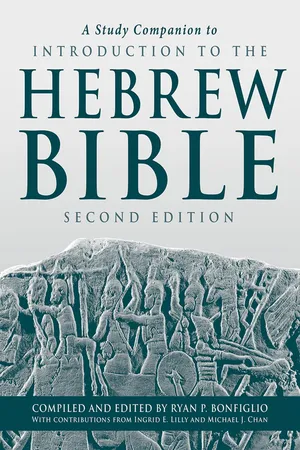
John J. Collins Introduction to the Hebrew Bible is one of the most widely used textbooks in the world, and for good reason. Balanced and richly informative, it introduces current thinking and leads the student into the important interpretive questions. This Study Companion is tied directly to Introduction to the Hebrew Bible and can be purchased individually, or as part of a Course Pack. It features essential primary readings keyed to the text, along with a running timeline feature and discussions of technical terms, archaeological sites, and methods and concepts in biblical studies. Students can use the study companion as a workbook and a handy complement to the textbook and the Hebrew Bible itself.
- 160 pages
- English
- ePUB (mobile friendly)
- Available on iOS & Android
eBook - ePub
A Study Companion to Introduction to the Hebrew Bible
About this book
Information
13
1 Kings 1–11: Solomon and the Divided Monarchy
Key Points
Mark Twain once remarked, “History doesn’t repeat itself, but it often rhymes.” Something similar can be said about the history of the monarchic period presented in 1 and 2 Kings. The noticeable “rhyme” of these books, which is provided by Deuteronomistic editors, is especially evident in the recurrence of certain themes and theologies. These include the negative evaluation of all northern kings, the emphasis on centralized worship at the Jerusalem temple, and the continuity of the Davidic covenant. The Deuteronomistic shaping of these books is also apparent in formulaic language about obedience (“with all the heart and soul”), disobedience (“to walk in the sin of Jeroboam”), and the synchronization of the reigns of Israelite and Judean kings.
The content of 1 Kings 1–11 primarily focuses on the reign of Solomon, David’s successor. His accession to the throne does not go unchallenged, and as a result, he must rely on court intrigue and the ruthless elimination of his rivals to secure power (chapters 1–2). The early years of his reign are portrayed as a golden age in Israelite history. Solomon demonstrates profound wisdom, establishes extensive international relations, and initiates an ambitious building campaign (chapters 3–5; 9–10). Yet Solomon”s crowning achievement is the construction of the temple in Jerusalem (chapters 6–7), which was likely modeled after the typical plan of temples in ancient Syria-Palestine. Through a series of three dedicatory prayers (chapter 8), Solomon articulates the main contours of the Deuteronomist’s temple theology. This theology affirms that the temple is a place where God’s name dwells and where prayer can be directed.
Despite his many accomplishments, Solomon’s reign ends in failure. He sacrifices at high places (1 Kgs. 3:3), conscripts his people into forced labor (1 Kgs. 9:15), and loves many foreign women (1 Kgs. 11:1-8). Led astray into idolatry, God resolves to tear away a large part of the kingdom from Solomon’s offspring. However, out of loyalty to the Davidic covenant, God allows two tribes to remain under the control of Solomon’s successors. The subsequent division of the “United Monarchy” results in two independent entities—the Northern Kingdom of Israel and the Southern Kingdom of Judah.
The portrait of Solomon’s kingdom provided in 1 Kings 1–11 has been challenged by many modern historians. The archaeological record provides little evidence of an expansive kingdom or extensive building projects in and around Jerusalem during the tenth century. Nevertheless, there is good reason to believe that the Deuteronomist did not invent the story of Solomon’s reign out of whole cloth. In all likelihood, the golden age of Solomon reflects aspirations of later Judean kings, which are projected onto the more modest historical reality of early Israel.
Key Terms
Solomonic enlightenment Coined by the German scholar Gerhard von Rad, the Solomonic enlightenment refers to the supposed flourishing of Israelite culture during the mid-tenth century bce. Von Rad proposed that Solomon’s court fostered extensive literary activity, including the composition of the J source of the Pentateuch. Contemporary scholars have come to question the historicity of the Solomonic enlightenment, including the early date of the J source and the extent of literacy in early Israel.
Sins of Jeroboam This term refers to Jeroboam’s construction of worship centers at Dan and Bethel. In the eyes of the Deuteronomist, this action is a violation of the command to centralize worship in Jerusalem. All northern Israelite kings violate this command and thus are said “to walk in the sins of Jeroboam.” The story of the golden calf in Exodus 32 likely functions as a polemic against the golden calves Jeroboam sets up at Dan and Bethel. However, Jeroboam likely intended these objects to be pedestals for the invisible deity (like the cherubim throne), not idols.
Corvée Corvée is a form of forced labor often imposed on people in lieu of taxes. Solomon initiated a corvée during the construction of the temple (1 Kgs. 5:13-14; 9:15). When Solomon’s son, Rehoboam, follows the advice of his young advisors to intensify the corvée, the ten northern tribes revolt. There is a parallel between the corvée imposed on the Israelites by Solomon and Rehoboam and the corvée imposed on them by the Egyptians in the exodus story.
Northern Kingdom After the reign of Solomon, ten tribes break away from Rehoboam’s control and form their own nation, known as the Northern Kingdom or “Israel.” The Deuteronomist understands this schism as a punishment for Solomon’s apostasy, although the socioeconomic reasons for the division are related to the corvée. The capital of the Northern Kingdom was originally located at Shechem but was later transferred to Samaria during the reign of Omri. All northern rulers are evaluated negatively in 1 and 2 Kings.
Cherubim The term cherubim (plural of cherub) refers to hybrid, winged creatures that include features of various animals. In the inner sanctuary of Solomon’s temple, two large cherubim with wings spread open were part of the covering of the ark. The cherubim functioned as resting place or throne for the presence of the invisible God. Two-dimensional cherub imagery is also found in other parts of the temple, including the curtains and veil. Hybrid creatures were popular in ancient Near Eastern art and should not be confused with the chubby, infant-like angelic beings known from Western art.
Key Personalities
Ahijah
Ahijah was a prophet from Shiloh who plays a key role in the Deuteronomistic explanation of the split between the Northern and Southern Kingdoms. When Ahijah meets Jeroboam on the road from Jerusalem, he performs a symbolic act by tearing a garment into twelve pieces. Ten pieces, which symbolize tribes, are taken by Jeroboam as evidence that God is tearing the kingdom from the hand of Solomon due to his apostasy. Ahijah promises Jeroboam that if he walks in God’s ways, he will be given “an enduring house” (1 Kgs. 11:38). However, two pieces of the garment, representing Judah and Benjamin, remain with Rehoboam for the sake of the promise made to David in 2 Samuel 7. Rehoboam’s refusal to lift the corvée in 1 Kings 12:15 is explained as a fulfillment of Ahijah’s prophecy. Later, Ahijah figures prominently in the condemnation of the sin of Jeroboam. Ahijah prophecies not only that Jeroboam’s house will be cut off, but that the whole Northern Kingdom will go into exile “beyond the Euphrates” (1 Kgs. 14:12-16). Immediately after uttering these words, Jeroboam’s son dies, thus fulfilling part of Ahijah’s prophecy. The story of Ahijah anticipates the more prominent role prophets play throughout 1 and 2 Kings.
Hiram of Tyre
Hiram was a tenth century king of Tyre who had contact with both David and Solomon (2 Sam. 5, 1 Kgs. 5). The biblical accounts of Hiram all address commercial relations with Israelite kings, reflecting the fact that Tyre was an important hub of trade located on a small island just off the southern Phoenician coast. In 2 Samuel 5:11, Hiram sends cedar trees, carpenters, and masons to David in order to build him a palace. This gift was likely intended to honor David, who recently captured Jerusalem. In David’s view, Hiram’s actions confirm that the LORD had established him as king over Israel. Because of Hiram’s friendship with David, the king of Tyre also sends servants to greet Solomon after he had been anointed as king. Solomon sends word to Hiram requesting that he once again provide cedars from Lebanon for a royal building project—this time, a “house” (temple) for God. Hiram gladly responds to this request and ships “timber of cedar and cypress” to Israel (1 Kgs. 5:8-10) in return for an annual shipment of oil and wheat (1 Kgs. 5:11-12). Later, Solomon also gives Hiram twenty cities in the Galilee region (1 Kgs. 9:10-14), perhaps because the king was forced into financial difficulty due to his building projects or trade. While Hiram is said to be displeased with these cities, the treaty between the king of Tyre and the king of Israel does not seem to be jeopardized. Later, Hiram provides Solomon with ships and sailors for a fleet of commercial ships that carry precious metals, ivory, and exotic animals (1 Kgs. 9:26-28; 10:11, 22). First Kings 7 specifies that a skilled craftsman, whose name also happens to be Hiram, contributed to the construction of Solomon’s temple (1 Kgs. 7:13-47). This Hiram should not be confused with the king of Tyre.
Questions for Study and Discussion
- Solomon is typically remembered for his wisdom, but a careful reading of the narrative itself reveals that Solomon is not so easily labeled. Is he wise? Foolish? Ironic? What is your view on the matter and what evidence would you point to in support of your view?
- Writing was a privilege in ancient Israel that was primarily available to privileged men. Temples and palaces in particular are the typical patrons of scribes. Given that King Solomon is ultimately cast in a negative light, who do you think might be responsible for creating these negative images of one of Israel’s most famous monarchs?
- The chapter claims that, “The hand of the Deuteronomistic editors is more obvious in the books of Kings than in those of Samuel.” Based on your reading of the chapter, how would you describe Deuteronomistic theology? What are its key features? How does it understand God’s
- The book of Kings is a theological interpretation of Israel’s history. For instance, the political rebellion that split the southern and northern kingdoms is understood as God’s work, and Solomon’s wisdom is attributed to divine action. How do you respond to this kind of historiography? What are its problems? What are its benefits?
Primary Text
The Inauguration of the Temple: 1 Kings 8:1-30, 54-66
Close reading tips
- Up to this point, the ark had been housed in a tent sanctuary.
- Note that the festival mentioned in verse 2 is the festival of booths (also known as tabernacles), which occurs in September-October.
- Note that verse 9 emphasizes that the ark was a mere receptacle for the tablets of Moses. The Deuteronomist wanted to counter the notion that the a material object could symbolize God’s presence.
- Verses 14-21 represent the first of Solomon’s three prayers, each of which illuminates the Deuteronomist’s temple theology.
- In order to avoid saying that God actually dwelled in the temple, Solomon refers to the building as “a house for the name of the LORD, the God of Israel” (verses 17 and 21).
- Note that in verses 29-30, prayer should be directed toward the temple. This statement may presuppose conditions during the Babylonian exile when it was no longer possible to pray in the temple.
- Note that in the third prayer (verses 54-61), obedience is the proper response to God’s past faithfulness to the Israelites.
- The number of sacrifices said to be offered in verse 63 is highly exaggerated in order to highlight the centrality of the sanctuary to Solomon and his kingship.
1 Then Solomon assembled the elders of Israel and all the heads of the tribes, the leaders of the ancestral houses of the Israelites, before King Solomon in Jerusalem, to bring up the ark of the covenant of the LORD out of the city of David, which is Zion. 2 All the people of Israel assembled to King Solomon at the festival in the month Ethanim, which is the seventh month. 3 And all the elders of Israel came, and the priests carried the ark. 4 So they brought up the ark...
Table of contents
- Cover
- Title Page
- Copyright
- Table Of Contents
- For the Students: How to Use this Guide
- Introduction: What Are the Hebrew Bible and Old Testament?
- The Near Eastern Context
- The Nature of Pentateuchal Narrative
- The Primeval History
- The Patriarchs
- The Exodus from Egypt
- The Revelation at Sinai
- The Priestly Theology: Exodus 25–40, Leviticus, and Numbers
- Deuteronomy
- The Book of Joshua
- Judges
- First Samuel
- Second Samuel
- 1 Kings 1–11: Solomon and the Divided Monarchy
- 1 Kings 12—2 Kings 25: Tales of Prophets and the End of the Kingdoms of Israel and Judah
- Amos and Hosea
- Isaiah, Micah, Nahum, and Zephaniah
- The Babylonian Era: Habakkuk, Jeremiah, and Lamentations
- The Exilic Period: Ezekiel and Obadiah
- The Additions to the Book of Isaiah
- Postexilic Prophecy: Haggai, Zechariah, Malachi, Joel
- Ezra and Nehemiah
- The Book of Chronicles
- The Psalms and Song of Songs
- Proverbs
- Job and Qoheleth
- The Hebrew Short Story: Ruth, Esther, Tobit, Judith
- Daniel, 1–2 Maccabees
- The Deuterocanonical Wisdom Books: Ben Sira, Wisdom of Solomon, Baruch
- From Tradition to Canon
- A Short Guide to Writing Exegetical Research Papers
Trusted by 375,005 students
Access to over 1.5 million titles for a fair monthly price.
Study more efficiently using our study tools.
Frequently asked questions
Yes, you can cancel anytime from the Subscription tab in your account settings on the Perlego website. Your subscription will stay active until the end of your current billing period. Learn how to cancel your subscription
No, books cannot be downloaded as external files, such as PDFs, for use outside of Perlego. However, you can download books within the Perlego app for offline reading on mobile or tablet. Learn how to download books offline
Perlego offers two plans: Essential and Complete
- Essential is ideal for learners and professionals who enjoy exploring a wide range of subjects. Access the Essential Library with 800,000+ trusted titles and best-sellers across business, personal growth, and the humanities. Includes unlimited reading time and Standard Read Aloud voice.
- Complete: Perfect for advanced learners and researchers needing full, unrestricted access. Unlock 1.5M+ books across hundreds of subjects, including academic and specialized titles. The Complete Plan also includes advanced features like Premium Read Aloud and Research Assistant.
We are an online textbook subscription service, where you can get access to an entire online library for less than the price of a single book per month. With over 1.5 million books across 990+ topics, we’ve got you covered! Learn about our mission
Look out for the read-aloud symbol on your next book to see if you can listen to it. The read-aloud tool reads text aloud for you, highlighting the text as it is being read. You can pause it, speed it up and slow it down. Learn more about Read Aloud
Yes! You can use the Perlego app on both iOS and Android devices to read anytime, anywhere — even offline. Perfect for commutes or when you’re on the go.
Please note we cannot support devices running on iOS 13 and Android 7 or earlier. Learn more about using the app
Please note we cannot support devices running on iOS 13 and Android 7 or earlier. Learn more about using the app
Yes, you can access A Study Companion to Introduction to the Hebrew Bible by Ryan P. Bonfiglio in PDF and/or ePUB format, as well as other popular books in Theology & Religion & Biblical Criticism & Interpretation. We have over 1.5 million books available in our catalogue for you to explore.