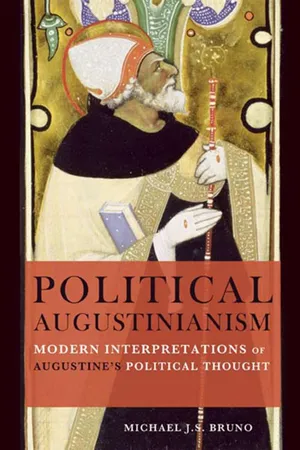
Political Augustinianism examines these modern political readings of Augustine, providing an extensive account of the pivotal French, British, and American strands of interpretation. Fr. Michael J. S. Bruno guides the reader through these modern strands of interpretation, examines their historical, theological, and socio-political context, and discusses the hermeneutical underpinnings of the modern discussion of Augustine’s social and political thought.
eBook - ePub
Political Augustinianism
Modern Interpretations of Augustine's Political Thought
- 224 pages
- English
- ePUB (mobile friendly)
- Available on iOS & Android
eBook - ePub
Political Augustinianism
Modern Interpretations of Augustine's Political Thought
About this book
Alongside Saint Thomas Aquinas, the thought of Saint Augustine stands as one of the central fountainheads of not only theology but Western social and political theory. In the twentieth century especially, Augustine has been pivotal to the development of modern and contemporary political and social construction. Schools of ‘Augustinianism’ proliferated, especially in French, German, and English, and debated critical questions around the relationship of the church and state, war, justice, ethics, virtue, and the life of citizenship, interpreted through a lens provided by Augustine.
Information
Topic
Theology & ReligionSubtopic
Christian Theology5
Interpreting Augustine’s Political and Social Thought
Hermeneutical Issues and Contemporary Applications
Contextualizing Contemporary Augustinian Hermeneutics
In October of 1988, a roundtable discussion was held on the issue of contemporary Augustinian interpretation. In my opinion, this meeting was second in importance for our discussion only to the groundbreaking 1954 Augustinian Congress held in Paris. At this meeting, a number of contemporary authors involved in this discussion met at The Union Club in New York City, namely Robert Markus, Ernest Fortin, Elizabeth Clark, Jean Bethke Elshtain, James Schall, Eugene TeSelle, Graham Walker, and Richard John Neuhaus. They debated over the course of two days on various elements of Augustine’s thought, including love, friendship, his Neoplatonic influences, the virtues, and values. However, arguably the most controversial and divisive debate in this discussion emerged over the question of how to read Augustine and how to appropriate his thought today.
Indeed, while debating Augustine’s understanding of virtue and human nature, Rabbi David Novak interjected to point out the need to consider the hermeneutical question underpinning their discussion. Novak argued from his experience of studying the Jewish philosopher and sage, Maimonides:
There’s a fundamental problem that has to be brought out in the open. The problem that you have with Augustine is the problem that I have with Maimonides. Are we talking about what Maimonides meant or about the truth of what Maimonides said? Now if we’re talking about what he meant, then we should incorporate all the linguistic, historical skills that we have at our disposal, and say what he meant in the proper context. If we’re asking whether what he’s saying is true, then we are asking what Maimonides said is true about Judaism as we experience it here and now . . . That’s the hermeneutical problem that you have. Are you looking for the meaning only? Or are you looking for the truth?[1]
Novak’s interjection is an important and relevant one for our discussion as well. It must be noted that while Novak sought their separation, the two hermeneutical trends which he identifies, namely the interpretation of meaning and application of truth in Augustine, have been inextricably joined. How one interprets Augustine’s writings will obviously influence and determine the subsequent application of his thought. Elshtain illumines this relationship further, “Fortunately, there is a vast body of work—so vast no single person could ever hope to wade through it, much less Augustine’s own vast corpus—that tries to understand Augustine in the context of his own time and to situate him in and for our time in a way that helps us to think ‘with Augustine’ yet again.”[2] This hermeneutical task of thinking “with Augustine,” is one that has been taken up by many authors. For example, we have examined how the entire trend of “political Augustinianism” originates in the interpretation and consideration of Augustine’s concept of civitas dei. In the discussion of this concept, Augustine is subsequently accused by various authors of subverting the political order and ceding temporal authority as a whole to the sacred imperium.
From a theological perspective, the interpretation of Augustine’s corpus necessarily precedes and lays the foundation for the subsequent application of principles drawn from his work in order to answer modern questions. While many historians will find such efforts as an unnecessary and even foolhardy departure from Augustine, the fact remains that such efforts are part of a larger theological method. The interpretation of the Church’s tradition and the application of principles that are discovered within it are both important theological tasks relevant to our examination of Augustine of Hippo. While it is evident that such interpretations rely upon historical context, linguistic analysis, and other critical tools at our disposal, theology still seeks to go deeper. It seeks to study not only a particular text or author, but also to discover principles of importance to the life of the Church in its current social and historical context. As we have seen throughout this discussion, the past century with its turbulence and bloodshed has led many to turn again to the Bishop of Hippo. In this chapter, therefore, what remains is admittedly a theological analysis of the debate that we have surveyed and the Augustinian principles that have been invoked repeatedly over its history. As Charles Mathewes explains, “Application is intrinsic to interpretation; we do not understand Augustine properly unless we try, at least implicitly, to apply his thought to today—thereby bringing new illumination into facets of his thought.”[3]
Having laid out over the past four chapters the various commentaries and schools of interpretation in Augustine’s political and social thought, it is necessary now to examine some of the major hermeneutical issues that lie underneath our discussion. In doing so, we necessarily will have to evaluate the validity of some of the arguments we have discussed. Aiding this task is the fact that the sources from Augustine’s vast corpus that have been invoked are similar, namely Augustine’s De Civitate Dei, De Doctrina Christiana, Confessiones, and his letters to Macedonius and Marcellinus. However, the way in which these sources have been interpreted and utilized varies widely. Also, it is evident that the goals of various commentators and scholars differ. Some seek to retrieve Augustine’s vision and apply it to our own age, which is the task Elshtain calls “thinking with Augustine.” However, others dissent from and seek to “overcome” Augustine’s influence in Western political thought and theology in general. This latter school sees in Augustine the source of numerous problematic trends: a paternalistic social ideal, a fixation on sexuality, an exaltation of guilt and self-loathing, a weakened human anthropology, the condemnation of the world and temporal authority, and other social and political “problems.” Elshtain criticized this latter effort as:
Those who credit, or discredit, Augustine as the father of nearly all our discontents, the progenitor of nothing less than Western ressentiment, a term made famous by Nietzsche that signifies the envy of the strong by the weak yet includes their subsequent revenge as they turn the tables and institute regimes of moralistic repression that wallow in sickly tales of the superiority of victims.[4]
The hermeneutic of this latter group is not one of retrieval, but rather refutation. These authors see in Augustine’s corpus not a well from which to draw, but a poisoned tree which needs to be cut down before others reap its fruit. They maintain a rather stern image of the Bishop of Hippo and a harsh condemnation of his continued influence and relevance. However, the hermeneutical question must be posed as to whether this latter image of Augustine is in fact the Bishop of Hippo, or simply a straw man who has borne undue and unwarranted criticism. Similar to the debate over Augustine’s connections to the medieval ideal of unified power, much of what is attributed to the Bishop of Hippo must be attributed to his later interpreters. The hermeneutical problem, therefore, in this latter school remains the question of how much of the “Augustinian tradition” can be actually attributed to Augustine himself. Put in another way, what constitutes an “authoritative” interpretation of Augustine’s political and social thought? There also remains the related question as to whether an authoritative interpretation is even possible in the first place. These questions will be examined further in this chapter, and have already been alluded to throughout our discussion. For example, the interjections of Henri de Lubac in the discussion of l’augustinisme politique exposed early on many of these hermeneutical issues and concerns.
Before beginning this task, therefore, Eugene TeSelle has put forward a helpful summary of the various interpretations at play in our discussion and the different hermeneutical perspectives that necessarily support each of them:
What is it that we expect of Augustine in the political realm? The patterns of response suggest several answers. Some expect a confirmation of ‘political realism’ (Niebuhr; Deane), or an anticipation of modern secular politics (Markus), or a putting down of all liberal-to-radical, secular humanistic attempts to change the world, a condemnation of what Charles Cochrane called years ago ‘creative politics,’ or what is even worse a historical ‘gnosticism’ that seeks human perfection in the earthly future (Schall). Some look for a whipping boy, a detestable example of all that Christian ethics ought not to be, guilt ridden over sexuality, fawning toward those in power, eager to praise the martyrs but persecute pagans, heretics, and schismatics let me confess to sharing in his tendency). Some wish to diagnose or dissect a fundamentally wrong-headed theology,...
Table of contents
- Cover
- Title Page
- Copyright
- Dedication
- Table Of Contents
- Foreward
- Abbreviations
- Acknowledgments
- Introduction
- French Interpretations of Augustine’s Social and Political Thought
- From Realism to Justice Ethics
- Disputing the Saeculum
- Recovering Augustine’s Vision of Public Life and Virtue
- Interpreting Augustine’s Political and Social Thought
- Conclusion
- Bibliography
- Index
Trusted by 375,005 students
Access to over 1.5 million titles for a fair monthly price.
Study more efficiently using our study tools.
Frequently asked questions
Yes, you can cancel anytime from the Subscription tab in your account settings on the Perlego website. Your subscription will stay active until the end of your current billing period. Learn how to cancel your subscription
No, books cannot be downloaded as external files, such as PDFs, for use outside of Perlego. However, you can download books within the Perlego app for offline reading on mobile or tablet. Learn how to download books offline
Perlego offers two plans: Essential and Complete
- Essential is ideal for learners and professionals who enjoy exploring a wide range of subjects. Access the Essential Library with 800,000+ trusted titles and best-sellers across business, personal growth, and the humanities. Includes unlimited reading time and Standard Read Aloud voice.
- Complete: Perfect for advanced learners and researchers needing full, unrestricted access. Unlock 1.5M+ books across hundreds of subjects, including academic and specialized titles. The Complete Plan also includes advanced features like Premium Read Aloud and Research Assistant.
We are an online textbook subscription service, where you can get access to an entire online library for less than the price of a single book per month. With over 1.5 million books across 990+ topics, we’ve got you covered! Learn about our mission
Look out for the read-aloud symbol on your next book to see if you can listen to it. The read-aloud tool reads text aloud for you, highlighting the text as it is being read. You can pause it, speed it up and slow it down. Learn more about Read Aloud
Yes! You can use the Perlego app on both iOS and Android devices to read anytime, anywhere — even offline. Perfect for commutes or when you’re on the go.
Please note we cannot support devices running on iOS 13 and Android 7 or earlier. Learn more about using the app
Please note we cannot support devices running on iOS 13 and Android 7 or earlier. Learn more about using the app
Yes, you can access Political Augustinianism by Michael J. S. Bruno,Michael J. S. Bruno in PDF and/or ePUB format, as well as other popular books in Theology & Religion & Christian Theology. We have over 1.5 million books available in our catalogue for you to explore.