- 192 pages
- English
- ePUB (mobile friendly)
- Available on iOS & Android
eBook - ePub
About this book
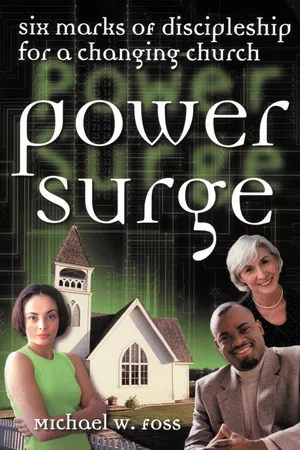
Drawing on his experience at Prince of Peace Lutheran Church, Foss makes the case for transforming congregations from a membership model to a discipleship model of church affiliation. The book begins with a careful analysis of recent patterns in church membership/demographics which argue for this paradigm shift. Subsequent chapters detail the unique leadership and organizational needs of a discipleship model; explore the building and maintaining of fundamental trust--in God and in His people--as the cornerstone of the model; and provide practical helps for assessing the present and strategies for moving into the future.
Information
Topic
Theology & ReligionSubtopic
Christian Church1
making the move from membership to Discipleship
It was one of those moments I’ll never forget. It happened on a Sunday in spring, and like the season, it too had to do with newness.
My associate pastor and I found we worked well together as a team, and our congregation’s membership was nearing one thousand people. We felt both grateful and confident. On this particular Sunday, however, I was in for a shock. As I looked out with pride on that growing, vibrant, worshipful congregation, I suddenly realized that there were individuals and families who were joining the church whose names I did not know, in whose homes I had not visited. I was stunned. I felt as if the world had changed overnight and I was just discovering it. I was shaken to the core, because my guiding model of ministry—that of being a personal pastor for each parishioner—was no longer viable.
My model for ministry also included focusing on church growth through increasing membership. Evangelism was a matter of bringing people into the church and then tending to their spiritual needs. But how could I do that if I didn’t even know them? My associate was very capable. He’d been in many of their homes and knew many of their names. But, as he later confessed, many he didn’t know well at all.
Although I didn’t realize it at the time, my paradigm for ministry was being significantly challenged. That Sunday, with its sudden insight, was the beginning of my move from a focus on membership to a focus on discipleship.
My training had taught me only one way to do ministry and to judge its effectiveness—call it the membership model of ministry. If the membership was growing and happy—and they seemed to be—then my ministry was successful. The model with which I had been working wasn’t all about numbers, though. I also assumed that the pastoral staff’s effective pastoral care was a necessary element to our spiritual health and vitality. I assumed that personally knowing the names and families and, as much as possible, the histories of those who attended and joined our church was an essential element in my ministry. I taught confirmation, attended the women’s lunches, played golf and racquetball with the men, led a number of Bible studies—all in an attempt to be a personal pastor to as many as possible.
In a growing church with more and more members to be served, this is a certain prescription for clergy burnout. The reason many churches don’t grow—or stop growing—is that the pastoral staff reaches its limit for personal care and then, consciously or unconsciously, creates a climate and systems that discourage growth.
ROOTS OF THE MEMBERSHIP MODEL
For decades, the membership model of the church has dominated American Protestantism. That model lingers as an adaptation of the village church system that existed in premodern western Europe. In the village, the pastor or priest served as the holy man for the whole community. He was responsible for serving the spiritual and often material needs of parish families at important life passages, such as birth, confirmation, marriage, critical illness or injury, and death.
The relationships of individuals and families to God were mediated through the rites of the church as administered by the village pastor. The pastor received a certain amount of prestige and the power that goes with it—often a great deal, depending upon his abilities—and the people received the assurance of connectedness to God as the pastor shared the sacraments, led worship, provided personal pastoral care, and in general tended to the spiritual life of the community.
To be a pastor or priest also was to be in the center of village life. A pastor’s relationship to the village served as a cohesive force in the identity of the community, and the pastor often played an important role in affirming and upholding the identity of individuals and families as members of the church and citizens of the village itself. Beliefs, values, and behaviors were articulated by the clergy in ways that shaped the larger community as well as the church. As such, the ministry of the church and the role of the clergy functioned like social glue as well as a source of spiritual solace.
For many modern Christians, particularly in the post–World War II era, the membership model of the church functioned in an analogous way. The congregation provided social as well as spiritual connections. Church was a place to meet others with whom one could confidently do business, share friendship, and uphold similar values. There were clear understandings of what membership in such a community of faith required. It meant giving some of one’s time and finances to keep the organization going and to pay the pastor’s salary. It meant not only accepting that ministry belonged to the minister but also expecting to be ministered to. It meant acting in a manner consistent with conventional morality and appropriate behavior. Church membership was akin to good citizenship. It created a significant sense of personal identity, and with that came the confidence that the church was both preserving values that were necessary for the health of the larger community and nation as well as playing an important role in efforts to improve society.
No wonder the post–World War II years saw an explosion in the number of congregations in the United States. The successful completion of the war itself was understood to have been accomplished through a sturdy faith in God and the concerted effort of Americans working together for a common goal. The individual, it was understood, could make his or her best contribution by being a contributing member of a group, and the membership of the mainline churches grew exponentially.
The social and spiritual messages of the Protestant churches, their professionalized ministries, and their organizational structures were well suited for that time—and for years to come. I and many of my colleagues were effective doing ministry in this mode. Until recently, the churches grew and, we believed, our communities, nation, and world benefited from that growth.
But times have changed. The church and its clergy have lost their privileged positions at the center of community life; hundreds of civic and social organizations compete for the time, talents, and finances of the citizenry; postmodern pluralism has relativized every belief and value system so that the faith is reduced to a commodity in the religious marketplace. For all too many today, Christianity is at best parochial and quaint (read irrelevant) and at worst dangerously intolerant. And for most in our culture, religion of whatever brand has been reduced to the private sphere of life. The gospel as public faith, sadly, seems a contradiction in terms.
The changing cultural context, with its displacement of Christianity from the center of individual and community life to the periphery, has caused a mutation in the membership model of the church. In the Protestant explosion of the 1950s, membership implied obligation. In today’s cultural context, membership has come to imply prerogatives.
I don’t want to push the analogy too far, but for the sake of illustration, let’s think of the membership model of the church as similar to the membership model of a modern health club. One becomes a member of a health club by paying dues (in a church, the monthly or weekly offering). Having paid their dues, the members expect the services of the club to be at their disposal. Exercise equipment, weight room, aerobics classes, an indoor track, swimming pool—all there for them, with a trained staff to see that they benefit by them. Members may bring a guest on occasion, but only those who pay their dues have a right to the use of the facilities and the attention of the staff. There is no need to belabor the point. Many of the people who sit in the pews on Sunday have come to think of church membership in ways analogous to how the fitness crowd views membership in a health club.
The tragic flaw in the contemporary version of the membership model of the church lies in the focus of its ministry. In that model, ministry focuses on the membership of a particular congregation. With the member as the focal point, the role of the clergy is to meet the spiritual needs of the members, keep the members happy, and generally do ministry in ways that make as few waves as possible. If the members’ perceived needs are adequately met, if they are happy with the services provided by the professional staff, and if conflict is avoided or minimized, then the membership can be counted on to do their part. Their part, of course, is to pay their “dues,” to keep the offering flowing that pays the bills, salaries, and costs of ministry.
You can see why the membership model of ministry is also called the maintenance model of ministry. Maintaining the institution for the sake of its members is the primary goal—whether stated or not—of the congregation.
I don’t want to be harsh. Under the membership model of the church, hardworking, faithful clergy have met the spiritual needs of their members in often heroic and heartwarming ways. The church has been there for its people at those signal times of life when connectedness to God is most needed. The church has been a comfortable and comforting place for many people, although their numbers are clearly diminishing. The membership model has had its strengths as well as its weaknesses.
Perhaps the greatest weakness of the model has been the loss, over time, of its vision for the mission of the church—a mission that can be characterized quite simply as participation in God’s love in Jesus Christ for the world. As the membership model gradually changed its focal point from the mission of the church to the member of the church, the church was tamed, privatized, turned in on itself. Powerful individuals and families—including clergy!—were able to control the ministry of a congregation according to their private agendas. Instead of a people organized for mission, the churches frequently became institutions organized for those already there. Decisions could be made with little or no reference to the church’s role in the world as the historical presence of Christ.
As a product of the membership model for ministry—by nurture as well as by training—I read the Great Commission as if it had been written, “Go therefore and make members of all nations, baptizing them in the name of the Father and the Son and the Holy Spirit, teaching them to observe all that I have commanded you.” But, of course, that is not how it reads. The critical word is disciples. Disciples are those who are both baptized and taught to observe what Jesus has commanded his followers. And that, as noted in the introduction, means to love in his name and spirit. Being a part of the church has little or nothing to do with prerogatives or privileged status except in one regard—disciples know that they are infinitely loved by the God who made them. They know that being a part of the church, the community of faith, has to do with being loved and loving, that is, with discipleship.
THE MEMBERSHIP MODEL IN MICROCOSM
“We just have too few of us to do the job anymore,” the chair of the altar guild had come to me to say. “And, Pastor, we’re tired.”
I knew that their numbers were few and older. I also knew that those numbers could be increased and given a youthful energy with careful recruitment of some of our newer members who were eager to become involved.
“I’ll tell you what,” I responded. “Let me see if a couple of women who have recently joined the church might be interested. I’ll let you know.”
“Pastor,” she said, “that would be great.”
But it wasn’t. Two months later three women, all new members, joined the altar guild. Three months after that, they had all resigned. When I asked each of them why they had left the guild, they all said the same thing: “The other women didn’t really want us to help.”
I knew it wasn’t intentional. The members of our altar guild were fine people, but they had their own ways of doing things, their own comfort with working with one another. Later, I realized that they were a microcosm of the congregation. They had formed their own fellowship group—a group that didn’t need, or want, any new members. They shared a friendship and history with one another that centered in the “Work” of the guild. It is no wonder the newcomers felt left out.
What is important to recognize in this story is how the mission of the guild had become secondary to the comfort of the group’s members. The truth was that they were indeed overworked! But in my attempts to solve their problem, I had miscalculated the power of their “membership” to dictate how, when, and by whom their work was done. I believe that if I could have redirected their attention to the mission they shared and convinced them that, for the sake of their mission to the larger church community, they needed to become involved in recruiting, welcoming, and mentoring others, then the “hazing” described by those other women would have been less likely to happen.
Let me hasten to add that this is but one illustration of the power of the membership model. It happens in every congregation where the membership and its prerogatives are the lens through which issues are seen and solutions presented. No wonder the few who seem to be “always doing the work” are most visible in our ministries—they are in the center of our membership!
At Prince of Peace, we recently studied the involvement of individuals in our various ministries. We discovered that, conservatively, we were benefiting from 5,400 hours of volunteer effort every week. We estimated that these hours of lay ministry are given by more than 4,000 different individuals. Our move from membership to discipleship, though by no means complete, has led to a congregation of vibrant, involved, growing disciples of Christ.
EXCLUSIVITY VERSUS INCLUSIVITY
Another problem with the membership model is its tendency to define the congregation exclusively rather than inclusively. The membership model identifies who is in and who is out. No wonder then that those outside the church consistently say that church people are more judgmental than others. No wonder that those for whom the front door of the church is a revolving door often say that the reason they don’t stay is the lack of genuine hospitality. They don’t feel genuinely welcomed, wanted, or needed.
That is not to say that church people are cold, indifferent, or unfriendly. My experience is just the opposite. Rather, it is the system that is not friendly. The membership model sets the church over against those outside the membership. The whole notion of the “church for others” gets lost, and people act, both consciously and unconsciously, to protect the “church for ourselves.”
The sense of exclusivity that the church portrays under the membership model is a key factor in discouraging postmodern seekers from crossing the threshold, coming inside, and staying around long enough to hear and experience the gospel of God’s love. The postmodern impulse in the United States is creating a people that highly values tolerance, uncritical acceptance of others, and a great plurality of beliefs, values, and behaviors. In this social reality, it therefore should come as no shock that membership in our churches continues to decline. The perception that the church doesn’t embrace outsiders undermines our credibility. What we need to communicate to those outside the church is radical openness to all, an openness extended from a position of strong, vibrant self-identity as followers of Christ and participants in God’s love for the world. That’s what the discipleship model of the church gives us.
The United States has become a pluralistic country that no longer consciously subscribes to the Judeo-Christian ethic summed up in the Great Commandment: “You shall love the Lord your God with all your heart, and with all your soul, and with all your mind. This is the greatest and first commandment. And a second is like it: You shall love your neighbor as yourself” (Matthew 22:36-40). Hence the incredible need for disciples of Christ in all walks of life who have internalized and live that ethic and whose lives witness to the wonder and truth of it.
The Protestant church has focused on itself—for that is what the membership model requires—and our core beliefs are not served by that orientation. Our core beliefs turn us outwards, not inwards. The membership model of the church turns us inwards and not outwards, and as Martin Luther once noted, sin is the state of being curved in on yourself!
Over the years, I have time and again invited folks who have been worshiping with us and contributing in many ways to the life of the congregation to join, only to be asked, “What do I get as a member that I don’t get now?” Membership is about getting; discipleship is about giving. Membership is about dues; discipleship is about stewardship. Membership is about belonging to a select group with its privileges and prerogatives; discipleship is about changing and shaping lives by the grace of God.
THE MOVE TO DISCIPLESHIP
The move from membership to disciples...
Table of contents
- Acknowledgments
- Introduction
- 1. Making the Move from Membership to Discipleship
- 2. Discipleship and Spiritual Leadership
- 3. Six Critical Marks of Leadership
- 4. Culture Shock!
- 5. The Marks of Discipleship
- 6. Beliefs, Values, Vision, and Mission
- 7. Beyond Committees to Ministry Teams
- 8. Developing Leaders for the Church and the World
- 9. Being What You Say You Are
- Closing Words
- Notes
Trusted by 375,005 students
Access to over 1.5 million titles for a fair monthly price.
Study more efficiently using our study tools.
Frequently asked questions
Yes, you can cancel anytime from the Subscription tab in your account settings on the Perlego website. Your subscription will stay active until the end of your current billing period. Learn how to cancel your subscription
No, books cannot be downloaded as external files, such as PDFs, for use outside of Perlego. However, you can download books within the Perlego app for offline reading on mobile or tablet. Learn how to download books offline
Perlego offers two plans: Essential and Complete
- Essential is ideal for learners and professionals who enjoy exploring a wide range of subjects. Access the Essential Library with 800,000+ trusted titles and best-sellers across business, personal growth, and the humanities. Includes unlimited reading time and Standard Read Aloud voice.
- Complete: Perfect for advanced learners and researchers needing full, unrestricted access. Unlock 1.5M+ books across hundreds of subjects, including academic and specialized titles. The Complete Plan also includes advanced features like Premium Read Aloud and Research Assistant.
We are an online textbook subscription service, where you can get access to an entire online library for less than the price of a single book per month. With over 1.5 million books across 990+ topics, we’ve got you covered! Learn about our mission
Look out for the read-aloud symbol on your next book to see if you can listen to it. The read-aloud tool reads text aloud for you, highlighting the text as it is being read. You can pause it, speed it up and slow it down. Learn more about Read Aloud
Yes! You can use the Perlego app on both iOS and Android devices to read anytime, anywhere — even offline. Perfect for commutes or when you’re on the go.
Please note we cannot support devices running on iOS 13 and Android 7 or earlier. Learn more about using the app
Please note we cannot support devices running on iOS 13 and Android 7 or earlier. Learn more about using the app
Yes, you can access Power Surge by Michael W. Foss in PDF and/or ePUB format, as well as other popular books in Theology & Religion & Christian Church. We have over 1.5 million books available in our catalogue for you to explore.