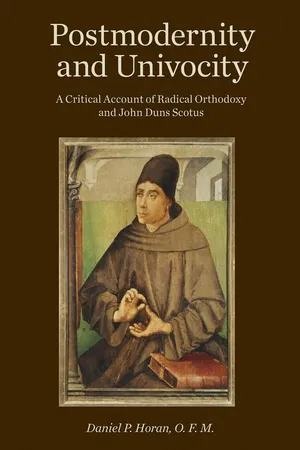
eBook - ePub
Postmodernity and Univocity
A Critical Account of Radical Orthodoxy and John Duns Scotus
- 144 pages
- English
- ePUB (mobile friendly)
- Available on iOS & Android
eBook - ePub
Postmodernity and Univocity
A Critical Account of Radical Orthodoxy and John Duns Scotus
About this book
Nearly twenty-five years ago, John Milbank inaugurated Radical Orthodoxy, one of the most significant and influential theological movements of the last two decades. In Milbank's Theology and Social Theory, he constructed a sweeping theological genealogy of the origins of modernity and the emergence of the secular, counterposed by a robust retrieval of traditional orthodoxy as the critical philosophical and theological mode of being in the postmodern world. That genealogy turns upon a critical point—the work of John Duns Scotus as the starting point of modernity and progenitor of a raft of philosophical and theological ills that have prevailed since. Milbank's account has been disseminated proliferously through Radical Orthodoxy and even beyond and is largely uncontested in contemporary theology. The present volume conducts a comprehensive examination and critical analysis of Radical Orthodoxy's use and interpretation of John Duns Scotus. Daniel P. Horan, O.F.M. offers a substantial challenge to the narrative of Radical Orthodoxy's idiosyncratic take on Scotus and his role in ushering in the philosophical age of the modern. This volume not only corrects the received account of Scotus but opens a constructive way forward toward a positive assessment and appropriation of Scotus's work for contemporary theology.
Information
Topic
Theology & ReligionSubtopic
Christian Theology3
Major Critiques and Analysis of Radical Orthodoxy’s Use of Scotus
In the previous two chapters, we explored the genesis and subsequent development of what I have termed the Scotus Story in Radical Orthodoxy and beyond. Tracing the scripting of the Scotus as protomodern antagonist narrative, we came to see the increasing degree of influence and ubiquity the story has gained. Through the work of John Milbank, Catherine Pickstock, and others, many contemporary theologians have adopted the Scotus Story. As we saw in chapter 2, this influential narrative has gone largely unquestioned and unanalyzed, especially by those who have adopted it in their own work. There exists little opposition to the increasingly widespread adoption of this interpretation of Scotus’s thought. The primary exception to this has appeared in the occasional responses offered by the small cadre of philosophers representing the contemporary guild of Scotist scholars. Two figures emerge as overtly critical of Radical Orthodoxy’s reading of the subtle doctor’s work, striving in large part to call attention to what they consider to be a misreading of Scotus’s doctrine of the univocity of being.
The leading Scotus apologist is Richard Cross, the former Oxford theologian and current faculty member in the philosophy department at the University of Notre Dame. A widely respected authority on the philosophy of John Duns Scotus, especially in the English-speaking world, Cross has been the most vocal critic of the Radical Orthodox reading of Scotus and its presentation of the subtle doctor’s approach to univocity. Concerning himself with explicit correction, Cross has seen his role as one to assess the “accuracy of the various accounts” of Radical Orthodoxy’s use of Scotus.[1] This is a role he does not take lightly, noting that Milbank and Pickstock are clearly mistaken in their understanding of Scotus’s intention, method, and aim.
In addition to Richard Cross, Thomas Williams, a professor at the University of South Florida, has provided elucidating commentary on what he sees as problematic in the work of Radical Orthodoxy vis-à-vis Scotus. Williams coined the phrase “univocity is true and salutary” in the title of his most visible critique of the Radical Orthodoxy reading of Scotus’s doctrine of univocity.[2] Invited to respond to Catherine Pickstock’s article “Duns Scotus: His Historical and Contemporary Significance” published in the same issue of Modern Theology, Williams is keen to highlight the “notably careless” treatment of Scotus by Pickstock and others.[3] As the title of his essay implies, Williams focuses on the ways in which the doctrine of univocity, as outlined by Scotus, is in fact valid and praiseworthy. Additionally, Williams has delivered less visible responses to the Radical Orthodoxy version of the Scotus Story in the form of conference papers and colloquia presentations.
In addition to Cross and Williams, there are few North American scholars that have publicly taken notice of the inherent problems latent in the Scotus Story as crafted by members of the Radical Orthodoxy movement. Even fewer have responded to the mistaken interpretations and claims made by Milbank, Pickstock, and those who have followed them. One additional exception to this rule, beyond Cross and Williams, is Mary Beth Ingham. Ingham, a well-known Scotus scholar whose interest focuses primarily on Scotus’s ethics, participated in the roundtable-like symposium in the special issue of Modern Theology, along with Williams. In her short text, Ingham is forthcoming about her desire to leave the details of critique concerning univocity to Cross and others, thinkers she views as solid in their assessment and already vocal about their criticism of Radical Orthodoxy. Instead, Ingham’s contribution is largely historical and contextual, focused on how Radical Orthodoxy in general (and Pickstock in particular) has “moved from interpretations about Scotus to affirmations about his thought” and has neglected to consider Scotist thought within the context of his “Franciscan assumptions.”[4] Ingham’s contribution is significant by way of refocusing attention to the importance of historical and philosophical context for interpreting a thinker.
There are several European thinkers that have actively engaged Radical Orthodoxy’s position on Scotus. A notable contributor to the ongoing Scotus conversation regarding Radical Orthodoxy and authentic ressourcement is the French Dominican Emmanuel Perrier. He too contributed to the special issue of Modern Theology, with an article that supports Ingham’s call for accurate contextualization, and a demarcation of Scotus’s thought per se from “Scotist thought” and its subsequent interpretation(s).[5]
Isidoro Manzano, Orlando Todisco, and Javier Andonegui, all Franciscan friars, have also responded to recent claims made about and against Scotus within Radical Orthodoxy. Their works have approached the subject from a variety of angles. Manzano is particularly interested in the function Scotus serves in Pickstock’s political agenda. He seeks to reevaluate the claim that Scotus’s philosophical work prepares a path for destructive political thought, in turn positing that Scotus’s thought is richly fecund with positive ethical and social implications, most of which are found in texts not familiar to Pickstock.[6] Todisco is less concerned with refuting the claim that Scotus is the originator of modernity than asserting the positive nature of such a development, in contradistinction to the negative and more polemical view offered by Radical Orthodoxy.[7] Andonegui is well aware of the same trend emerging in contemporary theology that Cross notes in his work, namely the viral transmission of the Scotus Story and the increasing unquestioned adoption of the narrative among many scholars. Andonegui’s primary observation is that the scholars responsible for advancing the Scotus Story are simply mistaken in their reading of the subtle doctor because they are not sufficiently familiar with the Scotus corpus. He is also interested, like Ingham and Perrier, in the recontextualization of Scotus’s thought.[8]
Curiously, several scholars whose works are frequently invoked by Radical Orthodoxy writers in support or defense of the Scotus Story have responded with an apparently cautious, if not quite a critical, voice. Here one might look to Olivier Boulnois, for example, who is a favorite source for Milbank and Pickstock. His important work, Etre et Représentation: Une genealogie de la métaphysique moderne a l’époque de Duns Scot,[9] is cited by Radical Orthodoxy thinkers. This is not without cause, for Boulnois is generally a supporter of the view that Scotus’s thought lends a significant contribution to the onset of what would become the long road to modernity. However, Boulnois has also noted the presence of several so-called “ruptures” in philosophical history that have contributed to this alleged genealogy as a whole, forming something of a constellation of responsibility, thereby not limiting culpability just to Scotus.[10] Additionally, Boulnois’s work strengthens the connection of dependence between the Radical Orthodoxy movement, and their likeminded fellows, and the interpretation of Scotus presented in the early twentieth century by Étienne Gilson, whose reading of the subtle doctor is largely contested by Scotus scholars. Ludger Honnefelder is another important figure for Radical Orthodoxy in the casting of the Scotus Story. His work, especially Scientia Transcendens: Die Formale Bestimmung der Seiendheit und Realität in der Metaphysik des Mittelalters und der Neuzeit,[11] is referenced in passing in the work of both Milbank and Pickstock.[12] It is important to note the frequently indirect referential dimension of Radical Orthodoxy’s engagement with Honnefelder’s work, which suggests a less proximate relationship between Honnefleder and the Scotus Story than Radical Orthodoxy thinkers would have readers believe. Serious engagement with Honnefelder’s scholarship offers a more nuanced reading of Honnefelder’s view of the subtle doctor’s work. While Honnefelder, like Boulnois, does not seem interested in challenging the possibility that certain later interpretations of Scotus’s work could have contributed to the axial shifts in the history of philosophy and theology, the German scholar is more careful in his reading of Scotus qua Scotus than Milbank, Pickstock, and others have been subsequently.
In this chapter, I will present a tripartite examination of Radical Orthodoxy’s use of Scotus. The first section focuses on Richard Cross’s response to the Scotus Story. Cross offers a succinct and direct ...
Table of contents
- Cover
- Title Page
- Copyright
- Table Of Contents
- Acknowledgements
- Introduction: The Return to the Narrative
- Radical Orthodoxy’s Use of John Duns Scotus
- The Reach of Radical Orthodoxy’s Influence
- Major Critiques and Analysis of Radical Orthodoxy’s Use of Scotus
- Toward A Correct Reading of Scotus’s Univocity
- Conclusion: Reclaiming Scotus
- Bibliography
- Index
Trusted by 375,005 students
Access to over 1.5 million titles for a fair monthly price.
Study more efficiently using our study tools.
Frequently asked questions
Yes, you can cancel anytime from the Subscription tab in your account settings on the Perlego website. Your subscription will stay active until the end of your current billing period. Learn how to cancel your subscription
No, books cannot be downloaded as external files, such as PDFs, for use outside of Perlego. However, you can download books within the Perlego app for offline reading on mobile or tablet. Learn how to download books offline
Perlego offers two plans: Essential and Complete
- Essential is ideal for learners and professionals who enjoy exploring a wide range of subjects. Access the Essential Library with 800,000+ trusted titles and best-sellers across business, personal growth, and the humanities. Includes unlimited reading time and Standard Read Aloud voice.
- Complete: Perfect for advanced learners and researchers needing full, unrestricted access. Unlock 1.5M+ books across hundreds of subjects, including academic and specialized titles. The Complete Plan also includes advanced features like Premium Read Aloud and Research Assistant.
We are an online textbook subscription service, where you can get access to an entire online library for less than the price of a single book per month. With over 1.5 million books across 990+ topics, we’ve got you covered! Learn about our mission
Look out for the read-aloud symbol on your next book to see if you can listen to it. The read-aloud tool reads text aloud for you, highlighting the text as it is being read. You can pause it, speed it up and slow it down. Learn more about Read Aloud
Yes! You can use the Perlego app on both iOS and Android devices to read anytime, anywhere — even offline. Perfect for commutes or when you’re on the go.
Please note we cannot support devices running on iOS 13 and Android 7 or earlier. Learn more about using the app
Please note we cannot support devices running on iOS 13 and Android 7 or earlier. Learn more about using the app
Yes, you can access Postmodernity and Univocity by Daniel P. Horan in PDF and/or ePUB format, as well as other popular books in Theology & Religion & Christian Theology. We have over 1.5 million books available in our catalogue for you to explore.