Throughout the course of his theological career, Jrgen Moltmann has been interested in the ecclesial and societal consequences of systematic theology. From his first major work, Theology of Hope, to his book Experiences in Theology, he has devoted substantive space to what each particular doctrine means for our life in this world, as individuals and as a community. The Transformative Church explores these concerns more deeply, looking at each of his major texts and highlighting themes relevant for a transformative ecclesiology. These themes are augmented by adding the perspectives of a contemporary church movement that reflects, in its practices, many of the same concerns. With these conversation partners, Patrick Oden constructs a more substantive transformative ecclesiology, one that is embedded in this world: we are to become in the church who we are to be in this world, becoming whole in Christ to be a messianic people in any context.
eBook - ePub
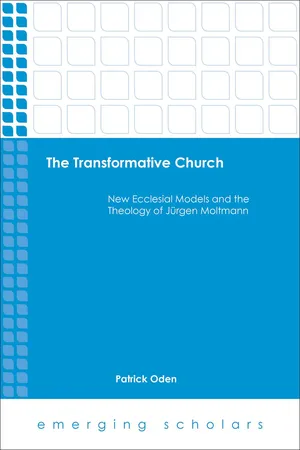
The Transformative Church
New Ecclesial Models and the Theology of Jrgen Moltmann
- 274 pages
- English
- ePUB (mobile friendly)
- Available on iOS & Android
eBook - ePub
About this book
Information
Topic
Theology & ReligionSubtopic
Christian Theology1
Defining Transformative Churches
In early 2003, just when the so-called emerging church was growing in publishing popularity, I burned out with church. Not burned out with ministry in particular, but with the politics and dysfunctions that I had experienced while working in churches. I was not alone. Indeed, such burnout in others helped spark the initial turn toward emerging church models and helped these models attract so much attention. What was curious about my situation is that, just as the emerging church was gaining in attention, I burned out in particular with the emerging church.[1]
I had become involved in new approaches to church in 1991, during my last year in high school. I began to attend what was then the most dynamic church in the area: NewSong, founded by Dieter Zander.[2] It grew out of a college-aged Bible study, beginning in an apartment and then moving to a succession of theaters and gyms as it grew in numbers. The mission was to reach out to “Generation X,” which was seen as a generation alienated from church in general and standard models of Christianity in particular.[3] It was, in some ways, the epitome of the church growth models initiated by Willow Creek, updated for a new generation, seeking to reach out to the unchurched through a shared language and a Sunday service that had appealing elements.
Indeed, the music on Sunday mornings was quite engaging, and the preaching was superb. There was more than this, however. It was not a professional-led community. It was an involved community where college-aged young people were both the target audience and made up the bulk of the voluntary leadership. The people were empowered to engage in ministry as small group leaders, in service to the broader community, and in other ways. I became part of real community of friends, seeking depth together and with God, seeking to reflect this in our whole lives. Other friends became part of two separate church plants, both in nearby cities, where the goals of these new church communities were taking on even more elements of what would later be characterized as the emerging church.[4]
While in seminary, I moved from being a voluntary participant to becoming an intern at NewSong, working with other leaders in small group communities and in developing expressions of participatory worship.[5] This later led to leading a young adult community where the teaching style took on the kind of shared conversation that has later become popular in emerging church circles.[6] All of these experiences were indeed initially very motivating and invigorating, both for my creative interest in ministry and my growth in community with God and with others. Yet the frustrations abounded as well. There were issues in both my own experiences and in the experiences of those I knew who were involved in these protoexpressions of emerging church models.
When Brian McLaren’s A New Kind of Christian, and then Dan Kimball’s book Emerging Churches, popularized for a new audience that which I had been involved with for a number of years, I reacted not with excitement about the new possibilities but with curious ambivalence.[7] These models and insights were not all they claimed to be. They offered a fresh expression but could not seem to sustain themselves without running into their own particular problems, as well as the problems that plague churches in general. With such texts pointing toward a new wave of church renewal, a renewal that I had engaged in and found wanting, I became disillusioned with both the emerging church movement and with church ministry in general. Where was I to turn? The prophet Jeremiah seemed to have words for me: “Thus says the Lord: Stand at the crossroads, and look, and ask for the ancient paths, where the good way lies; and walk in it, and find rest for your souls.”[8]
I left NewSong, and left ministry in general, moving to the mountains for an extended time, where I read Scripture anew, the early church fathers, as well as monastic writings such as the four volume Philokalia and John Cassian.[9] After a while, I began turning to more contemporary theologians whom I discovered while in seminary. I dove into Pannenberg’s Systematic Theology and other writers, not for philosophical information but because their studies of God were devotional for my soul. I was seeking depth and breadth in my parched faith. Fuller Seminary offered a class on Moltmann, which I audited, and with this course as a guide, I read all of his major works—having only read a couple texts prior to this. Early on in such reading, I was struck by a very curious insight. What Moltmann was discussing in his systematic theology was very similar to the kinds of discussions I had heard in emerging church circles. Moltmann was certainly more robust, yet the discussion was oriented in the same basic direction. With this realization, Moltmann revived my interest in the emerging church conversation, a conversation he had never heard about, yet he seemed to be sharing many similar themes and priorities.[10] How so? The answer to that question is the basis of this study.
Purpose and Thesis
The purpose of this present work is to develop in writing that which more instinctively occurred to me while reading—namely, that there is a vital connection between the practices of these new model churches and the theology of Jürgen Moltmann. Over the last few years, this connection has become even clearer. Indeed, even as Moltmann revived my interest in emerging church possibilities, the emerging church itself has continued to develop, honing and expanding the discussion, bringing together other similar ecclesial streams into a more cohesive expression—one to which I will, for the sake of simplicity, apply the term transformative churches. What does it mean to be a transformative church? Two elements orient my overall purpose. A church is transformative when it engages in the development of people to better reflect the life of Christ in their lives, and when this transformation then extends itself beyond the boundaries of a church community, as such people live their lives in new ways wherever they are.
It is this, then, that forms the basis of my thesis throughout the present work: we become in the church who we are to be in the world. This understanding of a transformative mission of the kingdom is, I assert, at the heart of both Moltmann’s theological project and the ecclesiological project of transformative churches.
There are two possible approaches to participatory and communal transformation, each of which we can find in both church history and contemporary theology. One is the sectarian approach, in which the religious community develops a distinct boundary between itself and the surrounding world, ideologically and often geographically. This religious community is able to develop within itself the transformative ideals that can be, then, a model to those outside of its boundaries. They do not necessarily exclude others, but may seek to include, indeed invite, them to participate. This then requires their full transition from one mode of being in the world and inclusion into the boundaried community. The second approach is an embedded system. Here, the religious community provides an orientation that is to be lived within the broader community. The church its own separated reality but a participant in the mission of God, which is open to all, and intended to be a transformative reality for all contexts.
Both Moltmann and the transformative churches express the second, embedded, model of church community. Indeed, Moltmann is especially wary about any division whatsoever between the church and the world. He argues that the world is in the church and good things are found in the world.[11] Yet, in general, there are still two contradictory forms of identity expressed in the world: that of God and that of not-God. This means that the church has a formative function even in the nonsectarian approach, which becomes about orienting people how to live in the world rather than how to live separated from the world. We become in the church who we are to be in the world.
This is a nondivisive distinction, utilizing the terms church and world not as separated, or inherently antagonistic, “cities,” but as differentiated levels of community. The church cannot be opposed to the world any more than a school of fish can be opposed to water; it is the milieu in which it expresses its reality. The church, however, is a necessary distinction as an identity-establishing system within the world that contrasts with other identity-establishing systems.[12] Such alternative identity-establishing systems create meaning and offer alternative forms of identity that are likewise both communal and participatory.[13] We can characterize these other systems by such terms as world or flesh in Scripture. However, these are used more as reductionist labels expressing the gathered multiplicity of alternatives to God’s Kingdom rather than inherently opposed to the more precisely defined flesh and world, both of which God made. God’s reality is the defining reality and God’s reality gives meaning to the form of community, and the expression of identity, within the church. We should not take the world more seriously than the God who seeks to redeem it. We should not see the world as an inherently unclean setting. When Jesus encountered the lepers, they were made clean. He transformed the setting. The church, as the body of Christ, is not an object that can be gazed upon as the model for the world; it is a collection of participants in whom the Spirit of God is forming the expression of the fullness of Christ, as individuals with each other, in this present reality we call the world.
This means, I assert, that the church is not the subject of God’s work, nor is it the object that gives formative meaning and contrast. The church exists as the church of Christ only inasmuch as the participants are being formed into the likeness of Christ, expressing this likeness in a multiplicity of ways in diverse settings. This expression is not simply about being a model for how to live, nor is it merely a particular set of ethics or moral expressions that contrast with deficient models. As a participant with Christ, in the Spirit, a person who is being formed into the likeness of Christ becomes a domain of resonance of Christ, resonating the reality of Christ in distinct practices but also in participatory presence.[14] Thus, a person who gathers with others likewise oriented reverberates the resonance of Christ in a community. This community can exist on many scales, from the local to the regional to the global to the cosmic. The self-similarity with Christ expands into a self-similar fractal across larger scales, beginning in Christ, and then in the one form...
Table of contents
- Cover
- Additional Praise for The Transformative Church
- Title Page
- Copyright
- Dedication
- Table Of Contents
- Acknowledgements
- Abbreviations
- Defining Transformative Churches
- Transformation in Historical Perspective
- Transformation in Anthropological Perspective
- Transformation in Trinitarian Perspective
- Practices of a Transforming History
- Practices of a Transforming Anthropology
- Practices of a Transforming Trinitarianism
- Conclusion
- Bibliography
- Index
Trusted by 375,005 students
Access to over 1.5 million titles for a fair monthly price.
Study more efficiently using our study tools.
Frequently asked questions
Yes, you can cancel anytime from the Subscription tab in your account settings on the Perlego website. Your subscription will stay active until the end of your current billing period. Learn how to cancel your subscription
No, books cannot be downloaded as external files, such as PDFs, for use outside of Perlego. However, you can download books within the Perlego app for offline reading on mobile or tablet. Learn how to download books offline
Perlego offers two plans: Essential and Complete
- Essential is ideal for learners and professionals who enjoy exploring a wide range of subjects. Access the Essential Library with 800,000+ trusted titles and best-sellers across business, personal growth, and the humanities. Includes unlimited reading time and Standard Read Aloud voice.
- Complete: Perfect for advanced learners and researchers needing full, unrestricted access. Unlock 1.5M+ books across hundreds of subjects, including academic and specialized titles. The Complete Plan also includes advanced features like Premium Read Aloud and Research Assistant.
We are an online textbook subscription service, where you can get access to an entire online library for less than the price of a single book per month. With over 1.5 million books across 990+ topics, we’ve got you covered! Learn about our mission
Look out for the read-aloud symbol on your next book to see if you can listen to it. The read-aloud tool reads text aloud for you, highlighting the text as it is being read. You can pause it, speed it up and slow it down. Learn more about Read Aloud
Yes! You can use the Perlego app on both iOS and Android devices to read anytime, anywhere — even offline. Perfect for commutes or when you’re on the go.
Please note we cannot support devices running on iOS 13 and Android 7 or earlier. Learn more about using the app
Please note we cannot support devices running on iOS 13 and Android 7 or earlier. Learn more about using the app
Yes, you can access The Transformative Church by Patrick Oden in PDF and/or ePUB format, as well as other popular books in Theology & Religion & Christian Theology. We have over 1.5 million books available in our catalogue for you to explore.