eBook - ePub
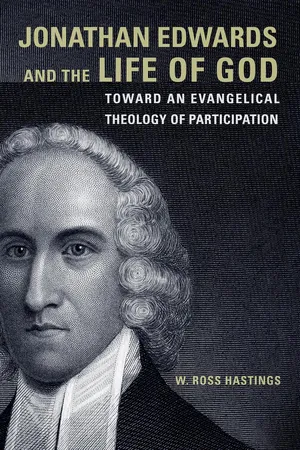
Jonathan Edwards and the Life of God
Toward an Evangelical Theology of Participation
- 448 pages
- English
- ePUB (mobile friendly)
- Available on iOS & Android
eBook - ePub
Jonathan Edwards and the Life of God
Toward an Evangelical Theology of Participation
About this book
Jonathan Edwards and the Life of God aims to offer a retrieval of Edwards's theology of participation for contemporary evangelical theology. It critically expounds and elucidates the concept of participation in God, or theosis, in Edwards's Trinitarian theology as it relates to around three unions: the three persons of the Trinity, the hypostatic union of the divine and human in Christ, and that of believers with Christ. This volume brings Edwards's rich theological work into conversation with the patristic (Augustine and the Cappadocians) and Reformed traditions (Calvin and, especially, Barth), in order to construct with Edwards a more hopeful, liberating, and truly human version of Christian life. Consideration of the life of God in Edwards thus moves "beyond" in two senses: first, perspectives on participation beyond those of Edwards from Barth, Volf, the Cappadocian Fathers, and others in the tradition, are engaged in order to locate and critique and enhance it; and secondly, in the sense that, as Hastings argues, participation leads, for Edwards and others, into the "beyond" of the beatific vision—the glory of God, which is the hope that, amongst other things, motivates the Christian life.
Information
Topic
Teología y religiónSubtopic
Teología cristiana3
A Journey yet Deeper into the Union of the Trinity
If we are impressed by Edwards’s confident defense of the Trinity and his commitment to the triune nature of God as intrinsic to who God is, and if we are convinced of his belief in its importance to Christian theology and practice, we might be inquisitive concerning Edwards’s precise understanding of the Trinity. When he sought to elucidate the inner life of God, what did this reveal? In the discussion that follows, we will examine these five salient questions, four of which will be addressed in the present chapter and the fifth in the following chapter:
1. How is the essence (ousia) of the Godhead related to the persons (hypostases)?
2. Is the Trinitarian essence of God substantial or dispositional?
3. How are the persons to be understood with respect to their eternal origin?
4. Is the manner in which the persons and the communion/essence relate to be understood in a social way or by way of a psychological analogy, which is to say, are the influences on Edwards’s Trinity Western or Eastern—or a cobbled mix of both?
5. What particular role does the Holy Spirit play within the Trinity, and why is this so important to Edwards’s salvation theology?
While it would be ideal to offer a detailed, systematic exegesis of the original sources in Edwards that guide our grappling with these questions, space forbids it. We can only list these primary sources and an occasional comment indicating what they contribute to the discussion. The scope of our analysis begins with Edwards’s earliest work in The Mind (“Excellency”), in which he attempts to show the logical necessity of the ontological Trinity. Edwards surmises that excellence in God, to whom one must attribute complex beauty, requires harmony, but for harmony to exist, there must be “consent” and therefore a plurality of persons.[1] We next move to Miscellany 94[2] (overcoming the objection of tritheism), on to the later work of Miscellany 308,[3] then to “On the Equality of the Persons of the Trinity,”[4] and most definitively “The Discourse on the Trinity”[5] or “Essay”[6] (overcoming the objection of depersonalization), which was published posthumously.
In the “Equality” fragment, Edwards’s desire to give honor to the Spirit in the Trinity is very evident, to the extent that Lee offers this editorial comment: “Edwards makes a clear departure from the Western tradition and sets forth a remarkably original conception of the Holy Spirit within the Trinity.”[7] Here, Edwards speaks of the Spirit as more than the bond of love—as an “active agent” and as one who “reigns,” “governs,” and “influences” the other two persons of the Trinity. A detailed account of two key aspects of Edwards’s theology of the Trinity can be found in “Equality”: (1) Edwards’s innovative Trinitarian and idiosyncratic approach to the simplicity of God, in which the divine persons of the Trinity are individuated by subsuming some of the divine perfections (the “real” attributes of memory, understanding and love) in individual persons of the Trinity and other perfections (“relations of existence”) in the divine essence; and (2) the invoking of a perichoresis (though he does not use that term) at the level of procession to resolve the issue of the unity of the Godhead as well as the integrity of each person as a person.
As Strobel suggests,[8] Edwards’s primary concern in the “Discourse” is apologetic regarding personhood—how God can be one person and also three. He notes a shift in Edwards’s thought after Miscellany 308 (also evident in the “Discourse”) away from the thought of a pre-existent essence that is meted out to the persons, who are constitutive of the divine essence. The integrity and “threeness” of personhood is also maintained by a processional perichoresis, such that the “real” attributes of each are “predicable one of another.”[9] The “Essay” also places particular emphasis on the Spirit as person, who as Love not only imparts love to the Father and Son but who also defines the unity of the Godhead: “So the Holy Ghost or the divine essence subsisting is divine, but understands because the Son the Divine Idea is in Him.”[10] This statement supplies further evidence of the high place the Spirit occupies in Edwards’s ontology; additional reference will be made to these sources as we proceed.
1. How Is the Essence (Ousia) of the Godhead
Related to the Persons (Hypostases)?
McClymond and McDermott write that “Edwards usually started his doctrine of God with the divine Three rather than the divine essence, perhaps because starting with God’s essence suggests there is something impersonal in God before the three Persons.”[11] If this is true (as I think it is), Edwards is quite similar to Karl Barth in this regard—the twentieth-century theologian responsible for the return of the church to its affirmation of the Trinity’s centrality (the circumference and architectonic of its theology) after “Enlightened” theologians like Schleiermacher had marginalized it. Barth is eloquent and forceful on the idea that no God “in back of” the Trinity exists, such as a mysterious unrevealed essence that would make God a Quaternity. For Barth, the revealed God is the real God, if he is a God to be trusted. He is the God and Father of our Lord Jesus Christ, revealed in the advent of the Son by the sending of the Spirit.
Regrettably, however, Barth’s insistence that who God is in Godself (in se)—indeed, the God of the revealed Trinity (pro nobis), the God of the gospel—did not quite translate into a clear expression of the nature of the divine Three as persons. Reticence about our ability to say “three persons” can be traced back to Augustine and is related to his avoidance of tritheism. This practice continues in the Western tradition through Thomas Aquinas, who only speaks of “modes of subsistence,” and Barth, who opts for “modes of being” (Gk. Seinsweisen) over persons, particularly because he believes that the traction of the term “person” in the Western world connotes “individual.” Notwithstanding, all that Barth contributes to the recovery of the Trinitarian center of Christian theology, he stops short of validating the concept of perichoretic personhood,[12] which was motivated by his desire to protect the unity of the Godhead as one Divine subject, an influence of Hegelian Idealism.[13] In the West, this trend comes to roost in the expression of God as three “persons as relations” in the work of Pope Benedict XVI. Miroslav Volf references this idea in his elucidating comparison of the three main traditions of thought with respect to the Trinity and their corresponding ecclesiologies: the Orthodox (social Trinity, with the Father as ontological font), the Catholic (psychological Trinity, with the Father as logical font), and the Free Church (social Trinity, with the eternal communion (koinõnia) as font, similar to Athanasius). In contrast with Benedict’s view, Volf points out the phrase “persons in relation,” which both the Orthodox and the Free Church social Trinitarians can affirm, and suggests this idea to be more in keeping with Cappadocian thought.[14]
In contrast to Barth and Benedict, Edwards did not hesitate to speak of personhood. His fragment was suitably given the title “On the Equality of the Persons of the Trinity,”[15] in which he champions the equality of the persons based on their common divine essence and affirms the Trinity on the grounds that even though each person has distinct glories, “the personal glory of each of the persons of the Trinity is equal.”[16] That is, the sum of their glories is equal in each case. His “Essay” or “Discourse” on the Trinity expresses the same clear articulation of personhood. Elsewhere, Edwards stresses that each of the divine persons is “every way equal in the society or family of the Three.”[17]How he articulates the individuation of the persons has been a matter of great controversy, as we shall shortly see, but the fact that he is comfortable with the notion that the Three persons constitute the sum and substance of the essence of God is not in question. In this respect, Edwards is Cappadocian in his sentiments. He would have agreed with John Zizioulas, who describes personhood as the “great innovation in philosophical thought, brought about by Cappadocian Trinitarian theology,” which, in turn, “carries with it decisively a new way of conceiving human existence.”[18] Edwards is also in line with the helpful term used by Volf to reflect the social Trinitarian view, which is more akin to the Cappadocian roots of the doctrine in respect to personhood.[19] Volf spea...
Table of contents
- Cover
- Additional Praise for Jonathan Edwards and the Life of God
- Title Page
- Copyright
- Dedication
- Table Of Contents
- Acknowledgements
- Chronology of the Primary Works of Edwards
- Introduction
- A Journey of Participation
- A Journey into the Union of the Trinity
- A Journey yet Deeper into the Union of the Trinity
- A Journey into the Bond of the Trinity
- Journey from Heaven to Earth
- Journey of Human Participation in God
- Participation in the Spirit in Justification for Sanctification or for Sanctification and Justification?
- Journey with Assurance?
- Journey of Contemplative, Communal Intimacy towards Becoming Fully Human Persons in Christ
- Bibliography
- Index of Names
- Index of Subjects
Trusted by 375,005 students
Access to over 1.5 million titles for a fair monthly price.
Study more efficiently using our study tools.
Frequently asked questions
Yes, you can cancel anytime from the Subscription tab in your account settings on the Perlego website. Your subscription will stay active until the end of your current billing period. Learn how to cancel your subscription
No, books cannot be downloaded as external files, such as PDFs, for use outside of Perlego. However, you can download books within the Perlego app for offline reading on mobile or tablet. Learn how to download books offline
Perlego offers two plans: Essential and Complete
- Essential is ideal for learners and professionals who enjoy exploring a wide range of subjects. Access the Essential Library with 800,000+ trusted titles and best-sellers across business, personal growth, and the humanities. Includes unlimited reading time and Standard Read Aloud voice.
- Complete: Perfect for advanced learners and researchers needing full, unrestricted access. Unlock 1.5M+ books across hundreds of subjects, including academic and specialized titles. The Complete Plan also includes advanced features like Premium Read Aloud and Research Assistant.
We are an online textbook subscription service, where you can get access to an entire online library for less than the price of a single book per month. With over 1.5 million books across 990+ topics, we’ve got you covered! Learn about our mission
Look out for the read-aloud symbol on your next book to see if you can listen to it. The read-aloud tool reads text aloud for you, highlighting the text as it is being read. You can pause it, speed it up and slow it down. Learn more about Read Aloud
Yes! You can use the Perlego app on both iOS and Android devices to read anytime, anywhere — even offline. Perfect for commutes or when you’re on the go.
Please note we cannot support devices running on iOS 13 and Android 7 or earlier. Learn more about using the app
Please note we cannot support devices running on iOS 13 and Android 7 or earlier. Learn more about using the app
Yes, you can access Jonathan Edwards and the Life of God by W. Ross Hastings,W. Ross Hastings in PDF and/or ePUB format, as well as other popular books in Teología y religión & Teología cristiana. We have over 1.5 million books available in our catalogue for you to explore.