eBook - ePub
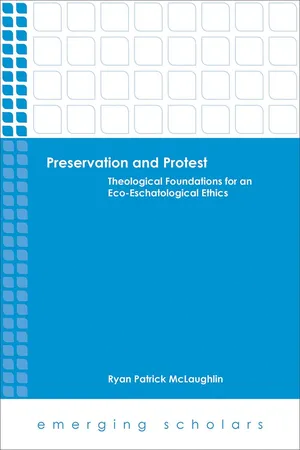
Preservation and Protest
Theological Foundations for an Eco-Eschatological Ethics
- 240 pages
- English
- ePUB (mobile friendly)
- Available on iOS & Android
eBook - ePub
Preservation and Protest
Theological Foundations for an Eco-Eschatological Ethics
About this book
Preservation and Protest proposes a novel taxonomy of four paradigms of nonhuman theological ethics by exploring the intersection of tensions between value terms and teleological terms. These tensions arise out of the theological loci of cosmology, anthropology, and eschatology. The individual paradigms of the taxonomy are critically elucidated through the work of Thomas Aquinas, Thomas Berry, Dumitru St?niloae, and Jürgen Moltmann and Andrew Linzey. McLaughlin systematically develops the paradigm of cosmocentric transfiguration, arguing that the entire cosmos—including all instantiations of life therein—shares in the eschatological hope of a harmonious participation in God's triune life, a participation that entails the end of suffering, predation, and death. This paradigm yields an ethics based upon a tension between preservation and protest. With this paradigm, McLaughlin offers an alternative to anthropocentric and conservationist paradigms within the Christian tradition, an alternative that affirms both scientific claims about natural history and the theological hope for eschatological redemption.
Information
Subtopic
Théologie chrétienne2
Cosmocentric Transfiguration in the Theologies of Jürgen Moltmann
and Andrew Linzey
Part II Introduction
Part II will develop basic parameters of cosmocentric transfiguration by critically engaging and comparing the work of Jürgen Moltmann and Andrew Linzey. While Moltmann and Linzey are contemporaries, there is very little engagement between them. To my knowledge Moltmann never engages Linzey’s work. Linzey does engage Moltmann, but very rarely and never in any great detail.
This lack of engagement is lamentable as Moltmann and Linzey complement one another well. Moltmann thrives in theological ingenuity but is rather non-concrete (and inconsistent) in his ethics. Linzey’s ethics are, more often than not, specific and definite. However, he tends to be less developed in his theological explorations than Moltmann. Collectively, they provide a solid theological and ethical vision of cosmocentric transfiguration.
A brief overview of each thinker here will introduce part II.
Jürgen Moltmann
“If I have theological virtue at all, then it is one that has never hitherto been recognized as such: curiosity.”[1] This sentence provides an insight into Jürgen Moltmann’s (b. 1926) methodology, which is unapologetically subjective, personal, dialogical, and experimental.[2] Even so, Moltmann’s influence on the landscape of theology in the twentieth century and today can hardly be overstated. His seminal work, Theology of Hope, launched him into international recognition, and his following works have not disappointed in their ingenuity.
Moltmann’s first three works—Theology of Hope (1965),[3]The Crucified God (1973), and The Church in the Power of the Holy Spirit (1975)—each “look at theology as a whole from one particular standpoint.”[4] In his later six volume set, he seeks to make contributions to theological themes pertinent to systematic theology without constructing a concrete system.
I now viewed my “whole” as a part belonging to a wider community, and as my contribution to theology as a whole. I know and accept the limits of my own existence and my context. I do not claim to say everything.[5]
This set of contributions includes, in order of publication, Trinity and the Kingdom (1980), God in Creation (1985), The Way of Jesus Christ (1989), The Spirit of Life (1991), The Coming of God (1995), and Experiences in Theology (2000). Moltmann has of course written many other works, the most recent of which, Ethics of Hope (2010), he refers to as “the close of my contributions to theological discussions.”[6]
Moltmann’s influences are vast and diverse.[7] He is quite impacted by Jewish thought, both in thinkers like Ernst Bloch, Franz Rosenzweig, Martin Buber, and Abraham Heschel; and in Kabbalism. His affiliation with Bloch evinces Moltmann’s debt to Karl Marx—a debt further evident by his affinity with the Frankfurt School.[8] He was instructed by both Karl Barth and Karl Rahner. His biblical scholarship bears the marks of Gerhard von Rad.[9] His works evince dialogue with contemporary theologians such as Wolfhart Pannenberg and Hans Urs von Balthasar.[10] In later works especially, he is heavily influenced by Eastern Orthodox theology.[11] Finally, it must be said that Moltmann has been influenced by his own life experience, including his stint as a German soldier in World War II.[12] Ultimately, Moltmann’s theology is an experiential and thus subjective contribution amidst the great community of theologians and thinkers to whom he acknowledges his indebtedness.
Andrew Linzey
Throughout his career, Linzey acknowledges that his work entails a “continued wrestling” that requires ongoing development.[13] Those who read individual works of his without referring to other installments in his extensive corpus often miss these developments along with nuances of his thought.[14] I do not pretend to engage everything Linzey has written. I do, however, take close account of the major works he has authored.[15] These works include Animal Rights (1976), Christianity and the Rights of Animals (1987), Animal Theology (1994), After Noah (1997), Animal Gospel (1998), Creatures of the Same God (2007), and Why Animal Suffering Matters (2009).[16]
Linzey has many influences. He acknowledges his debt to the animal welfare movement in general.[17] He is also influenced by particular ethical and theological voices, including Rosalina Godlovitch, whom Linzey suggests may be “the intellectual founder of the modern animal movement”[18]; Karl Barth, whose theology constituted the center of Linzey’s dissertation; Albert Schweitzer, whose “reverence for life” Linzey describes as “the most penetrating contribution made to our subject [i.e., animal rights] by a person from within the Christian Tradition”[19]; Dietrich Bonhoeffer, to whom Linzey credits the genesis of his notion of theos-rights[20]; Tom Regan, whose “intellectual grasp” regarding issues surrounding the rights of nonhuman animals, is, for Linzey, “without rival in the movement.”[21] Linzey also draws upon central thinkers of the Christian tradition, though mostly from the East.[22]
Linzey currently holds the International Fund for Animal Welfare’s Senior Research Fellowship at Mansfield College, Oxford, which is directed specifically toward Christian theology and animal welfare. His post is the first of its kind. He also is the founder and director of the Oxford Centre for Animal Ethics, “an international and multi-disciplinary center at Oxford dedicated to the ethical enhancement of the status of animals through academic research, teaching, and publication.”[23] While mainly an animal theologian/ethicist, Linzey has also published on child rights, human violence, embryonic research, and justice for homosexuals.[24]
- Jürgen Moltmann, The Coming of God: Christian Eschatology, trans. Margaret Kohl (Minneapolis, MN: Fortress Press, 1996), xiv. ↵
- See Jürgen Moltmann, Experiences in Theology: Ways and Forms of Christian Theology, trans. Margaret Kohl (Minneapolis, MN: Fortress Press, 2000). ↵
- These parenthetical dates reflect the year of the original German publication.↵
- Jürgen Moltmann, The Trinity and the Kingdom: The Doctrine of God, trans. Margaret Kohl (Minneapolis, MN: Fortress Press, 1993), xi.↵
- Moltmann, Trinity and the Kingdom, vii.↵
- Jürgen Moltmann, Ethics of Hope (hereafter EH...
Table of contents
- Cover
- Title Page
- Copyright
- Table Of Contents
- List of Tables and Illustrations
- Acknowledgements
- Preface
- Introduction
- A New Taxonomy of Nonhuman Theological Ethics
- Cosmocentric Transfiguration in the Theologies of Jürgen Moltmann and Andrew Linzey
- Toward an Eco-Eschatological Ethics of Preservation and Protest
- Conclusion
- Bibliography
- Index
Trusted by 375,005 students
Access to over 1.5 million titles for a fair monthly price.
Study more efficiently using our study tools.
Frequently asked questions
Yes, you can cancel anytime from the Subscription tab in your account settings on the Perlego website. Your subscription will stay active until the end of your current billing period. Learn how to cancel your subscription
No, books cannot be downloaded as external files, such as PDFs, for use outside of Perlego. However, you can download books within the Perlego app for offline reading on mobile or tablet. Learn how to download books offline
Perlego offers two plans: Essential and Complete
- Essential is ideal for learners and professionals who enjoy exploring a wide range of subjects. Access the Essential Library with 800,000+ trusted titles and best-sellers across business, personal growth, and the humanities. Includes unlimited reading time and Standard Read Aloud voice.
- Complete: Perfect for advanced learners and researchers needing full, unrestricted access. Unlock 1.5M+ books across hundreds of subjects, including academic and specialized titles. The Complete Plan also includes advanced features like Premium Read Aloud and Research Assistant.
We are an online textbook subscription service, where you can get access to an entire online library for less than the price of a single book per month. With over 1.5 million books across 990+ topics, we’ve got you covered! Learn about our mission
Look out for the read-aloud symbol on your next book to see if you can listen to it. The read-aloud tool reads text aloud for you, highlighting the text as it is being read. You can pause it, speed it up and slow it down. Learn more about Read Aloud
Yes! You can use the Perlego app on both iOS and Android devices to read anytime, anywhere — even offline. Perfect for commutes or when you’re on the go.
Please note we cannot support devices running on iOS 13 and Android 7 or earlier. Learn more about using the app
Please note we cannot support devices running on iOS 13 and Android 7 or earlier. Learn more about using the app
Yes, you can access Preservation and Protest by Ryan Patrick McLaughlin in PDF and/or ePUB format, as well as other popular books in Théologie et religion & Théologie chrétienne. We have over 1.5 million books available in our catalogue for you to explore.