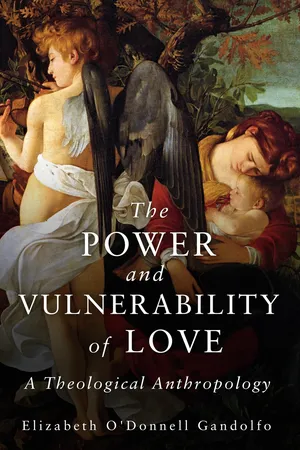
What is it about human beings that makes us capable and even desirous of inflicting terrible suffering on others (and ourselves)? If human beingsnot Godare the cause of evils such as extreme poverty, violence, and oppression, it is imperative that we probe the depths of the human heart to uncover why we, who are made in the image of Divine Eros, fail so miserably to love. Gandolfo constructs a theological anthropology in response to these pivotal questions. Gandolfo maintains that such an anthropologyand a response to these questionsbegins with the condition of human vulnerability. Drawing on womens experiences of maternity and natality, she argues that vulnerability is a dimension of human existence that causes us great anxiety, which in turn sets in motion tragic attempts by individuals and interest groups to eliminate their own vulnerability at the cost of vulnerable others. Yet vulnerability not only forms the basis for violence but also affords the possibility of human openness to the redemptive work of divine love. Poised paradoxically between tragic and redemptive vulnerability, human beings need existential resources and empowering practices to cope with and manage our vulnerability in more courageous, peaceful, and compassionate ways.
eBook - ePub
The Power and Vulnerability of Love
A Theological Anthropology
- 224 pages
- English
- ePUB (mobile friendly)
- Available on iOS & Android
eBook - ePub
About this book
Information
Topic
Theology & ReligionSubtopic
Christian Theology1
The Vulnerability of the Human Condition
1
The Fundamentals of Human Vulnerability
Embodiment and Interrelationality
You never stop feeling sorrow for your children. . . . The one that was most painful was my eight month old girl who was still nursing. I felt my breasts full of milk, and I wept bitterly. . . . Today I can tell the story, but in that moment I was not able to; I had such a knot and a pain in my heart that I couldn’t even speak. All I could do was bend over and cry.
~ Rufina Amaya, sole eyewitness survivor of the Salvadoran massacre at El Mozote in which she lost four children[1]
~ Rufina Amaya, sole eyewitness survivor of the Salvadoran massacre at El Mozote in which she lost four children[1]
. . . she was so beautiful. . . . Yeah, like, she’s very, very, um. She’s special. I don’t know. She, ‘cos because she, she brought out a hell of a lot of love in people. People could look at her and say, oh she’s lovely. She brought out a hell of a lot of love out of people.
~ Sam, working-class British mother, commenting on her young daughter[2]
~ Sam, working-class British mother, commenting on her young daughter[2]
In all of their diversity, mothers throughout history and across markers of racial, socio-economic, cultural, and sexual difference have experienced and embodied in their very flesh the stark contradictions of the human condition. Existence in this world of ours encompasses life and death, joy and grief, love and loss, harmony and conflict, creativity and confusion. This “coincidence of opposites”[3] endemic to human life is part and parcel of what Wendy Farley calls “the tragic structure” of finite existence, in which “the very structures that make human existence possible make us subject to the destructive power of suffering.”[4] Women’s diverse experiences of maternity and natality, suffused as they are with painful ambiguities, provide particularly powerful icons[5] of our tragic condition and the inevitability of vulnerability that it entails.
In this chapter and the one that follows, I argue that the dual realities of maternity and natality, the matrix in which we all have our origins, point to several defining characteristics of human existence: finite embodiment, relational interdependence, perishing, and ambiguity. Borrowing a term from Edward Schillebeeckx, I call these dimensions of human life “anthropological constants”—that is, constitutive conditions of human existence across culture, time, and space.[6] Like Schillebeeckx, I argue that there are certain dimensions of the human condition that are inherent to being human and therefore must be honored as the system of coordinates within which human beings experience redemption. The features of being human that I highlight here make up the conditions for the possibility of life itself, and of experiencing grace as healing, love, and joy in human life. Unlike Schillebeeckx, however, I assert that each of these anthropological constants is also a source of our inherent exposure to the ever-present possibility of harm. I stress that human happiness—understood in the Aristotelian sense of eudaimonia, or flourishing—is only possible working within the confines of our vulnerable condition. This renders our earthly telos contingent and vulnerable to destruction. In other words, however much Christians hope for healing and fulfillment beyond this veil of tears, human flourishing in the here and now is a fragile and fortunate and limited experience—a “lucky pane of glass”[7] that is all too easily shattered.
An analysis of motherhood and the human condition might begin differently. It might begin by insisting, as liberation and feminist theorists rightly do, that vulnerability—maternal or otherwise—and the suffering it entails are not inevitable features of the human condition. For example, the suffering of a woman like Rufina Amaya, whose maternal grief is highlighted in the epigraph to this chapter, is not an outcome of the universal frailty of human life, but rather the direct result of social and economic structures that privilege an elite minority who will stop at nothing (not even bayoneting babies) to maintain their positions of power. At the same time, the pride and affection with which Sam regards her child is not a “natural” occurrence rooted in biological destiny. Rather, it is a socially constructed phenomenon that can serve to uphold the patriarchal institution of motherhood. Adrienne Rich makes this very objection to understanding maternal affection and affliction as simply part of the human condition:
But, it will be said, this is the human condition, this interpenetration of pain and pleasure, frustration and fulfillment. I might have told myself the same thing, fifteen or eighteen years ago. But the patriarchal institution of motherhood is not the “human condition” any more than rape, prostitution, and slavery are. (Those who speak largely of the human condition are usually those most exempt from its oppressions—whether of sex, race, or servitude.)[8]
As a feminist theologian whose theological roots run deep in the soil of liberation theology, I share the conviction that forms of vulnerability resulting from oppression, violence, and injustice are by no means a direct or necessary result of universal human vulnerability. The ways in which we have organized social, economic, political, cultural, sexual, and family life are profoundly unjust and should never be justified as a natural outcome of the human condition. To do so, especially in the realm of theology, would be to resacralize an unjust world order that liberationists and feminists have toiled so hard to unmask as an idolatrous and unnecessary social construction. Suffering is not the divine will and the world need not be organized according to the laws of raw power, domination, and violence. As human beings we are free, and even obligated, to struggle for a change in the world order.
What liberationist and feminist approaches can tend to overlook, however, is the liberating potential of analyzing the root causes of suffering located deep in the human condition itself. In these first two chapters, I go deeper than a social critique of oppression will allow (however necessary such critique may be), and uncover the structures of human existence—the anthropological constants—that a priori render us vulnerable to suffering. There are features of our condition that are essential to human being in the world, and indeed are essential to the pursuit of human happiness. But these same dimensions of our existence expose us to a broad spectrum of suffering, from discomfort to pain to horrors, degradation, and ultimately death. In chapters 3 and 4 it will become clear that our inability to cope with our vulnerable condition and the suffering it entails both arises from and exacerbates the problem, since we often violate the vulnerability of others and ourselves in an attempt to deny, scapegoat, project, and protect ourselves from our own vulnerability to suffering.
In what follows, I draw on women’s diverse experiences of maternity and natality in order to lay out the anthropological constants that result in human vulnerability, defined here as the ever-present possibility of harm, pain, and suffering. I proceed with trepidation, given the dangers of positing anything universal about human nature. But I also proceed with confidence in the importance of the maternal perspectives that will be my guide and main resource in this anthropological endeavor. The maternal has been simultaneously revered and feared in Western thought and culture due to both its awesome creative power and its perilous proximity to the vulnerability that plagues our condition.[9] I do not intend to reinscribe forms of gender essentialism that identify women’s nature with motherhood or motherhood with vulnerability. Rather, I posit that mothers’ lives have historically, empirically, been so vulnerable—due to the interaction of biology and social imposition—that their own varied experiences of suffering and their diverse perspectives on the vulnerability of natal life can provide us with privileged clues regarding the universality of vulnerability in the human condition as a whole.
The in-depth description and analysis of human vulnerability that I offer here is more anthropological than theological. That is, I do not use explicitly Christian categories or metaphors such as sin, bondage, or woundedness to describe our condition. Nor do I attempt to rationalize why a benevolent and omnipotent God would choose to create a world in which evil and suffering are not only possibilities but inevitabilities. Rather, I take it for granted, in the words of Marilyn McCord Adams, that “God has created us radically vulnerable to horrors, by creating us as embodied persons, personal animals, enmattered spirits in a material world of real or apparent scarcity such as this.”[10] In an attempt to unpack the anthropological reality behind this statement, I argue that the anthropological constants of existence in this world inexorably expose us to the unavoidable possibility of harm. This detailed examination of the human condition will lay the necessary groundwork for the theological and practical reflections on suffering and redemption to follow in parts 2 and 3. Taking account of the human condition exposes the problem to which Christianity must respond with theological and practical assets for resilience and resistance. Before we can begin to understand those assets, however, we need a clearer picture of the predicament they are intended to address. It is to that predicament—the fragility of the human condition and, ultimately, of human happiness—that we now turn, with experiences of maternity and natality to light the way.
Finite Embodiment: Vulnerability to Physical Harm
It’s a personal plague, this illness, this childbearing. . . . I wonder how it will be for me: if what’s inside me is a source of grief and trouble, how will I survive? What might happen? That’s what comes to me now. . . . Maybe I’ll die. Or maybe I’ll live. How will it be? What will happen to me? That’s what comes to me now; that’s what’s in this heart-and-mind of mine. . . . my heart-and-mind hurts! I hurt and a crying need overcomes me and then I cry. I cry.
~Nepali woman in her ninth month of pregnancy with her third child[11]
~Nepali woman in her ninth month of pregnancy with her third child[11]
The female reproductive system does not destine women to a life of childbearing, but women who desire to bear children (“successful” or not) and women who do bear children (by “choice” or not) are subject to the possibility of unique and frightening forms of suffering, up to and including death. The fetal and natal bodies of their children are also vulnerable to a whole host of possible harms, from genetic disorders to negative effects of environmental toxins to miscarriage, stillbirth, and infant/early childhood death. Focusing our attention on the vulnerability of maternal and natal embodiment reveals the first anthropological constant: embodiment. The embodied nature of maternity and natality reminds us of our own fragile origins, as well as our continued exposure to bodily harm, suffering, and, ultimately, our unavoidable mortality. Engaging maternal and natal embodiment can put us in touch with the fact that, in Farley’s words, “[e]mbodiment in a natural, material world may be the most basic feature of human life, but it subjects human beings to an assortment of dangers and suffering.”[12] The maternal has been feared and reviled in large part because of its connection with the dangers and suffering of embodiment. The time is ripe to face our anxiety with a realistic account of just how vulnerable we—and all of our fellow human beings—are as finite, embodied creatures.
Kathryn S. March, a feminist anthropologist who studies the lives of rural Nepali women and who herself has suffered infertility and pregnancy loss, writes in her narrative, “Childbirth with Fear,” that “[i]n childbearing, whether from the charged perspective of modern professional women or from distant rural lifeways, bad things will happen to many of us, whether or not we are brave.”[13] Due to vast social inequalities that result in unequal access to pre- and post-natal care and modern medical technology, many more bad things are likely to happen to most of the world’s women than to the minority of us who enjoy the protections of privilege. However, the fact remains that women’s pregnant and post-partum bodies expose them (and their babies) to the possibility of a vast array of risks, including severe discomfort, pain, illness, disability, and even death. Even under the best of circumstances, where medical interventions are readily available, it is impossible to fully control the outcome of pregnancy for mothers or their children.
For example, pregnancy renders the maternal body subject to a variety of ailments, from relatively minor discomforts su...
Table of contents
- Cover
- Title Page
- Copyright
- Dedication
- Epigraph
- Table Of Contents
- Acknowledgments
- Introduction
- The Vulnerability of the Human Condition
- The Trinitarian Dynamics of Divine Love and Human Redemption: A Theological Anthropology of Resilience and Resistance
- To Suckle God with Exercises of Love
- Bibliography
- Index
Trusted by 375,005 students
Access to over 1.5 million titles for a fair monthly price.
Study more efficiently using our study tools.
Frequently asked questions
Yes, you can cancel anytime from the Subscription tab in your account settings on the Perlego website. Your subscription will stay active until the end of your current billing period. Learn how to cancel your subscription
No, books cannot be downloaded as external files, such as PDFs, for use outside of Perlego. However, you can download books within the Perlego app for offline reading on mobile or tablet. Learn how to download books offline
Perlego offers two plans: Essential and Complete
- Essential is ideal for learners and professionals who enjoy exploring a wide range of subjects. Access the Essential Library with 800,000+ trusted titles and best-sellers across business, personal growth, and the humanities. Includes unlimited reading time and Standard Read Aloud voice.
- Complete: Perfect for advanced learners and researchers needing full, unrestricted access. Unlock 1.5M+ books across hundreds of subjects, including academic and specialized titles. The Complete Plan also includes advanced features like Premium Read Aloud and Research Assistant.
We are an online textbook subscription service, where you can get access to an entire online library for less than the price of a single book per month. With over 1.5 million books across 990+ topics, we’ve got you covered! Learn about our mission
Look out for the read-aloud symbol on your next book to see if you can listen to it. The read-aloud tool reads text aloud for you, highlighting the text as it is being read. You can pause it, speed it up and slow it down. Learn more about Read Aloud
Yes! You can use the Perlego app on both iOS and Android devices to read anytime, anywhere — even offline. Perfect for commutes or when you’re on the go.
Please note we cannot support devices running on iOS 13 and Android 7 or earlier. Learn more about using the app
Please note we cannot support devices running on iOS 13 and Android 7 or earlier. Learn more about using the app
Yes, you can access The Power and Vulnerability of Love by Elizabeth O'Donnell Gandolfo in PDF and/or ePUB format, as well as other popular books in Theology & Religion & Christian Theology. We have over 1.5 million books available in our catalogue for you to explore.