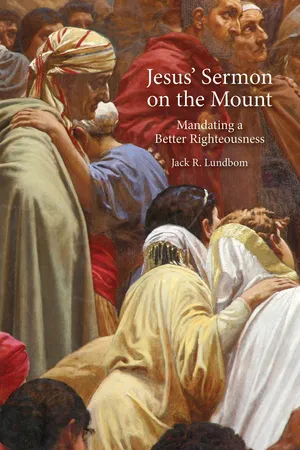
- 341 pages
- English
- ePUB (mobile friendly)
- Available on iOS & Android
eBook - ePub
About this book
The Sermon on the Mount (Matthew 5?7) is the best-known repository of the teachings of Jesus and one of the most studied. Amid the considerable erudition expended on the Sermon, however, Jack R. Lundbom argues that it has proven too easy to deflect or disregard the main thrust of the Sermon, which he characterizes as a mandate to holy living and a "greater righteousness." Through careful attention to the structure of Matthew's Gospel and the place of the Sermon within it, keen sensitivity to the patterns and themes of Israelite prophecy, and judicious comparisons with other Jewish and rabbinic literature, Lundbom elucidates the meaning of the Sermon and its continuity with Israel's prophetic heritage as well as the best of Jewish teaching. By deft appeal to Christian commentators on the Sermon, Lundbom brings its most important themes to life for the contemporary reader, seeking always to understand what the "greater righteousness" to which the Sermon summons might mean for us today.
Information
Topic
Theology & ReligionSubtopic
Biblical Studies2
The Sermon on the Mount
5
Jesus on the Mountain (5:1-2)
We have seen that Matthew presents the Sermon on the Mount as Jesus’ core teaching on the new covenant. This teaching is to be heard and put into practice by his disciples, and not only them, but all those aspiring to be his disciples. The Sermon begins on a very positive note. New covenant people are blessed, then said to be salt of the earth and light of the world. Jesus has come to fulfill the Law, not do away with it. New covenant people must therefore not relax even the least of his commands, but must aspire to a higher righteousness than that paraded by the scribes and Pharisees.
5 1When Jesus saw the crowds, he went up the mountain; and after he sat
down, his disciples came to him. 2 Then he began to speak, and taught them,
saying:
1. When Jesus saw the crowds, he went up the mountain; and after he sat down, his disciples came to him. Crowds of people are present, and at the conclusion of the sermon they are seen to be a listening part of Jesus’ audience (7:28), but Matthew keeps them in the background. According to Matthew, crowds follow Jesus because of his preaching, teaching, and healings in Galilee. But here the disciples have the preferred position of sitting close to him. They will hear Jesus, but so will the crowds. Natural acoustics discovered at various locations in Palestine show that large crowds could hear a speaker distinctly if he was atop a mountain or on level ground below.[1]
he went up the mountain. The setting recalls Moses ascending the mountain to receive the tablets of Law that formed the core of the Sinai covenant (Exod. 19:3).[2] There, however, the people heard the divine voice “out of the fire, the cloud, and the thick darkness,” in the valley below (Deut. 5:22). But now Matthew has Jesus giving the core teaching of the new covenant atop a Galilean mountain, with the people gathered somewhere below. Luther makes much of the public nature of Jesus’ teaching, saying this is always how Christian preaching and teaching ought to be done. It should not be carried out, he says, off in some corner or even in private houses by self-authorized individuals who boast of being possessed by the Holy Spirit. Public utterances allow the speaker to be bold and prophetic; they also make possible broader scrutiny of what is being said. In the first century, rabbis commonly taught indoors, that is, in synagogues or in schools, although there were exceptions. If crowds became too great, they would go outside. Rabbi Johanan ben Zakkai is said to have taught all day outside on one occasion, lecturing to crowds on laws of the festivals.[3]
he sat down. The common practice in synagogues and in schools was for the rabbi to teach sitting down. The Talmud makes frequent use of the expression “he sat and discoursed.” When Jesus visited the synagogue in his hometown of Nazareth, he stood up to read the Scripture but then sat down to give his interpretation (Luke 4:20). Jesus, therefore, is acting as a rabbi when he sits down to give his teaching.
his disciples came to him. The primary audience for this sermon is Jesus’ disciples, which has led some to conclude that Jesus was directing his teaching toward those who had already made a commitment to follow him, not just anyone.[4] But what about the crowds who at the beginning are in the background and at the end register astonishment at what they have heard (7:28-29)? Jesus is surely addressing a mixed company: believers, seekers, and uncommitted onlookers. Matthew may be ambiguous in portraying the crowd, but he seems to be telling us that, though Jesus was speaking primarily to his disciples, a crowd was nevertheless present, listening in, and many in that crowd were deeply moved—some perhaps to faith in the teacher uttering these stirring words.
Leander Keck makes the point that, though Matthew is directing the Sermon on the Mount to the church, it is by no means restricted to the church, for at the conclusion of his Gospel Matthew specifies that a worldwide mission is to be undertaken so others will be brought into the discipline of the Sermon (Matt. 28:19-20). The Sermon, says Keck, is for all people, even though the Christian community is held accountable in a special way for what is being taught.[5] Christian preaching and teaching today are most often directed at those who have already had a prior Christian experience or made a prior Christian commitment; nevertheless, others wishing to listen in should be welcomed. If the preaching and teaching are truly God sent, some may very well be astonished enough to join the company of Christian believers.
2. And he opened his mouth and he taught them, saying. In this “sermon” Jesus is teaching, not evangelizing. The point is made again in 7:28, where the sermon is called didachē (“teaching”). In the early church, the sermon began worship and was didachē.[6] Some today say that sermons in Christian worship must always contain a proclamation of the gospel, others that it must always have an evangelistic thrust. Gospel proclamation, or kērygma in Greek, is of course essential to the mission of the church. But teaching is also essential to the church’s mission. It would seem reasonable, then, that a sermon might be either kērygma or didachē, or a combination of both.
- See B. Cobbey Crisler, “The Acoustics and Crowd Capacity of Natural Theaters in Palestine,” BA 39 (1976): 128–41. Compare the biblical accounts of the speech of Jotham from the top of Mount Gerizim to the men of Shechem (Judg. 9:7-21), and an earlier covenant renewal ceremony at the same location after the Israelites had entered Canaan (Deut. 27:11-13). ↵
- C. G. Montefiore, The Synoptic Gospels (2nd rev. ed.; 2 vols.; London: Macmillan, 1927), 2:29. ↵
- Samuel T. Lachs, A Rabbinic Commentary on the New Testament (Hoboken, NJ: Ktav, 1987), 67. ↵
- Theodore H. Robinson, The Gospel of Matthew (Garden City, NY: Doubleday, Doran, 1928), 25–26. ↵
- Leander E. Keck, “The Sermon on the Mount,” in Jesus and Man’s Hope (ed. Donald G. Miller and Dikran Y. Hadidian; 2 vols.; Pittsburgh: Pittsburgh Theological Seminary, 1970–71), 2:315. ↵
- Jeremias, Sermon on the Mount, 21. ↵
6
The Blessings (5:3-12)
3 “Blessed are the poor in spirit,
for theirs is the kingdom of heaven.
4 “Blessed are those who mourn,
for they will be comforted.
5 “Blessed are the meek,
for they will inherit the earth.
6 “Blessed are those who hunger and thirst for righteousness,
for they will be filled.
7 “Blessed are the merciful,
for they will receive mercy.
8 “Blessed are the pure in heart,
for they will see God.
9 “Blessed are the peacemakers,
for they will be called children of God.
10 “Blessed are those who are persecuted for righteousness’ sake,
for theirs is the kingdom of heaven.
11 “Blessed are you when people revile you and persecute you and utter all kinds of evil against you falsely on my account. 12Rejoice and be glad, for your reward is great in heaven, for in the same way they persecuted the prophets who were before you.
The Sermon on the Mount begins not with commands, as in the Old Testament law code of Deuteronomy, but with blessings, which in Deuteronomy come last together with the curses (Deuteronomy 28). These blessings we call the “Beatitudes.” Luther calls this “a fine, sweet, and friendly beginning.” Here, without delay and with intentional directness, the blessings of the new covenant are pronounced on all who enter the kingdom Jesus...
Table of contents
- Cover
- Frontispiece
- Title Page
- Copyright
- Dedication
- Table Of Contents
- Preface
- Abbreviations
- The Sermon on the Mount
- Introduction
- The Sermon on the Mount and the Gospel of Matthew
- The Sermon on the Mount
- Appendix: Jewish, Christian, and Classical Authors Cited
- Bibliography
- Index of Authors
- Index of Scripture References
Trusted by 375,005 students
Access to over 1.5 million titles for a fair monthly price.
Study more efficiently using our study tools.
Frequently asked questions
Yes, you can cancel anytime from the Subscription tab in your account settings on the Perlego website. Your subscription will stay active until the end of your current billing period. Learn how to cancel your subscription
No, books cannot be downloaded as external files, such as PDFs, for use outside of Perlego. However, you can download books within the Perlego app for offline reading on mobile or tablet. Learn how to download books offline
Perlego offers two plans: Essential and Complete
- Essential is ideal for learners and professionals who enjoy exploring a wide range of subjects. Access the Essential Library with 800,000+ trusted titles and best-sellers across business, personal growth, and the humanities. Includes unlimited reading time and Standard Read Aloud voice.
- Complete: Perfect for advanced learners and researchers needing full, unrestricted access. Unlock 1.5M+ books across hundreds of subjects, including academic and specialized titles. The Complete Plan also includes advanced features like Premium Read Aloud and Research Assistant.
We are an online textbook subscription service, where you can get access to an entire online library for less than the price of a single book per month. With over 1.5 million books across 990+ topics, we’ve got you covered! Learn about our mission
Look out for the read-aloud symbol on your next book to see if you can listen to it. The read-aloud tool reads text aloud for you, highlighting the text as it is being read. You can pause it, speed it up and slow it down. Learn more about Read Aloud
Yes! You can use the Perlego app on both iOS and Android devices to read anytime, anywhere — even offline. Perfect for commutes or when you’re on the go.
Please note we cannot support devices running on iOS 13 and Android 7 or earlier. Learn more about using the app
Please note we cannot support devices running on iOS 13 and Android 7 or earlier. Learn more about using the app
Yes, you can access Jesus' Sermon on the Mount by Jack R. Lundbom in PDF and/or ePUB format, as well as other popular books in Theology & Religion & Biblical Studies. We have over 1.5 million books available in our catalogue for you to explore.