Arnold Dannenmann
Arnold Dannenmann (1907–1993), a Lutheran youth pastor, was a member of the German Christian Faith Movement. In addition to the book that is excerpted here, in 1933 he also published a book entitled Youth Commits Itself to Christ and to National Socialism [Jugend bekennt sich zu Christus und Nationalsozialismus].
Dannenmann begins by declaring boldly that every National Socialist is “bound to Adolf Hitler,” not as a slave but voluntarily, because Hitler has revealed something entirely new: that the German people can become one, “a community of the same blood.” From the beginning, then, the author is emphatic about the significance of National Socialism for Christian believers. His account reaches back to 1921 and the establishment of an early precursor of the movement, taking pains to distinguish it from neo-pagan and anti-Christian groups, but he focuses mainly on 1933. “For the German Christians,” he writes, “January 30, 1933 was what it was to become for many Christians in the months to come, that is, God’s day.” The work concludes with a long excerpt from the radio address Hitler gave on July 22, 1933, the night before the church elections in which the German Christians gained an overwhelming victory and considerable administrative power throughout the German Protestant Church.
In terms of style, the work is clearly meant for a broad popular audience. Dannenmann’s enthusiastic treatment of movement leaders like Friedrich Wieneke and Joachim Hossenfeld is almost hagiographic. Key German Christian ideas, among them race as an “order of creation” and the utter affinity of Christianity and National Socialism, are woven into the story, as are the revised [1933] guidelines of the German Christian Faith Movement.
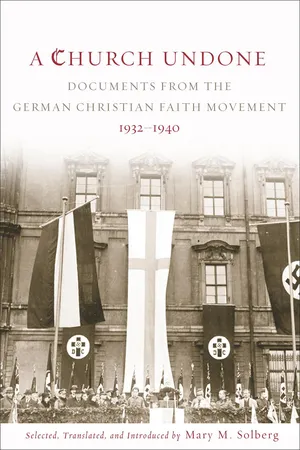
Figure 5. Cross and swastika, symbol of German Christian faith movement, on the front cover of the Handbook of the German Christians (1933).
Arnold Dannenmann
Preface
How did a Faith Movement called “German Christians” arise within the Protestant church on German soil? The present book aims to answer this question. The question is before us; about that there can be no doubt. It is raised by those who, as old comrades-in-arms, would themselves like to give an account of the men and principles they once followed, obedient and brave, true to their hearts and consciences. It is raised by those who have only recently been deeply touched by this movement, who did not experience its beginnings. It is raised by those who are still seeking, distinguishing, and critiquing, and by those for whom this movement still looks like a sphinx in a room of familiar, comfortable old church relationships.
It is high time that all those who are asking receive an answer. Arnold Dannenmann provides it here with great skill, in a language that can penetrate into every ear and every heart. I would like nothing better than that the images, struggles, and the battle of ideas that are here placed before the soul of the reader, may delight the awakened German people with their unparalleled and endless power. I would like nothing better than that this look at the beginning of so grace-filled a movement would awaken in everyone a sense of holy duty to keep it going. I would like nothing better than that, as a result of all these things, the great Third Reich of the Führer would sink indestructible roots in a Christian community made up of all our fellow Germans [Volksgenosse], one that promises a new harvest.
Friedrich Peter
Church Administrator, Berlin
The National Socialist
Every National Socialist is unconditionally bound to the Führer Adolf Hitler. This is not a slavish bond, but a voluntary one. This bond is not accidental. It exists because the Führer has brought a new awareness to every real National Socialist.
The year was 1925! In Munich, huge red party posters invited everyone to a mass meeting in the Hofbräuhaus.
The whole legislative delegation, under the leadership of Dr. Buttmann, was supposed to be there, and the Führer as well.
As young students, we were drawn to the gathering. The Führer himself did not speak once. But within a few minutes we were all in the grip of a boundless enthusiasm. This was not just a mood that came over us. A new awareness had empowered us! Above all, we knew one thing: that this same consciousness filled the whole assembly and turned it into one unified action group.
It was not simply the awareness that we were German, that we had to become a single German people [Volk] again; it was the awareness that this German people could only exist if it consisted not of a group of individuals but rather of a community of the same blood and the same history!
Only race creates a people! The scales fell from our eyes. Those who oppose the movement have miscalculated and continue to do so because they simply have not recognized the deepest source of the National Socialist movement, because they continue to think that it is a “nationalist” and also a “socialist” movement, even though the contrary has been said a thousand times.
We modern people have far too little faith that we will ever experience something unbelievably great in the midst of all the important trivia that surround us.
And when today we assert—no, we know—that with Adolf Hitler and National Socialism an epoch in German history has begun that is at least as decisive for the German people as, for example, the epoch of Martin Luther, some may chuckle, and some will shake their heads, but the National Socialist knows that this really is a fact.
It is clear that the one who in his heart believes in Christ, and who has been gripped by the National Socialist vision, is faced with something new.
It’s true that as youngsters we Christians were always taught by the church that people and faith belong together. It’s true that it was not possible for a Christian who knew the articles of his faith, to fall into internationalist fantasies. It’s true that it was even less possible that any Christian could become a traitor to his people. No!—No!—
But one thing we did not know, nor could we know: the immense significance for a people of its basis in blood and soil [Blut und Boden].
National Socialism has taught us that. Perhaps we young people sense this much more powerfully than the older generation possibly can. Today we know that it isn’t enough simply to be German in name only, or through some patriotic act; rather, we know that Germany’s future or fall depend on how it goes with the blood and soil of this people.
The Law of God
We see in this the holy laws of God!
We have always confessed: I believe that God has made me and all creatures, has given me body and soul, eyes, ears, and all my limbs, my reason and all my senses, and still preserves them; along with these also clothing and shoes, food and drink, house and homestead, wife and children, fields, cattle, and all my goods; that He provides me richly and daily with all that I need to support this body and life, protects me from all danger, and guards and preserves me from all evil; and all this out of pure, fatherly, divine goodness and mercy.
But this statement of faith has been interpreted for us in countless gatherings of the National Socialist movement—in a way that it has rarely been interpreted for any people.
Many speakers from the movement were not even aware of the religious duty they were fulfilling. The Führer Adolf Hitler, however, knew it and was utterly aware of his divine mission.
The thousands of gatherings that roared through Germany during the National Socialist movement’s struggle to take power actually fulfilled a religious purpose.
The masses listened breathlessly, not just for one hour, but sometimes for two, three, and four hours to the National Socialist speakers, not only because the speakers were rhetorically brilliant and skilled and able to strike a popular chord as they said what needed to be said, but because their speeches were actually filled with a new awareness. And this new awareness arose from the depths of this article of the Christian creed.
I repeat: The speakers may have been completely unaware of this, and the listeners likewise. It is simply a fact that it is only in retrospect that one can give a clear account of what one has experienced in such tumultuous times.
The Christian who dismisses this interpretation is bypassing one of the most significant divine facts in the history of his people.
German Christians!
It could not have happened otherwise than that a handful of men whose lives had been seized by Christ, and also by the consciousness of our times, gathered together to make sure this powerful current did not flow right past the church.
Nor did they want to incorporate it into the church “politically.” By the very nature of the thing a church-political movement could never be the moving force behind such a profound discovery. Only the church as a whole, insofar as it wanted to be a German church, could become that moving force. This handful of men called themselves “German Christians.”
The Führer Adolf Hitler himself suggested this name, “German Christians.” Originally some in the group wanted to call themselves “Protestant Nationalists,” but Hitler himself rejected this appellation. With the exceptional gift that Adolf Hitler has for naming things in a way that shapes the future, he has created a concept that will have extraordinary significance throughout the entire history of the church. It already does!
Precursors!
Even at the beginning of the century the fragmented ethnic [völkisch] groups in Germany were raising the question of “German Christianity.” . . .
. . . [A]fter the collapse brought about by the November revolution of 1918, the idea of renewing the Christian church on the...