The Church in Act explores the dynamics of ecclesial and liturgical theology, examining the body of Christ in action. Maxwell E. Johnson, one of the premier liturgical specialists in the field, provides in this volume historical and doctrinal thinking on a diversity of liturgical subjects under the umbrella of Lutheran liturgical theology and in ecumenical conversation.
The topics under consideration range from baptismal spirituality to Eucharistic concerns, including real presence, pneumatology, and reservation; discussions on what constitutes liturgical normativity, the diverse hermeneutical approaches to the Revised Common Lectionary, and the place of Mary in ecumenical dialogue and culture (especially Latino-Hispanic); issues of full communion based on a liturgical reading of the Augsburg Confession VII; and specific questions related to liturgy and ecumenism today in light of recent translation changes in Roman Catholic practice. Together, the volume offers a robust account of the liturgical, sacramental, and spiritual practices of the church for scholars, students, pastors, and others who seek to minister in an ecumenical context with increased understanding and insight.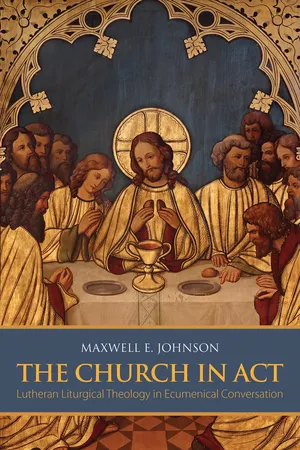
eBook - ePub
The Church in Act
Lutheran Liturgical Theology in Ecumenical Conversation
- 278 pages
- English
- ePUB (mobile friendly)
- Available on iOS & Android
eBook - ePub
About this book
Information
Topic
Theology & ReligionSubtopic
Christian Rituals & Practice2
The Holy Spirit and Lutheran Liturgical-Sacramental Theology
Lutheran liturgical-sacramental theology has always rightly placed a central emphasis on the role of the Holy Spirit in the gracious and saving gifts of word and sacrament. It is “through the Word and the sacraments, as through instruments,” says Article V of the Augsburg Confession, that “the Holy Spirit is given, and the Holy Spirit produces faith, where and when it pleases God, in those who hear the Gospel.”[1] Similarly, notes Luther in his Small Catechism, it is the Holy Spirit who “calls, gathers, enlightens, and sanctifies the whole Christian church on earth,”[2] and Lutherans have always looked to word and sacrament as the vehicles by which the Spirit does this.
As is well known among liturgical scholars, throughout the history of Christian worship this role of the Holy Spirit has often been most expressed in the prayer of blessing or sanctification of water in the rite of Baptism and in the anaphora, Eucharistic Prayer, or Great Thanksgiving either by an invocation (epiclesis) of the Spirit to “come” or by asking the Father to “let come,” or “send” the Holy Spirit upon the baptismal waters and upon the bread and wine of the Eucharist and the assembled community itself.[3] With regard to the Eucharist, traditional scholarship has argued that such epicleses have tended to be of two general types. Either they may be “consecratory” in that they request the Spirit to make, change, show, declare, bless, or sanctify the bread and wine as Christ’s Body and Blood, or they may be a “communion” type in that they ask that the assembled community itself might receive various “fruits” of holy communion by the Spirit’s activity.[4] Often they are both consecratory and communion at the same time. However, as Robert Taft has demonstrated, “originally . . . the epiclesis was primarily a prayer for communion, not for consecration; it was directed at the sanctification of the communicants, not of the gifts. Or, to put it better, perhaps, it was a prayer for the sanctification of the ecclesial communion, not for the sanctification of its sacramental sign, the Holy Communion.”[5]
So also, the location of such epicleses in the anaphora has varied within the different liturgical traditions of the church. In the West Syrian and Byzantine East the epiclesis was located after the Words of Institution and anamnesis in the prayer. In the Egyptian (or Alexandrian) Eastern tradition, two epicleses of the Spirit developed: one before and one after the Words of Institution and anamnesis. But while in the non-Roman West Spirit epicleses could and did appear in either location, in the Roman West, that is, in the canon missae as it evolved in the Roman tradition, no epiclesis of the Spirit was contained whatsoever. Even so, some form of invocation, or epiclesis-type petition, was still present in that God himself (in the Quam oblationem) was asked before the Institution Narrative to “bless and approve” the offering and to “let it become” Christ’s Body and Blood and, at a point after the Narrative (in the Supplices te rogamus), the fruits of communion were also requested: “We humbly beseech you, almighty God, bid these things be borne by the hands of your angel to your altar on high, in the sight of your divine majesty, that all of us who have received the most holy body and blood of your Son by partaking at this altar may be filled with all heavenly blessing and grace.”[6]
Epicleses of the Holy Spirit in Lutheran Worship
in North America
The Holy Spirit has not always been very obvious in Lutheran worship but has tended to function behind the scenes, in the words of Frederick Dale Bruner and William Hordern, as “the shy member of the Trinity,”[7] always directing attention to Christ. Lutheran baptismal and eucharistic liturgies have not tended traditionally to use epicleses of the Holy Spirit in their liturgical prayers. Luther’s own reforms of the Roman Rite of Baptism in 1523 and 1526 and his similar reforms of the Mass in the same years, the Formula Missae and Deutsche Messe, did not introduce an epiclesis of the Holy Spirit either over the baptismal waters in his famous Sindflutgebet or in the consecration of the bread and wine. And, with the notable exception of the Paul Zellar Strodach and Luther Reed Eucharistic Prayer in the 1958 Service Book and Hymnal, which invoked both the Word and Holy Spirit in the West Syrian position “to bless us, thy servants, and these thy own gifts of bread and wine, so that we and all who partake thereof may be filled with heavenly benediction and grace,” and so on,[8] explicit epicleses of the Holy Spirit in the trial liturgical booklets leading to the publication of Lutheran Book of Worship were rather new to United States Lutheranism. In Contemporary Worship 7: Holy Baptism, the prayer over the baptismal waters read,
Pour out your Holy Spirit, gracious Father, to make this a water of cleansing. Wash away the sins of all those who enter it, and bring them forth as inheritors of your glorious kingdom.[9]
And the eucharistic epiclesis in the West Syrian or Syro-Byzantine position in Contemporary Worship 2: The Holy Communion was equally direct:
Send the power of your Holy Spirit upon us and upon this bread and wine, that we who receive the body and blood of Christ may be his body in the world, living according to his example to bring peace and healing to all [hu]mankind.[10]
So “new,” in fact, were these baptismal and eucharistic epicleses of the Holy Spirit for some contemporary Lutherans that the work of the Inter-Lutheran Commission on Worship itself was criticized for having departed from traditional Lutheran doctrinal and sacramental theology. As Oliver K. Olson, one of the most outspoken critics of both Holy Baptism and The Holy Communion, wrote,
The problem of the epiclesis confronts us in two ways. Not only is the ILCW proposing the epiclesis of the Holy Spirit in the communion order, but also an epiclesis of the baptismal water. To begin with the latter, we should be aware that the answer to the catechism question, “How can water produce such great effects,” is a re-statement of the resistance of the Western church to the practice of epiclesis. Luther, in re-stating the position of Augustine that it is the Word of God that is the means of grace, not the water, can be said to speak for the Western church. . . . Restoration of the baptismal epiclesis, as planned, will produce an order at odds with Lutheran doctrine on baptism.[11]
He continued elsewhere: “The Eucharistic epiclesis as at Baptism corresponds to a Hellenistic personification of the Spirit . . ., detracts from the actual import of the celebration and . . . runs into contradiction with the apostolic Gospel.”[12] Another critic argued similarly that
repeated use of Spirit prayers displays a failure to take the Risen Lord at his Word. . . . The approach of the gracious God . . . has been liturgically blunted . . . liturgical gears have been shifted and direction reversed (man to God instead of God to man) at the crucial place in the service where God’s sacramental initiative ought to be underscored. . . . The focus of the [baptismal] prayer . . . is the water rather than the initiate. . . . Is there a parallel here to the ILCW insistence upon making the bread and wine rather than the communicant the chief focus of its Eucharistic epiclesis?[13]
That these critics were heard, at least in part, was reflected in the final shape of the...
Table of contents
- Cover
- Title Page
- Copyright
- Table Of Contents
- Preface
- Acknowledgements
- Baptismal Spirituality in the Early Church and Its Implications for the Church Today
- The Holy Spirit and Lutheran Liturgical-Sacramental Theology
- The Real and Multiple Presences of Christ in Contemporary Lutheran Liturgical and Sacramental Praxis
- Eucharistic Reservation and Lutheranism
- What Is Normative in Contemporary Lutheran Worship?
- Ordinary Time? The Time after Epiphany and Pentecost
- The Blessed Virgin Mary and Ecumenical Convergence in Doctrine, Doxology, and Devotion
- The Virgin of Guadalupe in Ecumenical Context
- Satis est
- Christian Worship and Ecumenism
- Conclusion
Trusted by 375,005 students
Access to over 1.5 million titles for a fair monthly price.
Study more efficiently using our study tools.
Frequently asked questions
Yes, you can cancel anytime from the Subscription tab in your account settings on the Perlego website. Your subscription will stay active until the end of your current billing period. Learn how to cancel your subscription
No, books cannot be downloaded as external files, such as PDFs, for use outside of Perlego. However, you can download books within the Perlego app for offline reading on mobile or tablet. Learn how to download books offline
Perlego offers two plans: Essential and Complete
- Essential is ideal for learners and professionals who enjoy exploring a wide range of subjects. Access the Essential Library with 800,000+ trusted titles and best-sellers across business, personal growth, and the humanities. Includes unlimited reading time and Standard Read Aloud voice.
- Complete: Perfect for advanced learners and researchers needing full, unrestricted access. Unlock 1.5M+ books across hundreds of subjects, including academic and specialized titles. The Complete Plan also includes advanced features like Premium Read Aloud and Research Assistant.
We are an online textbook subscription service, where you can get access to an entire online library for less than the price of a single book per month. With over 1.5 million books across 990+ topics, we’ve got you covered! Learn about our mission
Look out for the read-aloud symbol on your next book to see if you can listen to it. The read-aloud tool reads text aloud for you, highlighting the text as it is being read. You can pause it, speed it up and slow it down. Learn more about Read Aloud
Yes! You can use the Perlego app on both iOS and Android devices to read anytime, anywhere — even offline. Perfect for commutes or when you’re on the go.
Please note we cannot support devices running on iOS 13 and Android 7 or earlier. Learn more about using the app
Please note we cannot support devices running on iOS 13 and Android 7 or earlier. Learn more about using the app
Yes, you can access The Church in Act by Maxwell E. Johnson in PDF and/or ePUB format, as well as other popular books in Theology & Religion & Christian Rituals & Practice. We have over 1.5 million books available in our catalogue for you to explore.