eBook - ePub
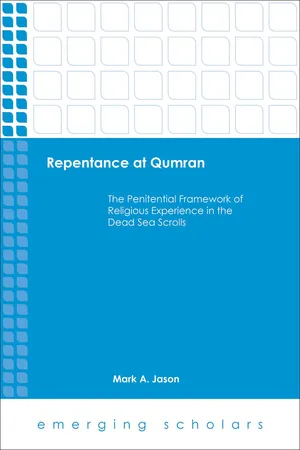
Repentace at Qumran
The Penitential Framework of Religious Experience in the Dead Sea Scrolls
- 302 pages
- English
- ePUB (mobile friendly)
- Available on iOS & Android
eBook - ePub
Repentace at Qumran
The Penitential Framework of Religious Experience in the Dead Sea Scrolls
About this book
Mark A. Jason offers a detailed investigation of the place of repentance in the Dead Sea Scrolls, addressing a significant lacuna in Qumran scholarship. Normally, when the belief system of the community is examined, "repentance" is usually taken for granted or relegated to a peripheral position. By careful attention to key texts, Jason establishes the importance of repentance as a fundamental way of structuring and describing religious experience within the Qumran community. Repentance was important not only for entry into the community and covenant but also for daily governance and cultic activities, and even for authenticating understanding of the end times. Jason shows, then, that repentance was a central and decisive element in shaping that community's identity and undergirded its religous experience from the start. Further, comparison with relevant texts from the Apocrypha and pseudepigrapha shows that the Qumran community represented a distinctive penitential movement in Second Temple Judaism.
Information
Subtopic
Études bibliques6
Repentance in Daily Life: Cult and Rituals
In chapter 4, we saw that the Qumran community could separate from wickedness because they believed that God had predestined them for it.[1] Not only was this predestined state taken to be an act of repentance, but it was also one that required them to remain penitent. Paradoxically, although members of the community were well aware that they were predestined thus, this did not prevent them from “responding” to this predestination by striving to remain truly penitent, thereby seeing themselves as a penitential community in the wilderness. In other words, their penitential actions within the community, although predestined, were nevertheless real since there was a constant awareness that their daily existence was a loving and devotional response to the God who had made them do so. As we saw in chapter 4, there was no incompatibility in this. They saw their worship and devotion (and in this context, penitential acts) as a true offering on their part to God.
The main expression of community members’ genuine devotion and worship involved the performance of daily cultic rites. These cultic rites were a manifestation of the ongoing penitential state to which the members of the community had been preordained. We saw in our introductory chapter that scholarly attention to repentance in the context of rituals at Qumran has predominately highlighted what I referred to as the “lustration text” (1QS 3:1-12).[2] Most scholars, especially in the early days of scrolls research, used this text to emphasize that at Qumran the internal dimension of rituals was important (and rightly so). However, in doing so, the rituals themselves as penitential acts are almost neglected. O. Betz’s comment is representative of such a view. He says: “soviel wichtiger als das aussere Zeremoniell ist die innere Reinheit.”[3] Throughout this chapter, I will highlight that while repentance certainly served to validate “outward” religiosity, these external rituals provided a necessary vehicle for genuine repentance on a daily basis, ensuring that one remained penitent. From the point of view of religious experience at Qumran, we will explore how wholehearted devotion to God, though preordained, was inseparable from cultic acts.
In order to do what I intend to do, I first need to highlight the place of rituals in the wider world contemporaneous with the Qumran community. As T. Hägerland says: “Repentance, as commonly understood in first-century Judaism, entailed not only moral reform but also ritual elements.”[4] He speaks of the “set of symbolic actions” that first-century Jews would normally perform as an integral part of repenting. These rituals are in general conformity with the penitential rites prescribed in the Hebrew Bible. These include weeping, sacrifices, washings, fasting, and the use of sackcloth and ashes, to name but a few penitential rites. Furthermore, according to Hägerland, all these ritual acts and external expressions constituted repentance.[5] Normally, these were associated with temple worship.[6] In such a context, it is plausible to assume that one’s perception of the temple largely determined and shaped one’s conception of rituals of repentance. In the Hebrew Bible, there are texts that advocate the Jerusalem temple as exerting a centripetal force on Israel and the nations.
In days to come
the mountain of the Lord’s house
shall be established as the highest of the mountains,
and shall be raised above the hills;
all the nations shall stream to it.
Many peoples shall come and say,
“Come, let us go up to the mountain of the Lord,
to the house of the God of Jacob;
that he may teach us his ways
and that we may walk in his paths.”
For out of Zion shall go forth instruction,
and the word of the Lord from Jerusalem. (Isa. 2:1-3)
the mountain of the Lord’s house
shall be established as the highest of the mountains,
and shall be raised above the hills;
all the nations shall stream to it.
Many peoples shall come and say,
“Come, let us go up to the mountain of the Lord,
to the house of the God of Jacob;
that he may teach us his ways
and that we may walk in his paths.”
For out of Zion shall go forth instruction,
and the word of the Lord from Jerusalem. (Isa. 2:1-3)
Or
Thus says the Lord of hosts: Peoples shall yet come, the inhabitants of many cities; the inhabitants of one city shall go to another, saying, “Come, let us go to entreat the favor of the Lord, and to seek the Lord of hosts; I myself am going.” Many peoples and strong nations shall come to seek the Lord of hosts in Jerusalem, and to entreat the favor of the Lord. Thus says the Lord of hosts: In those days ten men from nations of every language shall take hold of a Jew, grasping his garment and saying, “Let us go with you, for we have heard that God is with you.” (Zech. 8:20-23)
Others, however, explicitly condemn temple-based religious acts:
I hate, I despise your festivals,
and I take no delight in your solemn assemblies.
Even though you offer me your burnt offerings and grain offerings,
I will not accept them;
and the offerings of well-being of your fatted animals
I will not look upon.
Take away from me the noise of your songs;
I will not listen to the melody of your harps.
But let justice roll down like waters,
and righteousness like an ever-flowing stream. (Amos 5:21-24)
and I take no delight in your solemn assemblies.
Even though you offer me your burnt offerings and grain offerings,
I will not accept them;
and the offerings of well-being of your fatted animals
I will not look upon.
Take away from me the noise of your songs;
I will not listen to the melody of your harps.
But let justice roll down like waters,
and righteousness like an ever-flowing stream. (Amos 5:21-24)
What to me is the multitude of your sacrifices?
says the Lord;
I have had enough of burnt offerings of rams
and the fat of fed beasts;
I do not delight in the blood of bulls,
or of lambs, or of goats.
When you come to appear before me,
who asked this from your hand?
Trample my courts no more;
bringing offerings is futile;
incense is an abomination to me.
New moon and sabbath and calling of convocation—
I cannot endure solemn assemblies with iniquity.
Your new moons and your appointed festivals
my soul hates;
they have become a burden to me,
I am weary of bearing them.
When you stretch out your hands,
I will hide my eyes from you;
even though you make many prayers,
I will not listen;
your hands are full of blood.
Wash yourselves; make yourselves clean;
remove the evil of your doings
from before my eyes;
cease to do evil. (Isa. 1:11-16)
says the Lord;
I have had enough of burnt offerings of rams
and the fat of fed beasts;
I do not delight in the blood of bulls,
or of lambs, or of goats.
When you come to appear before me,
who asked this from your hand?
Trample my courts no more;
bringing offerings is futile;
incense is an abomination to me.
New moon and sabbath and calling of convocation—
I cannot endure solemn assemblies with iniquity.
Your new moons and your appointed festivals
my soul hates;
they have become a burden to me,
I am weary of bearing them.
When you stretch out your hands,
I will hide my eyes from you;
even though you make many prayers,
I will not listen;
your hands are full of blood.
Wash yourselves; make yourselves clean;
remove the evil of your doings
from before my eyes;
cease to do evil. (Isa. 1:11-16)
Whoever slaughters an ox is like one who kills a human being;
whoever sacrifices a lamb, like one who breaks a dog’s neck;
whoever presents a grain offering, like one who offers swine’s blood;
whoever makes a memorial offering of frankincense, like one who blesses an idol.
These have chosen their own ways,
and in their abominations they take delight. (Isa. 66:3)
whoever sacrifices a lamb, like one who breaks a dog’s neck;
whoever presents a grain offering, like one who offers swine’s blood;
whoever makes a memorial offering of frankincense, like one who blesses an idol.
These have chosen their own ways,
and in their abominations they take delight. (Isa. 66:3)
These sample texts suggest two very different attitudes to the temple. In the first two texts, we have a description of an eschatological and ideal situation; while in the latter three texts, the condemnations do not reject the temple but seek rather to correct an attitude and expose and address the superficiality of worship at the time. Thus, in the light of these two opposing views, we get an insight into the religious experience of worshipers when confronted by an indifferent or perhaps apathetic leadership at the temple: those who accept the temple as it is, and those who find alternative ways of worship so as not to participate in the corrupt system. Thus repentance is manifested through external, penitential acts normally expressed by temple-based rituals. However, one’s interaction with the corrupt temple and ritual system became the determining factor regarding how one understood rituals.
For example, the author of Psalms of Solomon is conscious of the corruption of the temple[7]—he talks of the time “when the sons of Jerusalem defiled the sanctuary of the Lord” (Pss. Sol. 2.2). As a result, God rejects their offerings (2.4). However, we do not know whether he advocates temple-less rituals. Similarly, Sib. Or. 3.564–567 describes how the Greeks perform penitential acts in the temple of the Great God. It could be that the (Greek) proselytes described in this text wanted to affirm their commitment to Judaism. On the other hand, John the Baptist’s offer of baptism occurred independent of the temple. The locus of the only “rite” of repentance John demanded was the Judean wilderness. However, we have no evidence of whether or not ...
Table of contents
- Cover
- Title Page
- Copyright
- Table Of Contents
- Abbreviations
- Acknowledgments
- Introduction
- Religious Experience and Repentance
- Motivations for Repentance
- Repentance, Separation, and the Covenant
- Predestined Repentance
- The Extent of Repentance
- Repentance in Daily Life: Cult and Rituals
- Repentance and Eschatology
- Conclusion
- Bibliography
- Index of Authors
- Index of Scriptures and Ancient Literature
Trusted by 375,005 students
Access to over 1.5 million titles for a fair monthly price.
Study more efficiently using our study tools.
Frequently asked questions
Yes, you can cancel anytime from the Subscription tab in your account settings on the Perlego website. Your subscription will stay active until the end of your current billing period. Learn how to cancel your subscription
No, books cannot be downloaded as external files, such as PDFs, for use outside of Perlego. However, you can download books within the Perlego app for offline reading on mobile or tablet. Learn how to download books offline
Perlego offers two plans: Essential and Complete
- Essential is ideal for learners and professionals who enjoy exploring a wide range of subjects. Access the Essential Library with 800,000+ trusted titles and best-sellers across business, personal growth, and the humanities. Includes unlimited reading time and Standard Read Aloud voice.
- Complete: Perfect for advanced learners and researchers needing full, unrestricted access. Unlock 1.5M+ books across hundreds of subjects, including academic and specialized titles. The Complete Plan also includes advanced features like Premium Read Aloud and Research Assistant.
We are an online textbook subscription service, where you can get access to an entire online library for less than the price of a single book per month. With over 1.5 million books across 990+ topics, we’ve got you covered! Learn about our mission
Look out for the read-aloud symbol on your next book to see if you can listen to it. The read-aloud tool reads text aloud for you, highlighting the text as it is being read. You can pause it, speed it up and slow it down. Learn more about Read Aloud
Yes! You can use the Perlego app on both iOS and Android devices to read anytime, anywhere — even offline. Perfect for commutes or when you’re on the go.
Please note we cannot support devices running on iOS 13 and Android 7 or earlier. Learn more about using the app
Please note we cannot support devices running on iOS 13 and Android 7 or earlier. Learn more about using the app
Yes, you can access Repentace at Qumran by Mark A. Jason in PDF and/or ePUB format, as well as other popular books in Théologie et religion & Études bibliques. We have over 1.5 million books available in our catalogue for you to explore.