- 208 pages
- English
- ePUB (mobile friendly)
- Available on iOS & Android
eBook - ePub
About this book
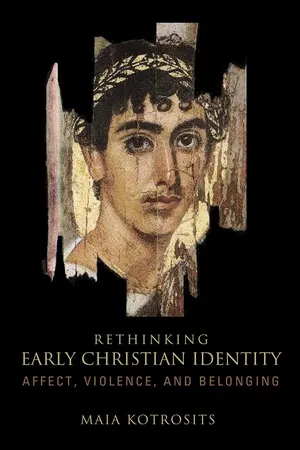
Maia Kotrosits challenges the contemporary notion of "early Christian literature," showing that a number of texts usually so described—New Testament writings including Hebrews, Acts, the Gospel of John, Colossians, and 1 Peter, as well as the letters of Ignatius, the Gospel of Truth, and the Secret Revelation of John—are "not particularly interested" in a distinctive Christian identity or self-definition. Rather, by appealing to the categories of trauma studies and diaspora theory and giving careful attention to the dynamics within each of these texts, she shows that this sample of writings offers complex reckonings with chaotic diasporic conditions and the transgenerational trauma of colonial violence. The heart of her study is an inquiry into the significance contemporary readers invest in ancient writings as expressions of a coherent identity, asking, "What do we need and want out of history?" Kotrosits interacts with important recent work on identity and sociality in the Roman world and on the dynamics of desire in contemporary biblical scholarship as well. At last, she argues that the writings discussed made possible the rise of Christianity by effecting a "forgetfulness" of imperial trauma—and questions the affective dimensions of contemporary empire-critical scholarship.
Trusted by 375,005 students
Access to over 1.5 million titles for a fair monthly price.
Study more efficiently using our study tools.
Information
2
On the Historical Queerness of Christianity
In some of the most cutting edge historical work in the fields of New Testament and early Christianity, early Christian identity has been associated with queerness. This association is made either because of the crossing or disruption of identity categories present in “early Christian” literature, or because of the kinds of apparently transgressive social performances that coalesce around these texts. But, as I’ll argue in this chapter, there are historical and theoretical problems as well as some surprisingly double political alignments embedded in this association. So what collective affective investments might this association between transgressive queerness and Christian identity in historiography signal? Can queerness be useful in our renderings of ancient sociality as represented in “early Christian” literature? How might we consider the social-affective landscape of the late first and early second centuries without Christian identity or an essential Christian transgressiveness?
The association of Christian identity with queerness first stirs up some matters about the relationship between queer theory and Christian historiography. Queer theory, roughly emerging in the early 90’s as a confluence of poststructuralist theory, LGBT activism, and feminist theory, has arrived only recently in the disciplines of New Testament and early Christianity. Ten years or more had gone by after Eve Sedgwick’s Epistemology of the Closet and Judith Butler’s Gender Trouble (two signal texts of what was, after their writing, designated queer theory)[1] before the fields of New Testament and early Christianity had shown any marked interest in gender, identity, or bodily life as social/discursive constructions, or in early Christian texts in the context of the history of sexuality.[2] By now, following trends in gender theory and cultural studies that have started to theorize queerness as “anti-identity” or non-normed identity rather than as sexual identity, there have been a number of recent projects within the fields of New Testament and early Christianity that have adopted this model for understanding “early Christians” or their assumed prototypes as queer in the sense of defying ancient identity categories.[3] Several of these projects revolve around Galatians, specifically emphasizing the baptismal formula “neither Jew nor Greek, slave nor free, male and female” in Galatians 3:28.[4] Others have pointed out that the term “Christian” seems to appear in contexts of violence and public shame (in martyr narratives, for example), noting the wildly complicated gender performances that also occur in these contexts.[5] Thus “queer” has become an historical category for understanding the emergence of the term “Christian” and even Christians themselves. Queer itself is not an uncontested term, however, having come to indicate both LGBTI identities[6] (being “queer identified”) and that which is inimical to identity. It appears now that in contemporary historiography “Christian,” like queerness, imparts ambiguously a particular identity and anti-identity, in any case carrying queerness’s implications of subversion.
The life of queer theory in Christian historiography is a bit surprising given the strained relationship (to say the least) between so many queer-identified people and numerous forms of contemporary Christianity: homophobic rejections of queer-identified clergy, and evangelical and conservative lobbying against marriage equality, for example. But that strained relationship is indeed the space into which the affinity between Christian historiography and queer theory apparently wants to burrow. What could be more troubling to bigoted anti-gay Christians than to hear the word queer tossed in the direction of their origins?[7] Queerness importantly disjoined early Christianity from the fantasy ideal of modern American middle-class mores, values, and family life, but it joined it to another fantasy ideal—that of the (post)modern progressive American malcontent. Of course, the historical queerness ascribed to “the early Christian” represents a fairly important disruptive strategy. But these strategic uses of queerness perhaps represent less a radicalizing of Christian historiography than the widespread conventionalization of queerness. Even early Christians are queer these days, solidifying queer’s trendiness and intellectual cachet.[8]
There are other ways that the term queer serves Christian historiography. Queer as nearly synonymous with subversion means that the queer “early Christian” is positioned—almost by definition—as out of alignment with and even in opposition to the Roman Empire in some way.[9] Although in many cases this arrives from admirably close readings of textual imaginations,[10] and though it may offer inspiration or complications for contemporary Christians living in and with American or western imperialism (more on that in the next chapter), the effect of this particular collective sensibility is what Jasbir Puar terms “queer exceptionalism.” In her book Terrorist Assemblages: Homonationalism in Queer Times,[11] Puar brings analyses of sexuality and gender to the problem of U.S. exceptionalism (claims to excellence and transcendence), observing a kind of “U.S. sexual exceptionalism” operating in the current cultural moment. She reflects on the images of sexualized violence from Abu Ghraib and the circulation of other eroticized and violent nationalist images after 9/11, drawing attention to the ways the nation is founded through the queering of certain populations who are cast as a perverse “threat to life” (or to “our way of life”). Such programmatic torture occurs simultaneously with U.S. claims to be a paragon and defender of human rights, and is justified through the “exceptional circumstances” of the war on terror. Puar notices how sexual exceptionalism is deployed by the U.S. and is perpetuated by individuals and collectives within the nation who identify with such claims. In particular she challenges the intensive focus on Arab or Muslim homophobia by some LGBTQI political groups, a focus which reinstalls the colonialist civilized vs. uncivilized binary underwriting so much U.S. nationalist violence.[12] When queerness is cast as essentially or monolithically subversive, she argues, it in effect masks the racial inflections and nationalist alliances promoted in these kinds of LGBTQI political interests.
With eerie congruence to U.S. sexual exceptionalism, the notion of “the early Christian” as historically queer establishes an idealized, even unique, resistance somewhere within the emergence of “Christian” (ever in quotes at this point) rhetoric and social practice, preserving something of an original virtue for Christianity. Of course, U.S. exceptionalism has been chained from the start to biblical exceptionalism through narratives of perfection and distinctiveness paired with a destiny associated with land. But while the historical queerness of early Christians by virtue of their Christianness is a trope that may cause visceral upset for some contemporary people, or may interrupt some consolidations of Christianity with normativity, it also, sadly, broadens U.S. and biblical exceptionalisms. The ambiguity of whether “Christian” signifies an identity or anti-identity has settled into the idea of the people we call “early Christians” as being queer subjects. Yet the very notion of a “queer subject” has an unfortunate contradiction about it. As Puar notes in her conclusion, “[d]espite the anti-identitarian critique that queer theory launches (i.e., queerness as an approach, not an identity or wedded to identity), the queer subject, a subject that is against identity, transgressive rather than (gay or lesbian) liberatory, nevertheless surfaces as an object in need of excavation, elaboration, or specularization.”[13]
I wonder if the work of summoning Christian subjects not only as queer but as “objects in need of excavation, elaboration, and specularization” at all is likewise closely tied to the perpetual lean in the fields of New Testament and early Christianity towards our exceptionalist imaginations of the first century. Where there are ancient Christian subjects, no matter how diverse, diffuse, or intricately configured, what often follows is a description of the unique positioning of these subjects in history, a claim about their very atypical deployment of discourse, or a contention that these subjects are peak innovators or distinctively transgressive.[14] The current fixation on empire risks embarrassing contradiction unless it attends to the sometimes subtle braiding of exceptionalism and the search for and description of ancient Christian subjects. The very desire to target and describe particular ancient subjects as Christian is itself knit into U.S. imperialism, given the larger colonial problem of trying to make Christians out of unwitting or unwilling others.
Although it may at the moment appear otherwise, I am criticizing neither fixations on empire nor the practice of borrowing from queer theory for historical ends. This very book testifies to my own fixation on empire, as well as to a deep attachment to queer modalities of history. But the nodes of empire and queerness tie together a whole host of fears, complaints, and yearnings about our own collusions in power, and these nodes can be engaged more scrupulously.
Puar’s Terrorist Assemblages is full of cautionary tales, as well as numerous compact creative propositions for rethinking social life, whether ancient or contemporary. For one, Puar puts affect to work with the Deleuzian notion of assemblages,[15] assuming a fully diffuse concept of subjectivity. She suggests that even more complicated models of identity like intersectionality, which theorizes the collusion of various systems of domination and focuses on multiple, intersecting forms of categorical difference, actually miss new fissions and fusions of gender, sexuality, and race that arise in an atmosphere of U.S. sexual exceptionalism and homonationalism.[16] Demonstrating the limits of identity and intersectional analyses, Puar suggests re-thinking queerness as assemblage, which “moves away from excavation work, deprivileges a binary opposition between queer and not-queer subjects, and, instead of retaining queerness exclusively as dissenting, resistant, and alternative (all of which queerness importantly is and does), it underscores contingency and complicity within dominant formations.”[17] An assemblage is an “affective conglomeration that recognizes other contingencies of belonging,” a “series of dispersed but mutually implicated and messy networks,” which foregrounds the receptions and receptiveness of bodies, the production of populations, and new modes of belonging that do not just cross but effectively scrambl...
Table of contents
- Cover
- Title Page
- Copyright
- Table Of Contents
- Acknowledgements
- Abbreviations
- Introduction: Making Sense of Ourselves
- The Force of History
- On the Historical Queerness of Christianity
- Reading Acts in Diaspora
- Expanding the Diasporic Imagination: The Secret Revelation of John
- Above It All: The Affective Life of Transcendence
- Pleasure, Pain, and Forgetting in the Gospel of Truth
- Returning to Rome
- Conclusion
- Bibliography
- Index
Frequently asked questions
Yes, you can cancel anytime from the Subscription tab in your account settings on the Perlego website. Your subscription will stay active until the end of your current billing period. Learn how to cancel your subscription
No, books cannot be downloaded as external files, such as PDFs, for use outside of Perlego. However, you can download books within the Perlego app for offline reading on mobile or tablet. Learn how to download books offline
Perlego offers two plans: Essential and Complete
- Essential is ideal for learners and professionals who enjoy exploring a wide range of subjects. Access the Essential Library with 800,000+ trusted titles and best-sellers across business, personal growth, and the humanities. Includes unlimited reading time and Standard Read Aloud voice.
- Complete: Perfect for advanced learners and researchers needing full, unrestricted access. Unlock 1.5M+ books across hundreds of subjects, including academic and specialized titles. The Complete Plan also includes advanced features like Premium Read Aloud and Research Assistant.
We are an online textbook subscription service, where you can get access to an entire online library for less than the price of a single book per month. With over 1.5 million books across 990+ topics, we’ve got you covered! Learn about our mission
Look out for the read-aloud symbol on your next book to see if you can listen to it. The read-aloud tool reads text aloud for you, highlighting the text as it is being read. You can pause it, speed it up and slow it down. Learn more about Read Aloud
Yes! You can use the Perlego app on both iOS and Android devices to read anytime, anywhere — even offline. Perfect for commutes or when you’re on the go.
Please note we cannot support devices running on iOS 13 and Android 7 or earlier. Learn more about using the app
Please note we cannot support devices running on iOS 13 and Android 7 or earlier. Learn more about using the app
Yes, you can access Rethinking Early Christian Identity by Maia Kotrosits in PDF and/or ePUB format, as well as other popular books in Theology & Religion & Biblical Criticism & Interpretation. We have over 1.5 million books available in our catalogue for you to explore.