- 288 pages
- English
- ePUB (mobile friendly)
- Available on iOS & Android
eBook - ePub
About this book
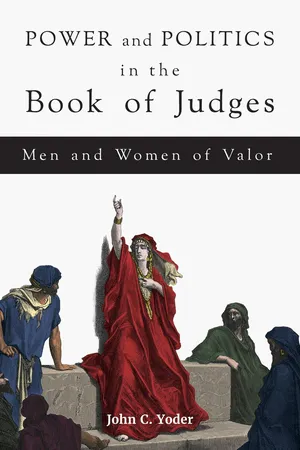
Power and Politics in the Book of Judges studies political culture and behavior in premonarchic Israel, focusing on the protagonists in the book of Judges. Although the sixth-century BCE Deuteronomistic editor portrayed them as moral champions and called them "judges," the original bardic storytellers and the men and women of valor themselves were preoccupied with the problem of gaining and maintaining political power. John C. Yoder considers the variety of strategies the men and women of valor used to gain and consolidate their power, including the use of violence, the redistribution of patronage, and the control of the labor and reproductive capacity of subordinates. They relied heavily, however, on other strategies that did not deplete their wealth or require the constant exercise of force: mobilizing and dispensing indigenous knowledge, cultivating a reputation for reliability and honor, and positioning themselves as skillful mediators between the realms of earth and heaven, using their association with Y
Trusted by 375,005 students
Access to over 1.5 million titles for a fair monthly price.
Study more efficiently using our study tools.
Information
1
Introduction and Overview
The Judges as Political Patrons
When a messenger of Yhwh first encountered Gideon, the messenger greeted him saying, “Yhwh is with you, valiant mighty man” (gibbôr heḥāyil – גבור החיל) (Judg. 6:12).[1] With these words, the messenger identified Gideon as a member of an elite class wielding extensive military, political, and economic power. The messenger did not address Gideon as a religious leader or identify him as a magistrate. Had the messenger been a modern political scientist, not a peripatetic prophet, he might have called Gideon a patrimonial leader or patron. Other terms that come to mind for the contemporary reader are strongman, big man, boss, or even warlord. Gideon was but one of many commanding figures, most of them warriors or heads of prominent houses, who exercised authority in ancient Syria-Palestine. In part, the power of these individuals was based on their ability to mobilize followers, followers who were not just fighters or producers, but who were people with unusual temporal or supernatural knowledge. The power of the great men and women of valor also rested on their reputation for reliability, their claim to honor, and their great wealth. These individuals are the focus of the Hebrew Bible’s book of Judges.
Although the heroes in the book of Judges were first and foremost political figures, to my knowledge they have never been the object of sustained study by a political scientist. Past scholarship on premonarchic Israel has been dominated by biblical scholars, historians, sociologists, and literary specialists.[2] In looking at politics in the centuries before the monarchy, they have chronicled the competition among the Israelites, Canaanites, and Philistines. They have looked at the process of tribal unification that ended in national solidarity. They have studied the consolidation of political authority as Israel transitioned from a decentralized polity to a centralized monarchy. While these scholars have done much to illuminate the Early Iron Age, the time period described in the book of Judges, their focus has not been primarily on the inner workings and intellectual foundation of political dealings in that era.[3]
An exception is Niels Peter Lemche, who argues that ancient Israel was governed by the rules and values of patron-client politics. Loyalty and deference were the glue holding the structure together. Patrons offered protection for people seeking justice and security while clients gave tribute and obedient support to the rulers. Even relationships enforced by threat and military power were cloaked in the language of family, friendship, and devotion. Frequently, political arrangements were sealed by vows of loyalty spoken in formal ceremonial settings.[4] While Lemche offers a valuable heuristic overview of patronage, he does not provide a detailed description of the internal dynamics of the patron-client relationship, nor does he attempt an in-depth analysis of political culture, the set of underlying values that shape all political behavior.
The goal of my book is to take on that task. The study will investigate the political resources available to powerful men and women in premonarchic Israel, consider the political strategies they employed, and describe the political culture that guided their actions. The analysis of early Israelite political strategies, political resources, and political culture is based on the fact that the men and women depicted in the book of Judges were deeply engaged in—even preoccupied with—temporal political power. In spite of this reality, except for the work of Max Weber, virtually all scholarly studies of premonarchic Israel regard the characters in Judges as religious figures, thus people preoccupied with the relationship between the world of humans and the world of the supernatural. However, the heroes portrayed in Judges did not think of themselves as religious functionaries or as dispensers of legal rulings. Of course, like everyone else in the ancient Near East, they took religion into account. But they regarded religion as a tool to be used for political advantage, not as a set of guidelines for encouraging ethical behavior or for promoting social justice.[5] Some of them did settle disputes and enforce common law. But those actions were just part of their work as heads of great houses and as patrons of larger communities. The main interest of the men and women of valor was not in religious faithfulness nor in the details of law; rather, their concern was maximizing political power. Their quest for power is richly documented in the praise names, oral histories, legends, and fictional tales contained in the book of Judges. These accounts reflect the strong men’s and women’s ideas about patronage politics, their strategies for political survival, and the challenges they faced in the pursuit of power.
The lives of the men and women of valor in Judges have been hidden by distance in time, cultural dissimilarity, and the fragility of the chain of transmission between original actions and eventual written descriptions. In fact, historical minimalists, rightly skeptical of an overly literalistic reading of the Hebrew Bible, despair of finding any useful data in the accounts claiming to illuminate the time of the judges.[6] But, the real cause of their obscurity may have more to do with our perspectives as moderns and postmoderns. Of course it is difficult to reconstruct the life and thought of people so far away in time and place, but that is a challenge familiar, even welcome, to any scholar trying to enter into distant worlds. The real reason why premonarchic leaders are so little known today is that their true nature and identity are embarrassments to those of us living in the shadow of the Enlightenment. We do not know who they are because we cannot accept them for who they truly were. We are offended by their crude religious rituals, their unscientific trust in the power of magic and divination, their easy recourse to brutality, their glorification of treachery and duplicity, and their shocking abuse of women. And, as Lemche notes, the patron-client values undergirding their political activities have been marginalized, even criminalized, in our times.[7]
Because the figures in Judges are unacceptable companions for people espousing contemporary Western values, they have been ignored or, worse yet, recreated in a way that is less jarring for modern sensibilities.[8] Few readers who are church- or synagogue-goers have ever heard a sermon about Ehud, the hero who assassinated his sovereign Eglon, perhaps while the latter was sitting on his commode. Even if they did hear such a talk, almost certainly it omitted the claim that feces spewed forth from the gaping sword wound in Eglon’s enormous belly or the possibility that Ehud escaped to the exterior of the palace by squeezing through the hole in Eglon’s toilet seat.[9] It is equally doubtful that many moderns have listened to a religious exposition extolling the virtues of casting lots to render legal judgments and determine guilt or innocence, or that they have been made aware that indispensable features of the ephod, a special garment worn by early spiritual leaders, were the two pockets holding the Urim and Thummim, stones used by a diviner to discover God’s will.[10] In addition, moderns would be surprised to learn that, instead of condemning Jephthah for sacrificing his only daughter, the book of Judges presents him as a principled hero. Also, people living today would find it difficult to accept the fact that the Ephraimite householder described in Judges 19 was willing to trade the honor of his virgin daughters for the safety of his stranger-guest and that his act was described as a culturally acceptable strategy. Generally, these and other uncomfortable details are disregarded by modern Christians and Jews.
When they are not simply ignored, oftentimes the narratives in Judges are rewritten to fit our more refined values. Instead of a brutal warlord celebrated by the praise name Hacker, Gideon is portrayed as an individual of commendable monotheistic zeal.[11] Samson is recalled as a champion, albeit a tad imprudent, endowed with great strength from Yhwh, not as a man lauded for his sexual appetite, his eagerness to exact revenge, and his propensity to take foolish risks. Jael is portrayed as a woman faithful to Yhwh, not as a seductress who symbolically rapes the lover-prey she puts to death. Jephthah becomes a miscalculating and heartless father, not an admirable promise keeper.
Lest it be assumed that only pious Jewish and Christian exegetes have inflicted intellectual violence on the men and women in Judges (perhaps a just reward for their unhesitating resort to bloodshed), more secular thinkers also have damaged them, either by dismissal or transformation. For example, the protagonists in Judges can become mere illustrations supporting prevailing literary theories. As a result, their stories are subject to dissection or revision. In an effort to force Ehud into the desired literary persona, that of a physically handicapped man who turns a shortcoming (his reputed left-handedness) into an advantage (the ability to draw a sword from an unexpected hiding place), commentators downplay the obvious reading that as a “left-handed Benjaminite” he was a member of an elite ambidextrous fighting force trained to wield a weapon equally well with either hand.[12] Modern deconstructionists, building on the notion of literary malleability and the opinion that text is about contestation, draw scholarship even further from the proposition that the narratives in Judges can generate useful data about ancient times.[13] Although often yielding brilliant insight into underlying messages or concealed meanings, deconstructionists sometimes force the text of Judges in directions its original narrators or editors would not have understood or supported.[14] Ironically, although many modern scholars have little faith that at the narrative level ancient texts can describe the premonarchic period with any reliability, those same analysts have boundless confidence in their own ability to wrest hidden meanings from subtle turns of phrases, variations in the declension of nouns and verbs, the choice and placement of words in sentences, or even the absence of information in an account.
Modern social scientists who have studied Judges tend to downplay the importance of individual heroes, the main focus of the book. Beginning with Max Weber in 1923, twentieth-century researchers approached the book of Judges using the tools of history, economics, and anthropology. Some scholars described premonarchic Israel as a segmentary lineage system in which kin groups competed to monopolize land, labor, and leadership. Others examined the political forms in Israel as they evolved from charismatic and tribal to institutional and monarchical. Scholars with a Marxist bent combed the text of Judges and other “historical” books to uncover evidence of an egalitarian Israelite peasant revolution against oppressive Canaanite city-states.[15] While these approaches take seriously the actual structures, trends, and events of history, they tend to focus on macro-level realities. In doing so, they risk reducing the men and women of valor to lineage metonyms or ciphers for economic and class conflict. Except perhaps for Weber, none give much attention to the way that individual political leaders may have operated, much less thought, in the late second millennium bce.
Biblical Sources about the Men and Women of Valor
An analysis of politics in the era before the monarchy should consider how the political leaders of the time were regarded in the Bible. This analysis logically begins with an overview of the sources that claim to describe that period in time. Three of the sources are contained in the book of Judges itself. In describing these three literary traditions, I rely heavily on the work of Susan Niditch, who summarizes and simplifies the contributions of previous scholarship. Without becoming overly entangled in the minutiae of source and text criticism, Niditch provides an appro...
Table of contents
- Cover
- Title Page
- Copyright
- Dedication
- Table Of Contents
- Acknowledgements
- Preface
- Introduction and Overview
- Power and Knowledge
- Power and Trust
- Power and Honor
- Power and Wealth
- Conclusions and Reflections
- Methodological Appendix
- Bibliography
- Index of Names and Subjects
- Index of Scripture References
Frequently asked questions
Yes, you can cancel anytime from the Subscription tab in your account settings on the Perlego website. Your subscription will stay active until the end of your current billing period. Learn how to cancel your subscription
No, books cannot be downloaded as external files, such as PDFs, for use outside of Perlego. However, you can download books within the Perlego app for offline reading on mobile or tablet. Learn how to download books offline
Perlego offers two plans: Essential and Complete
- Essential is ideal for learners and professionals who enjoy exploring a wide range of subjects. Access the Essential Library with 800,000+ trusted titles and best-sellers across business, personal growth, and the humanities. Includes unlimited reading time and Standard Read Aloud voice.
- Complete: Perfect for advanced learners and researchers needing full, unrestricted access. Unlock 1.5M+ books across hundreds of subjects, including academic and specialized titles. The Complete Plan also includes advanced features like Premium Read Aloud and Research Assistant.
We are an online textbook subscription service, where you can get access to an entire online library for less than the price of a single book per month. With over 1.5 million books across 990+ topics, we’ve got you covered! Learn about our mission
Look out for the read-aloud symbol on your next book to see if you can listen to it. The read-aloud tool reads text aloud for you, highlighting the text as it is being read. You can pause it, speed it up and slow it down. Learn more about Read Aloud
Yes! You can use the Perlego app on both iOS and Android devices to read anytime, anywhere — even offline. Perfect for commutes or when you’re on the go.
Please note we cannot support devices running on iOS 13 and Android 7 or earlier. Learn more about using the app
Please note we cannot support devices running on iOS 13 and Android 7 or earlier. Learn more about using the app
Yes, you can access Power and Politics in the Book of Judges by John C. Yoder in PDF and/or ePUB format, as well as other popular books in Teologia e religione & Critica e interpretazione biblica. We have over 1.5 million books available in our catalogue for you to explore.