eBook - ePub
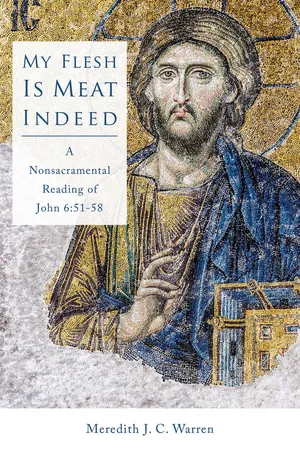
My Flesh Is Meat Indeed
A Nonsacramental Reading of John 6:51-58
- 304 pages
- English
- ePUB (mobile friendly)
- Available on iOS & Android
eBook - ePub
My Flesh Is Meat Indeed
A Nonsacramental Reading of John 6:51-58
About this book
Readers have long puzzled over the absence from the Johannine "Last Supper" of any words by Jesus over bread and wine—suggesting to some that John is indifferent or even hostile to sacramental thought or action—and the apparent dislocation to the feeding miracle, in John 6, of Jesus' declaration that believers must eat his flesh. Meredith J. C. Warren argues that in fact, the "bread of life" discourse in John 6:51c-58 does not bear any Eucharistic overtones. Rather, John plays on shared cultural expectations in the ancient Mediterranean world about the nature of heroic sacrifice and the accompanying sacrificial meal, which established the identification of a hero with a deity. From Homer and continuing through Greek romances like Chaereas and Callirhoe, An Ephesian Tale, Leucippe and Clitophon, and An Ethiopian Story, Warren traces a literary trope in which a hero or heroine's antagonistic relationship with a deity is resolved through the sacrifice of the hero. She argues that seen against this milieu, Jesus' insistence that his flesh be eaten serves to demonstrate his identity and confirms the Christology of the rest of the Gospel.
Trusted by 375,005 students
Access to over 1.5 million titles for a fair monthly price.
Study more efficiently using our study tools.
Information
1
“The Word Was Made Flesh”
(John 1:14)
Introduction
The tension throughout the Gospel of John between the divinity and humanity of Jesus is of paramount importance for the interpretation of John 6:51c-58 because the historical debate in scholarship about this pericope revolves around its interpretation as either a christological or eucharistic text.[1] As such, to anticipate my argument, the emphasis elsewhere in this Gospel, and especially in the prologue, on the relationship between Jesus’ divine and human characteristics lays the groundwork for a christological interpretation of John 6:51c-58 despite its eucharistic echoes. In John, the Word is both flesh (1:14) and God (1:1); John’s primary concern is in demonstrating the relationship between Jesus and the divine.[2] John 6:51c-58 has frequently been viewed as a eucharistic scene, inserted by a later redactor to sacramentalize a Gospel long viewed as anti-sacramental at its core.[3] Several scholars, whose arguments will be discussed below, have argued that since John 6:51c-58 appears to them to be a eucharistic scene, it must therefore be the product of a later period in which sacramentality had become important; they argue that John’s Gospel rarely has interest in sacramentality other than at this point and that the section is therefore the product of the so-called Ecclesiastical Redactor. This represents a circular argument in which a portion of John is assumed to be about a later practice (the Eucharist), resulting in a redactional argument regarding its authorship. Alternate theories have refuted this assumption and its repercussions by arguing for a christological reading of John 6:51c-58, and this alternative view is helpful to my argument. These theories have nonetheless neglected the relevance of Greco-Roman literature to John’s creation of Jesus’ identity vis-à-vis the divine. One of the ways the relationship between Jesus’ human and divine natures can be viewed is through the lens of the Greco-Roman category of the hero. John’s representation of Jesus shares many characteristics with the Hellenistic hero. I argue that this scene, in which Jesus encourages his followers to eat his flesh and drink his blood, is better viewed in the context of John’s concern with Jesus’ identity. Other heroes in the classical world become associated with gods and goddesses through ritual sacrifice; the literary representation of this phenomenon is found in the Hellenistic romance novels from around the time of John’s composition.[4] I suggest, therefore, that John 6:51c-58 is a section in which the Gospel writer concretizes the identification between Jesus and God.
The context of John 6:51c-58 is Jesus’ lecture on the beach of the Sea of Galilee/Tiberias (6:22ff), across the water from where he feeds the five thousand in the beginning of the chapter. Jesus has also recently performed the miracle of walking on the water (6:16-21). When the crowd confronts Jesus about his miracles, he answers with a lecture on the bread of life (6:25ff). Here, Jesus describes himself as the bread of life, which is superior to both the manna eaten in the wilderness in Exodus 16 and to that bread miraculously reproduced by Jesus the previous day in 6:1-14. When οἱ ἰουδαῖοι[5] protest that Jesus cannot possibly be from heaven as he claims, since his parents are both decidedly mortal (6:41-42), Jesus reiterates his credentials as a heavenly person sent by God and confirms his identity as the previously mentioned bread from heaven (6:44-51b). Then Jesus makes a truly shocking claim: “the bread that I will give for the life of the world is my flesh” (51c). That is, Jesus insists that he is the bread of life, and that this bread is his flesh; it is imperative for those who wish to live forever to eat this bread—that is, to eat Jesus’ own flesh. This statement is not accepted enthusiastically; again, οἱ ἰουδαῖοι protest, saying, “How can this man give us his flesh to eat?” (6:52). Jesus is forced to clarify. But when he does, the commandment is even stronger: while in 6:51b the listener is told that those who eat will live forever—a positive statement—in 6:53, Jesus turns the commandment into a negative one and states that those who do not eat the flesh and blood of the Son of Man have no life in them to begin with. The negative statement’s weight shocks even his disciples: “many of his disciples, when they heard it, said, ‘This is a hard saying; who can listen to it?’” (6:60); “after this many of his disciples drew back and no longer went about with him” (6:66). The context of οἱ ἰουδαῖοι questioning Jesus’ heavenly identity in 6:41-42 supports the interpretation of 6:51c-58 as christological.
In this chapter, I will strengthen the argument for this understanding of the passage by first discussing the state of the research concerning Jesus’ divine identity in John. I conclude that John overlays divine and human identities in the person of Jesus by emphasizing Jesus’ body and identity through the signs that he performs. Second, I will outline the scholarship dealing specifically with the Christology of John 6:51c-58. I argue here that a christological interpretation dovetails with John’s continued use of Jesus’ body as a sign and further, that a christological interpretation obviates the need to explain away this passage as late and redactional. Third, I will engage with Rudolf Bultmann’s argument concerning the so-called Ecclesiastical Redactor and suggest that there is in fact no need for such an explanation given (1) the interpretation of this section as christological in meaning, and (2) the continuity in language use, especially with regard to the terms σάρξ and τρῶγειν, terms to which some scholars have pointed as evidence for 6:51c-58 as a later addition. Fourth, I will discuss the problem of sacramentality in John. I will particularly address the problems of John 6’s interpretation as eucharistic, especially given the absence of a Last Supper institution in John. I argue that John 6:51c-58 reappropriates the sacrificial language of consuming flesh and drinking blood in order to make claims about Jesus’ divine identity. The chapter will conclude with a final proposal to view Jesus using the lens of the Hellenistic hero, and in particular, the heroes and heroines found in the romance novels that circulated at the time of John’s composition.
Johannine Christology: State of the Question
The simultaneously human and divine category of Jesus’ identity is the subject of one of the most divisive debates in the field of Johannine studies, a debate that naturally relates most closely to this project. Generally, scholars have tended to align themselves either with a more divine reading of Jesus or a more human one. There has been little in the way of chronological consensus; the debate has numbers on either side throughout the history of scholarship.[6] While scholars rarely, if ever, deny outright the importance of the other element of Jesus’ being, there is a tendency to present reasoned arguments as to why one aspect of Jesus’ identity is more significant than the other. As such, this kind of discussion is representative of the overarching trend in scholarship when discussing the Christology of John’s Gospel; in dichotomizing flesh and glory, Jesus’ complex identity as both God and human can become something of an afterthought. The contention surrounding this debate between the supporters of the flesh and the supporters of the glory speaks, in my opinion, to the importance of both the divine and the mortal in John’s Christology. John’s insistence that Jesus is both fleshly (1:14) and divine (1:1) indicates the author’s concern with Jesus’ identity as both simultaneously. Marianne Meye Thompson puts forward an argument that represents a shift in the debate.[7] Her response to Bultmann and Ernst Käsemann’s Christology rests on the interpretation of the word σάρξ in John 1:14.[8] Thompson looks to other locations of Johannine use of this term in an attempt to come to a definition of σάρξ from context. For her, σάρξ is, as it is for C. K. Barrett and Raymond Brown and to some extent Käsemann as well,[9] the opposition of the realm of humanity to that of God. In 1:14 this is demonstrated by the use of the term in contradistinction to λόγος.[10] The close juxtaposition of “the Word was with God” and “the Word became flesh” highlights the contrast between the godly and the fleshly spheres for John. The glory referred to in 14c, then, represents the ability of witnesses to testify about the glory, rather than, as it is for Käsemann, the pinnacle of Johannine Christology.[11] For Thompson, then, Jesus’ incarnation as described in the prologue emphasizes both aspects of Jesus’ identity in order to exacerbate the offence of the incarnation; this offence exists (John 6:60, 61) because Jesus embodies both the human and the divine.
While Thompson’s argument about 1:14 diffuses the problems with dichotomizing flesh and glory to a certain degree, as I will show in the following section, it is Paul Anderson’s discussion of John’s Christology as a dialectical relationship between the flesh and the glory that is perhaps the most helpful here because it elaborates on the issue of how the seemingly disparate identities coexist in one being.[12] He argues, and I agree, that John 1:14 is indeed key to understanding the Christology of this Gospel. However, unlike Bultmann or Käsemann, Anderson argues that 1:14’s reference to both the flesh and the glory
is a representative encapsulation of the dialectical portrayal of Jesus which runs throughout the entire Gospel. Therefore, any attempt to remove one of the poles which create the tension does violence to the central fibre of John’s christology overall . . . John 1:14a and c are held together by 1:14b ‘and dwelt am...
Table of contents
- Cover
- Title Page
- Copyright
- Dedication
- Table Of Contents
- Preface
- Introduction
- “The Word Was Made Flesh” (John 1:14)
- “Second Only To Artemis” (Leucippe and Clitophon 7.15)
- “Her Viscera Leapt Out” (Leucippe and Clitophon 3.15)
- “My Flesh is Meat Indeed” (John 6:55, KJV)
- Conclusion: “Equal to God” (John 5:18; Iliad 20.447)
- Bibliography
- Index of Subjects
- Index of Names
Frequently asked questions
Yes, you can cancel anytime from the Subscription tab in your account settings on the Perlego website. Your subscription will stay active until the end of your current billing period. Learn how to cancel your subscription
No, books cannot be downloaded as external files, such as PDFs, for use outside of Perlego. However, you can download books within the Perlego app for offline reading on mobile or tablet. Learn how to download books offline
Perlego offers two plans: Essential and Complete
- Essential is ideal for learners and professionals who enjoy exploring a wide range of subjects. Access the Essential Library with 800,000+ trusted titles and best-sellers across business, personal growth, and the humanities. Includes unlimited reading time and Standard Read Aloud voice.
- Complete: Perfect for advanced learners and researchers needing full, unrestricted access. Unlock 1.5M+ books across hundreds of subjects, including academic and specialized titles. The Complete Plan also includes advanced features like Premium Read Aloud and Research Assistant.
We are an online textbook subscription service, where you can get access to an entire online library for less than the price of a single book per month. With over 1.5 million books across 990+ topics, we’ve got you covered! Learn about our mission
Look out for the read-aloud symbol on your next book to see if you can listen to it. The read-aloud tool reads text aloud for you, highlighting the text as it is being read. You can pause it, speed it up and slow it down. Learn more about Read Aloud
Yes! You can use the Perlego app on both iOS and Android devices to read anytime, anywhere — even offline. Perfect for commutes or when you’re on the go.
Please note we cannot support devices running on iOS 13 and Android 7 or earlier. Learn more about using the app
Please note we cannot support devices running on iOS 13 and Android 7 or earlier. Learn more about using the app
Yes, you can access My Flesh Is Meat Indeed by Meredith J. C. Warren,Meredith J.C. Warren in PDF and/or ePUB format, as well as other popular books in Theology & Religion & Biblical Criticism & Interpretation. We have over 1.5 million books available in our catalogue for you to explore.