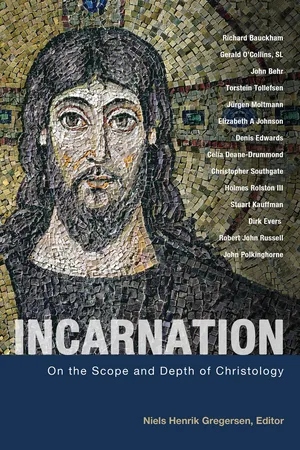
Deeply engaged with the classical tradition and the contemporary world, the book leads readers into critical explorations and debates of the concept of “deep incarnation”—the view that the divine incarnation in Jesus presupposes a radical embodiment that reaches into the roots of material and biological existence, as well as into the darker sides of creation. Such a wide-scope view of incarnation allows Christology to be relevant and meaningful when responding to the challenges of scientific cosmology and global religious pluralism: How does the revelation of the love of God in Christ relate to other experiences of communicative love and ethical sensitivity, to suffering and joy?; In what sense does God’s Logos and Wisdom “becoming flesh” include the world of “all flesh”—from grass to human persons; What are the connections between a Logos Christology and the informational aspects of the universe—those exemplified in its deep mathematical structures as well as those emerging in biological evolution?; In brief, how does “high” and “low” meet and mingle in the story of incarnation?
- 350 pages
- English
- ePUB (mobile friendly)
- Available on iOS & Android
eBook - ePub
About this book
In this volume, prominent scholars take the reader on a journey from New Testament and early church views of incarnation to contemporary understandings of Christology.
Trusted by 375,005 students
Access to over 1.5 million titles for a fair monthly price.
Study more efficiently using our study tools.
Information
Topic
Theology & ReligionSubtopic
Christian Theology2
Deep Incarnation: Perspectives from Contemporary Systematic Theology
5
Is God Incarnate in All That Is?
Jürgen Moltmann
The question of Niels Gregersen that is the title of this chapter includes the thesis, “God is incarnate in all that is.” By setting this in the form of a question, the discussion of the thesis is open. In this chapter, I shall examine the theological logic of this thesis. I shall take the idea up in a Christology from the incarnation of the Son of God to his death on the cross and his resurrection from the dead and elevation to the cosmocrator. With reference to the biblical use of the Hebrew words basar and kol basar (“flesh” and “all flesh”), I shall confirm the future of the world where God will be “all in all” (1 Cor. 15:28). It is only at the eschatological end that God will be “in all that is.”
Why, as Christian Theology Maintains, Did the Divine Logos “Become Flesh” in Jesus of Nazareth?
”God became human so that we human beings might become gods” (Athanasius, Inc. 52). In order to understand the first proposition about the incarnation (“God became human”), we have to take note of the clause that follows. The main christological statement is explained only by the soteriological purpose clause. Athanasius’s thesis is a good rendering of the christological dialectic:
Jesus Christ:
crucified—raised
died—risen
humiliated—exalted
became human—Lord of the world
crucified—raised
died—risen
humiliated—exalted
became human—Lord of the world
The soteriological significance of this dialectic is brought out very well by the patristic axiom, “What is not assumed cannot be healed.” That can be interpreted with Athanasius’s sense to mean, “God has become human so that we human beings can participate in the divine life as God’s sons and daughters,” or, following Martin Luther, “God becomes human in order to turn us from being unhappy and proud gods into true human beings who accept their lowliness.”[1]
God the Son humiliates himself to the point of death on the cross in order to exalt all the humiliated to God. More, the eternal Word of creation became “flesh” in order to heal “all flesh”—that is to say, all the living. In the double event of Christ’s incarnation and resurrection, we can see the tremendous divine dynamic that drives toward the transformation of all things into their true and abiding form. Nothing that is remains just as it is once it is accepted by Christ and transformed in him.
Where this dynamic of the crucified and raised Christ is present, “everything old has passed away; see, everything has become new” (2 Cor. 5:17). Can we discern this transforming dynamic only in human beings who through faith are “in Christ”? According to the Epistles to the Colossians and the Ephesians, we can also perceive the cosmic Christ in all things that the exalted Christ has “reconciled” (Col. 1:20). We recognize the cosmic Christ in the cosmos that has been reconciled and made ready for transformation. Paul has unjustly been accused of anthropocentricism, but for Paul too, God was first in Christ reconciling the cosmos with himself before he was “entrusting the message of reconciliation to us” (2 Cor. 5:19). Why? Because for Paul, too, Christ is the mediator of creation, “through whom are all things and through whom we exist” (1 Cor. 8:6).
Is that speculation, or pure mythology, as Rudolf Bultmann thought?[2] I may point to the Egyptian desert fathers, divinely enthused young men who withdrew into the desert, the land where it was not the gods who ruled but was the home of demons, so that there they might experience the victory of the cosmic Christ.[3] Anthony was the most famous of them. Pachomius built the first Christian monastery in the desert. It is true that today we no longer believe in demons, but the struggle with fears in the deserts of our world, and faith in the cosmic victory of the risen Christ, have more topical force today than ever before.
Christ’s Resurrection and Incarnation
Before we follow up this cosmic Christology further in the linguistic contexts of the biblical words basar and sarx, we first have to ask how people arrived at knowledge of the Son of God who became human in Jesus of Nazareth—knowledge of the Logos who became flesh in him. That cannot be seen from Jesus’ birth and his life and ministry, let alone from his death on a Roman cross. The cognitive ground for the perception of God’s incarnation in Jesus is to be found in his “resurrection from the dead” and his exaltation to God—he was “declared to be Son of God with power . . . by resurrection from the dead,” as Paul puts it (Rom. 1:4).[4] Without the event that the women and the disciples called the resurrection, we would know nothing about a Jesus of Nazareth. But the true substantive ground for his exaltation lies in his humbling of himself to the point of death on the cross, as the hymn in the Epistle to the Philippians says (Phil. 2:6-11). The presupposition for that, however, is the birth of God in the becoming human of Christ.
The incarnation of the Son of God presents Jesus’ whole life and death sub specie aeternitatis—or, to put it more exactly, sets it in the light of his resurrection. The Gospels relate “the history of a living person,” as Edward Schillebeeckx said, not the story of someone dead. Thus the incarnation of God comprehends Jesus’ whole life and death as the Christ of God, and Wolfhart Pannenberg has talked about the “retrospective power” of Christ’s resurrection on his life and death.[5] This is thought of chronologically, but the “resurrection of the dead” is an eschatological symbol. I would thus prefer to talk about the eschatological logic: the last reveals the first.[6] Christ’s resurrection from the dead reveals him as being the incarnate Son of God. His exaltation as the cosmic Christ reveals him as being the foundation of all things in creation. The fullness of life that has appeared in the risen Christ makes the intention of his participation in our life and his assumption of our death manifest.
Because the resurrection of the crucified Christ is ahead of the general resurrection of the dead, and because death itself has been overcome (or “slain,” as Luther put it), Christ is also the beginning of the new creation of all things out of their transience into their abiding form, which does not pass away. The resurrection of Christ has to be grasped not only in the framework of a historical eschatology, but in cosmic eschatology too. The risen Christ is not just a hope for eternal life given to mortal human beings; he is also the future of all things in a “new heavens and new earth, where righteousness is at home” (2 Pet. 3:13).
In the perspective of this eschatology, we have to cast another glance at the incarnation of God. His “taking flesh” sets Jesus’ whole person within his relationship to God: “In him the whole fullness of deity dwells bodily” (Col. 2:9). So it is impossible to say that “in Christ the being of God” consisted only of his “unremittingly powerful God-consciousness,” as Friedrich Schleiermacher taught in his doctrine of faith.[7] The Gospels relate the story of Jesus’ miracles in such a way as to show that healing power also emanated from his body (see, for example, the story of the woman with an issue of blood in Matt. 9:18-26).
A person does not only consist of body and soul, but subsists in his or her relationships as well. That is why Jesus’ relationship to the sick, the poor, and the outcasts, and his relationship with women and his disciples, are important for the perspectives of the incarnation. These perspectives also include the incarnate God’s relationships to nature: “He was with the wild beasts” (Mark 1:13), and “the wind and sea obey him” (Mark 4:35-41).
In his encyclical Dominum et vivificantem of May 18, 1986, John Paul II wrote: “The incarnation of God’s Son means not only the assumption of human nature into unity with God, but in some sense the assumption of everything that is ‘flesh’—the assumption of the whole humanity, of the whole visible and material world. The incarnation therefore also has a cosmic significance and dimension” (§ 50). Does this “assumption” of the cosmos into unity with God result in a God-cosmos instead of the God-human? How are we then to understand the human history of Jesus from the manger to the cross?
The deep-incarnation perspective sets not only Jesus’ person in light of a cosmic eschatology, but the path Jesus took as well. The path began in a stable and ended on the gallows. It is a way taken by Christ with God through human conditions of life and death, from the endowment with God’s Spirit at his baptism to God-forsakenness on the cross, so that everything might be filled with his presence. In his death, it is his path into the world of the dead, so that the world of the dead too might be irradiated with his gospel. It is his descent into hell, so that the gates of hell might be destroyed. It is his raising from the dead, so that the dead might be redeemed. It is his ascent into heaven, so that heaven too might be possessed, and his exaltation “to the right hand of God” (Acts 2:33), so that the cosmos might be reconciled, and all things “in heaven and on earth and under the earth” (Phil. 2:10) prepared for the creation. Why? The Orthodox Easter liturgy proclaims:
Now everything is filled with light,
heaven and earth
and the realm of the dead.
The whole creation exalts in Christ’s resurrection.[8]
heaven and earth
and the realm of the dead.
The whole creation exalts in Christ’s resurrection.[8]
If Christ’s resurrection has such a universal, cosmic significance, then a universal and cosmic light falls on his incarnation too. But this then raises the critical question: in what is God not incarnate?
If in Jesus God has “become flesh,” then he is not incarnate in the demonic political and natural enemies who withstood Jesus’ gospel, were the adversaries of his life, tortured him, and brought him to death on the cross. These are the “every ruler and every authority and power” that killed Christ and that the risen Christ will, for his part, “destroy” (1 Cor. 15:24). Further, “He must reign until he has put all his enemies under his feet. The last enemy to be destroyed is death” (1 Cor. 15:25-26). These are the powers of chaos, the forces that are hostile to human beings and creation, the godless destructive forces of annihilation. In these God is not present; on the contrary, the creation of the world ex nihilo and the resurrection of Christ from the dead are God’s protest against the deadly powers and the annihilating nothingness.
Here a far-reaching difference between Paul and the so-called deuteropauline writers emerges. The quotation from 1 Corinthians shows that where the principalities and powers were concerned, Paul was an eschatological anarchist: these forces are to be “destroyed.” But according to the Epistles to the Ephesians and Colossians, the cosmic Christ will merely strip them of their power, reconcile them, and put them to rights. “He has disarmed the principalities and powers and made a public example of them, triumphing over them in him” (Col. 2:15 rsv), for Christ is the head of all the principalities and powers (Col. 2:10). In the Epistle to the Ephesians, this happening is called the anakephalaiōsis tōn pantōn: “to gather up all things in him, things in heaven and things on earth” (Eph. 1:10). With his resurrection from the dead, Christ is set “at [God’s] right hand . . . far above all rule and authority and power and d...
Table of contents
- Cover
- Title Page
- Copyright
- Table Of Contents
- Acknowledgments
- Introduction
- Creation and Incarnation: New Testament and Early Church Perspectives
- Deep Incarnation: Perspectives from Contemporary Systematic Theology
- Divine Presence and Incarnation: Scientific and Philosophical Perspectives
- Concluding Reflections
- About the Authors
- Index
Frequently asked questions
Yes, you can cancel anytime from the Subscription tab in your account settings on the Perlego website. Your subscription will stay active until the end of your current billing period. Learn how to cancel your subscription
No, books cannot be downloaded as external files, such as PDFs, for use outside of Perlego. However, you can download books within the Perlego app for offline reading on mobile or tablet. Learn how to download books offline
Perlego offers two plans: Essential and Complete
- Essential is ideal for learners and professionals who enjoy exploring a wide range of subjects. Access the Essential Library with 800,000+ trusted titles and best-sellers across business, personal growth, and the humanities. Includes unlimited reading time and Standard Read Aloud voice.
- Complete: Perfect for advanced learners and researchers needing full, unrestricted access. Unlock 1.5M+ books across hundreds of subjects, including academic and specialized titles. The Complete Plan also includes advanced features like Premium Read Aloud and Research Assistant.
We are an online textbook subscription service, where you can get access to an entire online library for less than the price of a single book per month. With over 1.5 million books across 990+ topics, we’ve got you covered! Learn about our mission
Look out for the read-aloud symbol on your next book to see if you can listen to it. The read-aloud tool reads text aloud for you, highlighting the text as it is being read. You can pause it, speed it up and slow it down. Learn more about Read Aloud
Yes! You can use the Perlego app on both iOS and Android devices to read anytime, anywhere — even offline. Perfect for commutes or when you’re on the go.
Please note we cannot support devices running on iOS 13 and Android 7 or earlier. Learn more about using the app
Please note we cannot support devices running on iOS 13 and Android 7 or earlier. Learn more about using the app
Yes, you can access Incarnation by Niels Henrik Gregersen in PDF and/or ePUB format, as well as other popular books in Theology & Religion & Christian Theology. We have over 1.5 million books available in our catalogue for you to explore.