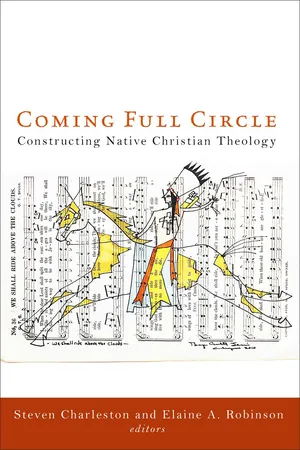
eBook - ePub
Coming Full Circle
Constructing Native Christian Theology
- 176 pages
- English
- ePUB (mobile friendly)
- Available on iOS & Android
eBook - ePub
Coming Full Circle
Constructing Native Christian Theology
About this book
Coming Full Circle, a unique, multicollaborative project, provides a working constructive Native Christian theology. Drawing together leading scholars in the field, along with elders and practitioners, this volume seeks to fill a significant lacuna in the area and to encourage young Native American scholars and non-Native theologians to reconsider the rich possibilities present in the intersection between Native theory and practice and Christian theology and practice. This innovative work begins with a Native American theory for doing constructive Christian theology and then illustrates the possibilities with chapters on specific Christian doctrines. With significant essays on key doctrinal loci such as sin, revelation and epistemology, prayer and worship, mission and ministry, reconciliation and restoration, and the new creation, this volume will make an important contribution representing the Native American voice in a constructive and contemporary vein. Although not a full-scale systematic dogmatics, this "theology in outline" offers the theory and constructive initiative to encourage further explorations in Native American Christian theologies.
Information
Topic
Theology & ReligionSubtopic
Christian Theology2
Revelation and Epistemology—We Know the Land, the Land Knows Us: Places of Revelation, Place as Revelation
Jace Weaver
Cherokee newspaperman and novelist John Rollin Ridge, writing in the mid-nineteenth century, told the story of one of the first missionaries to come among his people. The man gathered the people of the village together in their council house. He then proceeded to narrate to the assembled Indians the story of the biblical witness, beginning with creation. In one corner of the room was an aged warrior, the veteran of many campaigns. This Native periodically interrupted with interjections like, “Listen to what this man says! It has power.” Or “What he says is good!” The missionary was irritated by the disruptions, but the Indian was being supportive, and he didn’t want to silence him.
As the white man continued to relate the gospel story and the closer Jesus came to Jerusalem, the old man fell silent and began to rock back and forth in agitation. Finally, as the missionary came to the crucifixion, the Indian leapt to his feet and cried out, “Tell us where we can find the men who did this evil thing to this good man, and we will have revenge upon them!” The Christian was forced to admit to him that events of which he spoke happened a very long time ago in a very distant land and that the people responsible were not immediately available for revenge. At that point, says Ridge, the old man lost any interest in the new religion because it had nothing to do with his life.[1] Ridge’s story, though amusing and probably apocryphal, nonetheless illustrates a couple of key aspects about Native American religious traditions. They are rigorously empirical and experiential. There is an immediacy about them, and anything that does not relate to the lived lives of the people is likely to be dismissed as irrelevant.
In this chapter, I want to discuss the related theological concepts of epistemology and revelation. I will do so through the connected lenses of the empiricism and experiential nature of Native religious traditions. I will link these to the importance of both ritual or ceremony and place as they relate to indigenous religious traditions, which are land-based and often site-specific. Native religious traditions are not primarily religions of theology, or belief, or dogma. Rather, like Shinto, they are religions of ritual observance. Their ongoing vitality requires the continued communal practice of ceremonies by the people. Neither are they meta-religions of the book, like Judaism, Christianity, or Islam. Instead, they rely on the oral tradition for their transmission. Though there are often commonalities across various indigenous cultures and traditions, Native traditions are each tied to a specific people, and they are wholly in the hands of the practitioners to define. Because of this level of specificity, generalizations can be perilous.
Traditional homelands of indigenous nations cover North America from Nunavut in the north to the desert southwest, from Labrador on the Atlantic seaboard to California and Alaska on the Pacific. Native cultures and the religious traditions that permeate every aspect of them are geo-mythological, that is to say, they are shaped by the land and environment of a given people’s homelands. Given the vast differences in environment and landscape over this territory, Native cultures can differ one from another as radically as the culture of France versus the culture of Tibet, and religious traditions can be as divergent as Christianity is from Hinduism.
It might therefore be more correct to refer to “epistemologies” in the plural. In order, however, to be able to say something rather than nothing, I will rely on some of the aforementioned commonalities, and I will offer some concrete examples to illustrate these Native epistemologies. I will then offer some concluding reflections on when we come to these issues of epistemology and revelation as Native Christians, how the traditional ideas about these compare to the Western vision and traditional Christian theology. How might they inform our faith as Native American Christians?
I have said that Native traditions are empirical and experiential. They are based on generations upon generations of observation of the natural environment in which a given tribal group found themselves. As Mescalero Apache philosopher Viola Cordova puts it, a given religious tradition “must be based on the observation and experience of the group in a specific location and under circumstances specific to that location.”[2] In the seminal analysis of Vine Deloria Jr., one of the founders of contemporary Native American studies, in his book God Is Red, the empirical and experiential nature of Native cultures created an indigenous worldview very different from that of Western Christianity. The latter essentially roots itself temporally, in chronology and history. By contrast, Natives think spatially, grounding (no pun intended) their thought in place. Also, Christian thinking is linear: Time commences at the moment of creation, as depicted in Genesis, and then moves teleologically toward the parousia, whereas Natives think cyclically.
Writer Kristyna Bishop relates a conversation she had with Kalahari bushman in Botswana. The aged indigenous man told her that he could never leave his homeland “because the land knows me.” She continued that the sentiment expressed reminded her of something Richard Nerysoo, a Gwich’in leader in Canada’s Northwest Territories said to her, explaining that “being an Indian means saying that the land is an old friend that your father knew, your grandfather knew—your people have always known. If the land is destroyed, then we too are destroyed. If you people ever take our land, you will be taking our life.”[3] Nerysoo was not speaking metaphorically. It is this intensely intimate relationship to the land that makes removal of tribal nations from their homelands, depriving them of their numinous geography—as I have written—tantamount to psychic homicide.
That Native cultures would develop a worldview that was spatial and cyclical, in contrast to the thinking of the dominant culture, is natural. Living in subsistence economies, for Natives not to fully comprehend the environment and landscape in which a people was located was to invite disaster. Living on that land generation after generation, tribal peoples saw all kinds of endless cycles in the natural world—the waxing and waning of the moon, the movement of stars in the sky, the changes of the seasons. In the last of these, they witnessed a perpetual cycle of life, death, and rebirth. Nature was in its full vigor in summer, only to decay in the autumn and die in the winter. The circle was completed as the earth was reborn every spring.
These cycles caused some Native peoples to believe in reincarnation for both human beings and for other-than-human persons. It is commonly said that a belief in reincarnation is antithetical to Christian doctrine, which maintains the unique nature of every soul. Yet as the great British theologian Leslie Weatherhead pointed out in his book The Christian Agnostic, many of the early church fathers, including Augustine and Origen, either accepted it or were open to the possibility.[4] And Weatherhead quotes his fellow Protestant thinker C. S. Lewis: “I believe that if a million chances were likely to do good, they would be given.”[5]
Creating Minds, Creating Worlds
With this brief introduction to indigenous thought-ways, let me turn to Native conceptions of ultimate reality, how that reality is known, and how that knowing relates to the land. Let me provide several related examples. The late Navajo artist Carl Gorman said:
It has been said by some researchers into Navajo religion, that we have no Supreme God because He is not named. That is not so. The Supreme Being is not named because He is unknowable. He is simply the Unknown Power. We worship him through His creation. We feel too insignificant to approach directly that Great Power that is incomprehensible to man. Nature feeds our soul’s inspiration and so we approach Him through that part of Him that is close to us and within the reach of human understanding. We believe that this great unknown power is everywhere in His creation. The various forms of creation have some of this spirit within them. . . . As every form has some of the intelligent spirit of the Creator, we cannot but reverence all parts of the creation.[6]
Similarly, for the Pawnee, Tirawa is an all-powerful force who is unknowable. Tirawa cannot be seen, heard, or experienced except through his sixteen manifestations. What are these manifestations? They are the forces of nature: the wind, the clouds, lightning, thunder, rain, and so forth.[7]
The Sioux (Lakota, Dakota, Nakota) concept of Wakan tanka is sometimes translated as “great spirit.” Many today know that a better rendering is “great mystery.” The English translation that comes closest to the L/D/Nakota sense is “great mysterious.” What makes Wakan tanka wakan (i.e., great or holy) is that it has the power to create and the power to destroy. This Great Mysterious reveals itself to humankind in a variety of ways. It “behaves like a definite individuality, may be pleased or displeased, propitiated or placated and its aid may be secured by appropriate sacrifice . . . ”[8] Yet like Tirawa and ultimate reality for the Navajo, Wakan tanka cannot be comprehended by humankind. Only in the novel Waterlily by Vine Deloria’s great-aunt Ella Cara Deloria is it depicted as the god who draws near, audibly heard answering the fervent prayer of the mother of the protagonist when she prays for the survival and health of her newborn child.
Nerysoo’s Gwich’in, a people, like the Navajo, of the Athabaskan language family, conceive of ultimate reality not as a Great Mystery but as the Great Energy.[9] The Haudenosaunee (Iroquois) possess a concept of orenda. Orenda is a spiritual force or energy that permeates all objects and persons, that makes all actualization possible. Among the Cherokee, the Haudenosaunees’ Iroquoian kinsmen, orenda becomes Yowa. Yowa is a Cherokee conception of ultimate reality. According to some, but not all, accounts, Yowa created the world at Nu-ta-te-qua, the first new moon of autumn when all the fruits were ripe. The name was so holy that originally it could only be spoken by certain of the ani-kutani, members of the supposed ancient Cherokee priestly caste. It is also a spirit or essence that undergirds all of creation. Yowa, in turn, is a unity of the cho ta auh ne le eh, the three Elder Fires Above. These three are Uhahetaqua, Atanoti, and Usquahula, representing Yowa’s will or intention, action or intelligence, and love or compassion for the Cherokee people. These three are always and forever unanimous in thought and action. They are facets of a single mind exploring itself in myriad ways.[10]
Cherokee Emmet Starr, in his History of the Cherokee Indians, written in 1921, transliterates Yowa as “Yehowa.” This remains the Cherokee word today for Jehovah, the Jewish-Christian deity. Because of this, perhaps coupled with the rather Augustinian formulation of Yowa and the cho ta auh ne le eh, Starr concludes that this concept, and indeed all of Cherokee traditional religious belief and practice were, to use William McLoughlin’s term, “fractured myths,” myths that underwent change as a result of European and Euro-American contact and pressure. Starr concludes that the preaching of Christian Gottlieb Priber, an ex-Jesuit, in 1736 taught Cherokees biblical stories and ideas that, within seventy years, the Cherokees themselves forgot the origins of and mistakenly attributed them to indigenous Cherokee religious traditions under the ani-kutani, whom Starr believes were merely legendary. Thus all of what is presumed to be Cherokee religious tradition is, for Starr, derivative of Christianity. While the impact of Priber and other missionaries may have been significant, it begs credulity that a people could forget themselves so completely in so short a historical span of time, and other scholars discount their influence.[11]
Given the tremendous cultural and religious diversity among Native tribal traditions, conceptualizations of deity or ultimate reality vary enormously. The foregoing examples (which could be replicated many times over), however, demonstrate that for a gr...
Table of contents
- Cover
- Title Page
- Copyright
- Table Of Contents
- Preface
- Contributors
- Theory—Articulating a Native American Theological Theory
- Revelation and Epistemology—We Know the Land, the Land Knows Us: Places of Revelation, Place as Revelation
- Restoration and Reconciliation—Restoring Truth in a Time of Repentance
- Heaven and Hell—Heaven (Ga lv la di tso sv) and Hell (Tsv s gi no): A Cherokee Mother and Bishop’s Perspective
- Creation—The New Creation: A Maskoke Postcolonial Perspective
- Sin—Ambiguity and Complexity and the Sin of Not Conforming
- Church—Wocekiye Okolakiciye: A Lakota Experience of the Church
- Worship and Prayer—Living Prayer, Living Worship
- Mission and Ministry—Church and Culture: A Difficult Beginning
- Theological Anthropology—On Being Human: An Interview with Ada Deer
- For Further Reading
- Index
Trusted by 375,005 students
Access to over 1.5 million titles for a fair monthly price.
Study more efficiently using our study tools.
Frequently asked questions
Yes, you can cancel anytime from the Subscription tab in your account settings on the Perlego website. Your subscription will stay active until the end of your current billing period. Learn how to cancel your subscription
No, books cannot be downloaded as external files, such as PDFs, for use outside of Perlego. However, you can download books within the Perlego app for offline reading on mobile or tablet. Learn how to download books offline
Perlego offers two plans: Essential and Complete
- Essential is ideal for learners and professionals who enjoy exploring a wide range of subjects. Access the Essential Library with 800,000+ trusted titles and best-sellers across business, personal growth, and the humanities. Includes unlimited reading time and Standard Read Aloud voice.
- Complete: Perfect for advanced learners and researchers needing full, unrestricted access. Unlock 1.5M+ books across hundreds of subjects, including academic and specialized titles. The Complete Plan also includes advanced features like Premium Read Aloud and Research Assistant.
We are an online textbook subscription service, where you can get access to an entire online library for less than the price of a single book per month. With over 1.5 million books across 990+ topics, we’ve got you covered! Learn about our mission
Look out for the read-aloud symbol on your next book to see if you can listen to it. The read-aloud tool reads text aloud for you, highlighting the text as it is being read. You can pause it, speed it up and slow it down. Learn more about Read Aloud
Yes! You can use the Perlego app on both iOS and Android devices to read anytime, anywhere — even offline. Perfect for commutes or when you’re on the go.
Please note we cannot support devices running on iOS 13 and Android 7 or earlier. Learn more about using the app
Please note we cannot support devices running on iOS 13 and Android 7 or earlier. Learn more about using the app
Yes, you can access Coming Full Circle by Steven Charleston, Elaine A. Robinson, Steven Charleston,Elaine A. Robinson in PDF and/or ePUB format, as well as other popular books in Theology & Religion & Christian Theology. We have over 1.5 million books available in our catalogue for you to explore.