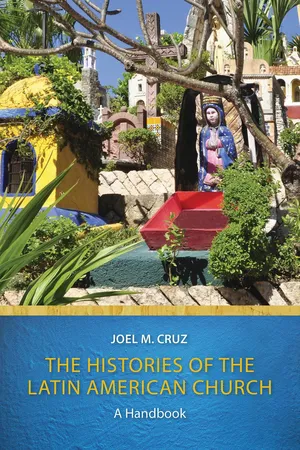
Latin American Christianity is too often presented as a unified story appended to the end of larger western narratives. And yet the stories of Christianity in Latin America are as varied and diverse as the lands and the peoples who live there. The unique political, ecclesial, social, and historical realities of each nation inevitably shaped a variety of Christian expressions in each. Now, for the first time, a resource exists to help students and scholars understand the histories of Latin American Christianity.
An ideal resource, this handbook is designed as an accompaniment to reading and research in the field.
After a generous overview to the history and theology of the region, the text moves nation-by-nation, providing timelines, outlines, and substantial introductions to the politics, people, movements, and relevant facts of Christianity as experienced in that nation.
The result is an informative and eye-opening introduction to a kaleidoscope of efforts to articulate the meanings and implications of Christianity in the context of Latin America.
- 350 pages
- English
- ePUB (mobile friendly)
- Available on iOS & Android
eBook - ePub
About this book
Information
Topic
Theology & ReligionSubtopic
Asian Religions2
Country-by-Country Exploration
Argentina
2:1:1: Demographics
| Official name | Argentine Republic (República Argentina) |
| Capital | Buenos Aires |
| Government | Constitutional republic |
| Divisions | Twenty-three provinces |
| National holidays | March 24—Day of Remembrance for Truth and Justice June 20—Flag Day July 9—Independence Day (1816) Second Monday in October—Day of Respect for Cultural Diversity Fourth Monday in November—Day of National Sovereignty |
| Population | 40,117,096 (2010 Census)[1] |
| Ethnic makeup | European (Italian, Spanish, French, German)—86.4 percent Mestizo—6.5 percent Indigenous (Mapuche, Kolla, Toba, Guaraní, and so on)—3.4 percent Arab—3.3 percent Other (Asian, African)—0.4 percent |
| Language | Spanish (official), German, Italian, English, Welsh, Portuguese, Slavic, andIndigenous (Guaraní, Aruacanian/Mapuche, Quechua) |
| Religion | Roman Catholic—76.5 percent[2] Protestant—9.0 percent Historic/Mainline Protestant—1.1 percent Pentecostal/Evangelical—7.9 percent Other—3.2 percent None / None specified—11.3 percent |
2:1:2: Timeline
| Date | Christianity | Social-Political and Cultural Events |
| 1480 | The Inca Empire conquers northwestern Argentina. | |
| 1502 | Amerigo Vespucci’s expedition encounters the Río de la Plata region. | |
| 1516 | Juan de Solís becomes the first European to explore the Río de la Plata region; he is subsequently killed and possibly cannibalized by the natives. | |
| 1535 | Mercedarian friars are the first religious order to explore the La Plata region. | |
| 1536 | Santa María de Buen Aire founded by Pedro de Mendoza; abandoned five years later due to indigenous attacks. | |
| 1538 | First Franciscan friars arrive to assist in the evangelization and colonization of the La Plata and Tucumán regions. | |
| 1550 | Dominicans accompany Spanish conquistadores from Peru into Tucumán. | |
| 1552 | Diocese of La Plata erected covering Argentina, Chile, Paraguay, and Bolivia (today the Archdiocese of La Plata encompasses Bolivia). | |
| 1570 | Diocese of Cordoba in Tucumán founded.As part of the Viceroyalty of Peru, Argentina is subject to the Inquisition, newly established in Lima. | |
| 1575 | Franciscan missionary LUIS DE BOLAÑOS arrives in South America. | |
| 1580 | Buenos Aires reestablished as part of the Viceroyalty of Peru.First church built, now site of the Metropolitan Cathedral of Buenos Aires. | |
| 1586 | Jesuits arrive in Tucumán and use it as a base from which to launch evangelistic expeditions into Paraguay and Buenos Aires. | |
| 1588 | ALONSO DE BÁRCENA, Jesuit missionary, arrives in Argentina to minister among the Indians. | First African slaves arrive in Río de la Plata. |
| 1593 | JUAN ROMERO begins work as superior of missions in Tucumán. | |
| 1609 | First Jesuit reductions to the Guaraní founded in the Upper Paraná region. | |
| 1610 | Franciscan missionary FRANCISCO SOLANO dies. | |
| 1617 | Diocese of Buenos Aires founded. | |
| 1622 | University of Córdoba founded by the Society of Jesus.Cathedral of Buenos Aires is dedicated. | |
| 1629 | First Provincial Council of La Plata convened by Fernando de Arías y Ugarte to reform efforts at Indian evangelization and education. | |
| 1766 | British occupy the Falkland Islands (Islas Maldivas). | |
| 1767 | Expulsion of the Jesuits from Spanish America; Franciscans, Dominicans, and Mercedarians take over their reductions. | |
| 1774–1778 | Second Provincial Council of La Plata presided over by Archbishop Pedro Argadoña to review the geographical limits of dioceses as well as the education and development of the clergy and the faithful. | |
| 1776 | Viceroyalty of Río de la Plata (Argentina, Paraguay, Chile, Uruguay, and parts of Bolivia) is established. | |
| 1780 | The Spanish authorities force the British to leave the Falkland Islands. | |
| 1806 | Unsuccessful British invasion repelled by local militias. | |
| 1810 | Father MANUEL ALBERTI takes part in the May Revolution against Spain. | |
| 1812 | Our Lady of Mercies crowned as patron of the army. | |
| 1813 | The Inquisition is dismantled. | Freedom of immigration to all nations promulgated. |
| 1814–1876 | Argentine Civil Wars fought. | |
| 1814 | GREGORIO DE FUNES defends republican forms of government. | |
| 1816 | Led by José de San Martín, Argentina declares its independence from Spain at the Congress of Tucumán; of the twenty-nine who signed the declaration, eleven were priests. | |
| 1818 | JAMES “DIEGO” THOMPSON arrives as a Bible colporteur from the British and Foreign Bible Society. | |
| 1822 | Anglican mission begun among Patagonian Indians. | Clerical reform laws under minister of Buenos Aires, Bernardino Rivadavia, place the Catholic clergy under the control of the state, abolish the tithe and ecclesiastical privileges, secularize some monasteries, suppress religious orders, and make education a responsibility of the government. |
| 1823 | Presbyterian Church in the USA begins mission work. | |
| 1824 | Scottish Presbyterians arrive to evangelize. | Bernardino Rivadavia rebuffs the papal delegate. |
| 1825–1829 | First Presbyterians and Anglicans arrive from Great Britain to minister to English-speaking populations. | |
| 1825 | Religious tolerance enacted. | |
| 1829–1832 | Juan Manuel de Rosas serves as governor. | |
| 1829–1851 | MARIANO MEDRANO serves as bishop of Buenos Aires. | |
| 1831 | Juan Manuel de Rosas voids all papal edicts issued after 1810; seeks to control church appointments, reviving patronage. | |
| 1832 | First Conquest of the Desert under Rosas against the indigenous populations.Charles Darwin arrives in Argentina aboard HMS Beagle. | |
| 1833 | British reassert control over the Falklands. | |
| 1835–1852 | Juan Manuel de Rosas rules as dictator. | |
| 1835 | Juan Manuel de Rosas reverses the Clerical reform laws in order to control the church. | |
| 1836–1839 | War of the Confederations pits Peru and Bolivia against Argentina and Chile. | |
| 1836 | First Methodists begin missions in Argentina. | |
| 1839 | Catholic Churches ordered to display images of Rosas and his wife over altars and public spaces. | |
| 1843 | Evangelical Church of the River Plate founded in Buenos Aires by Swiss and Russian-German immigrants.German Lutherans arrive. | |
| 1844 | South American Mission Society formed in England to evangelize among the indigenous people of Tierra de Fuego. | |
| 1853 | MAMERTO ESQUIÚ preaches the “Sermon of the Constitution” in Catamarca, urging the union of all Argentines. | The Argentine Constitution is adopted. The Roman Catholic Church retains a privileged and official position but religious freedom is promulgated.Slavery abolished in the Argentine Constitution. |
| 1859 | First Waldensians arrive in Río de la Plata from Europe. | Buenos Aires refuses to become part of the country of Argentina. |
| 1864–1870 | The Paraguayan War (Paraguay versus Brazil, Argentina, and Uruguay) fought. | |
| 1864 | American Bible Society | |
| 1865 | Buenos Aires is raised to archdiocese. | |
| 1875–1884 | Second Conquest of the Desert extends Argentine rule into Patagonia by massacring Indian populations. | |
| 1878 | ANTONIO MAMERTO GIL NÚÑEZ dies; now venerated as the popular folk saint Gauchito Gil. | |
| 1882 | Plymouth Brethren arrive from England.Danish Lutheran Church | |
| 1884 | Catholic Union Party formed by politician JOSÉ MANUEL ESTRADA.First Assembly of Argentine Catholics meets to counter liberal tendencies in government. | Civil marriage and compulsory civil education leads to church-state tensions. |
| 1886 | Dutch Reformed arrive, establishing the Argentine Reformed Church. | |
| 1889 | Salvation Army | Civil marriage mandated. |
| 1892 | FEDERICO GROTE begins to advocate behalf of workers’ rights. | |
| 1894 | Seventh-Day Adventist Church | |
| 1895 | First Christian and Missionary Alliance missions. | |
| 1898 | South American Missionary Society arrives. | |
| 1900 | San Pedro Mission to the Indians begins. | |
| 1901 | YMCA arrives. | |
| 1902 | First Russian Orthodox Church consecrated in Buenos Aires. | |
| 1903 | Southern Baptist Convention | |
| 1904 | Christian Church (Disciples of Christ) missions begun.LAURITA VICUÑA dies. | Christ the Redeemer of the Andes is dedicated. |
| 1905 | Lutheran Church–Missouri Synod | |
| 1907 | First Greek Orthodox Church in Argentina established. | |
| 1909 | Alice Wood and Berger Johnson, first Pentecostal missionaries, arrive.Christian Assembly Church established among Italian immigrants.Church of the Nazarene established. | |
| 1919 | Evangelical Lutheran Church in the USA sends missionaries. | |
| 1920 | Swedish Pentecostal missionaries begin the Assemblies of God in Argentina. | First indirect blood transfusion |
| 1922 | Evangelical Congregational Church of Argentina founded by German pietists fleeing the Russian Revolution. | |
| 1928 | Ernesto “Che” Guevara born in Rosario, Argentina. | |
| 1930 | Golden Age of Tango begins (and lasts until 1955). | |
| 1931 | Catholic Action organized in Argentina. | |
| 1934 | BENITO DE JESÚS SÁEZ dies during the Spanish Civil War.International Eucharistic Congress held in Argentina. | |
| 1935 | Carlos Gardel, tango singer, dies. | |
| 1936 | Julio Meinvielle, priest, attacks assumptions of the New Christendom. | |
| 1940 | Church of God (Cleveland, Tennessee) arrives. | |
| 1941 | Chosen People Ministries evangelizes among Jews in Buenos Aires. | |
| 1943–1955 | Juan Perón serves as president. | |
| 1943 | Assemblies of God (USA) sends its first missionaries. | |
| 1948 | Pentecostal churches merge and form National Union of the Assemblies of God. | |
| 1949 | Latin American Evangelical Conference (CELA) forms in Buenos Aires. | |
| 1950 | Opus Dei arrives in Argentina. | |
| 1951 | ARTIMIDES ZATTI, Salesian brother, dies.United Evangelical Lutheran Church of Argentina and Uruguay formed. | |
| 1952 | EVA “Evita” PERÓN dies. | |
| 1954 | Pentecostal revival led by TOMMY HICKS held with the permission of the Perón administration draws over 200 thousand. | Juan Perón threatens the Catholic Church with total disestablishment, resulting in church vandalism, clergy publicly denounced, and Catholic schools confiscated. |
| 1955 | Corpus Christi celebration turns into antigovernment demonstration wh... |
Table of contents
- Cover
- Title Page
- Copyright
- Dedication
- Table Of Contents
- Introduction
- How To Use This Book
- Abbreviations
- List of Illustrations
- Survey of the Region
- Country-by-Country Exploration
- Denominational and Organizational Weblinks
- For Further Reading
- Calendar
- Glossary
- Bibliography
Trusted by 375,005 students
Access to over 1.5 million titles for a fair monthly price.
Study more efficiently using our study tools.
Frequently asked questions
Yes, you can cancel anytime from the Subscription tab in your account settings on the Perlego website. Your subscription will stay active until the end of your current billing period. Learn how to cancel your subscription
No, books cannot be downloaded as external files, such as PDFs, for use outside of Perlego. However, you can download books within the Perlego app for offline reading on mobile or tablet. Learn how to download books offline
Perlego offers two plans: Essential and Complete
- Essential is ideal for learners and professionals who enjoy exploring a wide range of subjects. Access the Essential Library with 800,000+ trusted titles and best-sellers across business, personal growth, and the humanities. Includes unlimited reading time and Standard Read Aloud voice.
- Complete: Perfect for advanced learners and researchers needing full, unrestricted access. Unlock 1.5M+ books across hundreds of subjects, including academic and specialized titles. The Complete Plan also includes advanced features like Premium Read Aloud and Research Assistant.
We are an online textbook subscription service, where you can get access to an entire online library for less than the price of a single book per month. With over 1.5 million books across 990+ topics, we’ve got you covered! Learn about our mission
Look out for the read-aloud symbol on your next book to see if you can listen to it. The read-aloud tool reads text aloud for you, highlighting the text as it is being read. You can pause it, speed it up and slow it down. Learn more about Read Aloud
Yes! You can use the Perlego app on both iOS and Android devices to read anytime, anywhere — even offline. Perfect for commutes or when you’re on the go.
Please note we cannot support devices running on iOS 13 and Android 7 or earlier. Learn more about using the app
Please note we cannot support devices running on iOS 13 and Android 7 or earlier. Learn more about using the app
Yes, you can access The Histories of the Latin American Church by Joel M. Cruz in PDF and/or ePUB format, as well as other popular books in Theology & Religion & Asian Religions. We have over 1.5 million books available in our catalogue for you to explore.