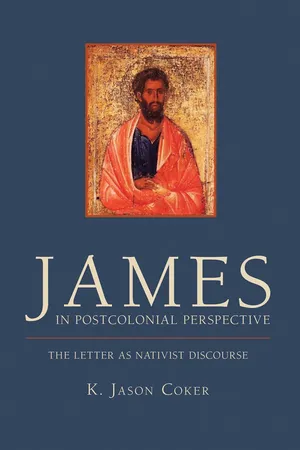
eBook - ePub
James in Postcolonial Perspective
The Letter as Nativist Discourse
- 326 pages
- English
- ePUB (mobile friendly)
- Available on iOS & Android
eBook - ePub
About this book
James confronts the exploitive wealthy; it also opposes Pauline hybridity. K. Jason Coker argues that postcolonial perspectives allow us to understand how these themes converge in the letter. James opposes the exploitation of the Roman Empire and a peculiar Pauline form of hybridity that compromises with it; refutes Roman cultural practices, such as the patronage system and economic practices, that threaten the identity of the letter's recipients; and condemns those who would transgress the boundaries between purity and impurity, God and "world."
Trusted by 375,005 students
Access to over 1.5 million titles for a fair monthly price.
Study more efficiently using our study tools.
Information
Topic
Theology & ReligionSubtopic
Biblical Commentary2
Confronting Colonialism and Hating Hybridity
4
Identifying the Imperial Presence
As James constructs a center based on purity and perfection, he systematically has two distinct adversaries: the Roman Empire and those who assimilate imperial sociopolitical practices. The Roman Empire stands for the absolute other in relation to the kingdom (James 2:5) to which James gives his utter allegiance and implores his readers/hearers to give theirs. James’s argument against the Roman Empire finds its strongest vocalization in his condemnation of the wealthy (James 2:1-13; 5:1-6) and his condemnation of earthly wisdom (James 3:13-18). In both cases, James constructs a binary between the wealthy and the poor, and wisdom from above and earthly wisdom. If James’s pure and undefiled piety manifests itself in care for the orphan and widow and is unstained by the world (1:27), then the Roman social system of patronage and economic system of landownership represent the world’s opposition to his conception of purity. These two rival empires compete for the allegiance of James’s audience; therefore, those in the “diaspora” who receive James’s letter are either with him or against him. The recipients of the letter are forced to accept the imperatives of James or acquiesce to the values of Roman imperialism. Those who reject James’s propositions and assimilate the sociopolitical values of Rome are characterized by James as double-minded (4:8), adulteresses and friends of the world (4:4). Their actions (2:14-26), speech (3:1-12), mind (4:1-12), and plans (4:13-17) are fully corrupted by “the world.” This stringent dualism typifies nativist rhetoric. James’s arguments fluctuate between anti-imperialism and antihybridity throughout his letter, which gives the letter an overall structure:
A. Anti-imperial argument regarding wealth (2:1-13)
B. Antihybridity argument regarding faith/action (2:14-26)
C. Antihybridity argument regarding speech/action (3:1-12)
D. Anti-imperial argument regarding wisdom (3:13-18)
C′. Antihybridity argument regarding friendship (4:1-12)
B′. Antihybridity argument regarding travel itineraries (4:13-17)
A′. Anti-imperial argument regarding wealth (5:1-6)
This structure emphasizes the dual opponents in James’s rhetoric. His drive toward purity put him at odds with the overarching sociopolitical structure of his day and only accentuated his frustration with those who assimilated that culture. What follows is an analysis of James’s dual argument.
In his exhortations against empire, James concentrates on two aspects of Roman ideation: wealth and wisdom. James 2:1-13 and 5:1-6 deal explicitly with wealth and poverty. In both cases, James is clear that the poor are to be valued due to God’s preference for them (2:5) and the wealthy are utterly outside the boundaries of the empire (βασιλεία), which is promised to the poor. James opens the body of his letter by confronting favoritism (προσωπολεμψία) within the community (συναγωγή) based on wealth. The final section of the body of the letter (5:1-6) closes with what may be the harshest critique of the wealthy in the entire New Testament besides Revelation 18.[1] In the language of prophetic literature (e.g., Jer. 5:5-6; Mal. 3:5), James condemns the wealthy and calls them to “weep” and “wail for the miseries that are coming upon” them (5:1). James 2:1-13 and 5:1-6 frame the entire letter with the indictment of the wealthy. It is clear from this inclusio that “the wealthy” are the main antagonists in the letter and are the recipients of James’s harshest critiques. Patrick J. Hartin agrees, arguing that “[t]his topic of rich and poor is referred to again at the end of the body of the epistle (pericope N 5.1-6) thereby ensuring that the entire body of the epistle forms an inclusio within this consideration of rich and poor.”[2] These “wealthy” are also the ones responsible for the “earthly wisdom” (σοφία ἐπίγειος) found in the center of the letter (3:13-18), which is in direct opposition to “wisdom that comes down from above” (σοφία ἄνωθεν κατακαυχᾶσθε). Hartin sees the entire pericope of 2:1-13 as wisdom exposition of sorts that “argues in true wisdom fashion that showing partiality is not reconcilable with faith in Jesus Christ as the Lord of glory. In this context Jesus as the Lord of glory is the source of the wisdom which enables a person to act as a true Christian, for whom showing partiality in dealings with the rich and poor would be totally contradictory.”[3] Although Hartin’s use of “Christian” may be premature, he makes a strong connection between James 2:1-13 and 3:13-18 relating to wisdom. The wisdom James espouses in 3:13-18 is characterized by purity (ἁγνή) that coincides with his conception of pure piety in 1:26-27. The center of the letter, then, consists of pure wisdom that comes from pure piety and is set against earthy, unspiritual, and demonic wisdom that comes from the world. That “earthly wisdom” is characterized by “bitter jealousy” (ζῆλον πικρὸν), “selfish ambition” (ἐριθείαν), “boasting” (κατακαυχάομαι), “lying” (ψεύδομαι), “disorder” (ἀκαταστασία), and “all evil deeds” (πᾶν φαῦλον πρᾶγμα) indicates that James has in mind the same opponents as in 2:1-13 and 5:1-6. It is the wisdom of the “wealthy” world that James criticizes in 3:13-18. These three sections make up James’s anti-imperial discourse as we shall see below.
The type of terminology that James employs to combat enemies in these passages reflects nativist resistance. In constructing the ultimate other, James positions himself as pure, peaceful, gentle, reasonable, full of mercy, impartial, and sincere (3:17). The fact that purity is the first of these characteristics connects the center of the letter to the theme of the letter (1:26-27) and pervades James’s entire discourse. Purity stands against impurity; good stands against evil (4:7). This form of binary rhetoric is not unique to James or his ancient milieu. Significantly for our analysis, it also fueled the kinds of modern decolonizing movements exemplified in the writings of Frantz Fanon. In his depiction of colonizers and colonized as two different “species” of humanity, Fanon maintains that “decolonization is the meeting of two forces, opposed to each other by their very nature, which in fact owe their originality to that sort of substantification which results from and is nourished by the situation in the colonies.”[4] He adds later, “The colonial world is a world cut in two.”[5] Similar binary rhetoric is enforced throughout the Letter of James. There is no third option for James. Either there is pure piety (1:26-27), divine partiality for the poor (2:1-13), and wisdom from above; or there is no piety, partiality for the wealthy, and earthly wisdom. James’s colonial world is also a “world cut in two.” Fanon explains this divided world in the language of early Christian heresiology, as we have seen, by adopting and adapting the term “Manicheism.” The colonizer describes the colonized as absolutely other and develops a body of knowledge that defines the “native” or colonized.[6] Roman adoption of “barbarian” as a way to hegemonically describe non-Roman existence created the cultural boundary between Roman and Other.[7] The use of this kind of rhetoric by the colonizer “paints the native as a sort of quintessence of evil.”[8] The nativist move is to accept these essentialized categories and invert the binary by championing nativist values and morals. This is precisely the move that James makes by affirming God’s preference for the poor in direct contradiction to common social preference for the wealthy, which amounts to the incompatibility between wisdom from above and earthly wisdom.[9] In this divided world,
The settler’s work is to make even the dreams of liberty impossible for the native. The native’s work is to imagine all possible methods for destroying the settler. On the logical plane, the Manicheism of the settler produces a Manicheism of the native. To the theory of the “absolute evil of the native” the theory of the “absolute evil of the settler” replies.[10]
The values of empire, then, become a mockery of values: “The violence with which the supremacy of white values is affirmed and the aggressiveness which has permeated the victory of these values over the ways of life and of thought of the native mean that, in revenge, the native laughs in mockery when Western values are mentioned in front of him.”[11] Analogously, James claims a divided world and endorses his nativist position with imperatival force.
Wealth and Poverty within Imperialism (James 2:1-13): Alternative Empire
James opens the body of his letter (2:1-13) with a warning against showing partiality to the wealthy. The pericope is divided into two sections (vv. 1-7 and vv. 8-13) connected by the conjunction μέντοι that creates an emphatic position between the first two conditional sentences of the second section (vv. 8-9).[12] There is also a shift in the class of conditional sentences that happens in verse 8, which indicates a rhetorical shift. After the introductory sentence in verse 1, James uses a third class conditional sentence (v. 2) that controls the rest of the passage until verse 8,[13] where a series of three (vv. 8, 9, and 11) first class conditional sentences are employed that subtly change the topic of the pericope.[14] Verses 1-7 deal specifically with what kind of partiality is acceptable in the kingdom, while verses 8-13 highlight the laws of the kingdom that support that thesis.
James 2:1-7: Imperial Partiality
In the opening address of chapter 2, James identifies his addressees as the “brothers” (ἀδελφοί) and this construction is commonly accompanied by the possessive pronoun “my” (μου).[15] How this familial construction relates to the Diaspora is important in order to understand the relationship between James and his addressees. There is a certain tension between the distance created by using the term διασπορά and the closeness created by using the familial term ἀδελφοί. In other words, is ἀδελφοί a technical term that does not necessarily connote closeness, or does James move from the general διασπορά to specific ἀδελφοί? Already, James has used ἀδελφοί throughout his introductory chapter (vv. 2, 9, 16, and 19) and couples it with “beloved” in most cases (see ἀγαπητοί in vv. 16 and 19). The use of “beloved brothers” creates an inside language that places the addressees in a favorable position with James. Within the pericope of 2:1-13, James uses this familial vocabulary twice (vv. 1 and 5). In this case, James is pulling the marginal διασπορά into his cultural center thereby creating an indispensable connection. James is not at the center of pious life by himself. With the use of this familial love language, or fictive kinship, the addressees are among the family of James in spite of their diasporic existence. This familial unity is similar to Fanon’s conception of the unity needed for decolonization: “Decolonization unifies that people by the radical decision to remove from it its heterogeneity, and by unifying it on a national, sometimes a racial, basis.”[16] Family language, or fictive kinship, functions as this type of unifying effort; however, the addressees’ capacity to follow James’s teaching will determine if they will be able to stay within this familial setting. The familial love language also tempers the force of the imperatives used throughout the letter, which comes immediately to the fore in 2:1: μη . . . ἔχετε.
The first imperative in 2:1 indicates that favoritism was not acceptable in Jesus’ faith. The use of ...
Table of contents
- Cover
- Title Page
- Copyright
- Table Of Contents
- Acknowledgments
- Constructing the Native
- Confronting Colonialism and Hating Hybridity
- Bibliography
- Index of Subjects and Names
- Index of Scripture and Ancient Literature References
Frequently asked questions
Yes, you can cancel anytime from the Subscription tab in your account settings on the Perlego website. Your subscription will stay active until the end of your current billing period. Learn how to cancel your subscription
No, books cannot be downloaded as external files, such as PDFs, for use outside of Perlego. However, you can download books within the Perlego app for offline reading on mobile or tablet. Learn how to download books offline
Perlego offers two plans: Essential and Complete
- Essential is ideal for learners and professionals who enjoy exploring a wide range of subjects. Access the Essential Library with 800,000+ trusted titles and best-sellers across business, personal growth, and the humanities. Includes unlimited reading time and Standard Read Aloud voice.
- Complete: Perfect for advanced learners and researchers needing full, unrestricted access. Unlock 1.5M+ books across hundreds of subjects, including academic and specialized titles. The Complete Plan also includes advanced features like Premium Read Aloud and Research Assistant.
We are an online textbook subscription service, where you can get access to an entire online library for less than the price of a single book per month. With over 1.5 million books across 990+ topics, we’ve got you covered! Learn about our mission
Look out for the read-aloud symbol on your next book to see if you can listen to it. The read-aloud tool reads text aloud for you, highlighting the text as it is being read. You can pause it, speed it up and slow it down. Learn more about Read Aloud
Yes! You can use the Perlego app on both iOS and Android devices to read anytime, anywhere — even offline. Perfect for commutes or when you’re on the go.
Please note we cannot support devices running on iOS 13 and Android 7 or earlier. Learn more about using the app
Please note we cannot support devices running on iOS 13 and Android 7 or earlier. Learn more about using the app
Yes, you can access James in Postcolonial Perspective by K. Jason Coker,K. Jason Coker in PDF and/or ePUB format, as well as other popular books in Theology & Religion & Biblical Commentary. We have over 1.5 million books available in our catalogue for you to explore.