eBook - ePub
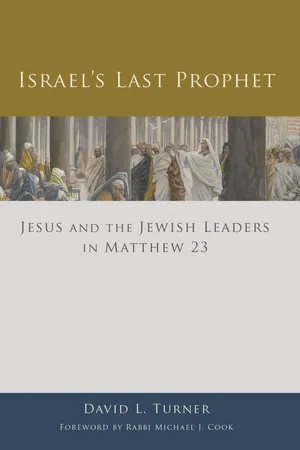
Israel's Last Prophet
Jesus and the Jewish Leaders in Matthew 23
- 518 pages
- English
- ePUB (mobile friendly)
- Available on iOS & Android
eBook - ePub
About this book
Jesus' words of indictment and judgment in the Gospel according to Matthew have fueled centuries of Christian anti-Judaism and the horrors of the twentieth-century Holocaust. The solemn parables and pronouncements of judgment in chapters 22?23 come to a climax in Jesus' ironic command that the scribes and Pharisees "fill up the measure" of their ancestors, bringing upon their generation the judgment of God (Matt. 23:32–36). But what did those words originally mean within Matthew's narrative? Carefully distinguishing what can be known from what may only be conjectured, David L. Turner examines how Matthew has taken up Deuteronomic themes of prophetic rejection and judgment and woven them throughout the Gospel, particularly in Matthew 23. Turner argues that the Gospel author was engaged in a heated intramural dispute with other Jewish groups and that the terrible legacy of Christian anti-Jewish violence results, in part, from a gross misunderstanding of Matthew's original context and purpose—on the part of generations who failed to recognize the author's worldview and allusions.
Trusted by 375,005 students
Access to over 1.5 million titles for a fair monthly price.
Study more efficiently using our study tools.
Information
2
The Rejection of the Prophets in Matthew
In the first three chapters of this study, I have described and traced the motif of prophetic rejection through the Hebrew Bible, Second Temple Jewish literature, and the New Testament. The motif occurs in the context of Deuteronomism, the belief that Israel’s destiny depends on its obedience to God, who has covenanted with them through the archetypal prophet, Moses. Israel’s fidelity to the Torah of Moses waxes and wanes, and God sends additional prophets to remind the nation of its obligations. At times Israel listens, but at other times it does not, and occasionally prophets are treated violently. Eventually the defeat and deportation of both the northern and southern kingdoms are explained as the inevitable denouement of sustained rejection of the prophets. The New Testament recalls these difficult times, and also casts the ministry of Jesus and his apostles in terms of the rejected prophet motif.
Now the circle narrows to the Gospel of Matthew. The Matthean Gospel sets Jesus’ ministry in the context of biblical Deuteronomism with its opening genealogy. Matthew speaks of prophets and prophecy more frequently than do the other Gospels. Matthew’s fulfillment formula citations and other uses of the Hebrew Bible stand out in his narrative. These three considerations are crucial in determining Matthew’s understanding of the Bible, which itself is foundational for understanding the role of the rejected prophet motif in Matthew. Matthew’s presents John as the penultimate rejected prophet, Jesus as the ultimate rejected prophet, and Jesus’ disciples as an ongoing prophetic community that itself should expect rejection. The chapter includes a study of the parable of the tenants (21:33–46) because it epitomizes Matthew’s entire teaching on Deuteronomism and the rejected prophet motif. Finally, the notorious blood libel text, Matt. 27:25, is addressed.
4
Matthew’s Understanding of the Bible
Matthew’s understanding of the Bible can be understood from his genealogy of Jesus, his portrayal of prophets and prophesying, and his biblical citations.
Matthew’s Genealogy of Jesus (1:2–17)
Matthew’s genealogy fits hand in glove with the Deuteronomistic view of Israel’s history that was discussed at the outset of this study. This viewpoint places the rejection of the prophets into a covenantal scheme in which Israel’s disloyalty to Torah, despite prophetic warnings, results in the punishment of the exile, with restoration contingent on repentance and renewed obedience.
Matthew’s story of the origin of Jesus begins with a title (1:1) and genealogy (1:2–17). Although the Gospel of Luke also presents a genealogy of Jesus (3:23–38), its context, structure, and content greatly differ from Matthew’s. The title of Matthew affirms Jesus’ connection to the archetypical patriarch, Abraham, and to King David. Both Abraham and David received covenantal promises from God that Matthew views as culminating in Jesus the Messiah, who will reign over Israel and extend God’s blessings to all the nations (Gen. 12:1–3; 2 Sam. 7:8–16; cf. Jub. 18:13).[1] The structure of the genealogy is based on this connection to Abraham and David, and its content develops this connection.[2] After mentioning the Messiah, David, and Abraham in his title (1:1), Matthew continues in a roughly chiastic fashion in his genealogy to mention Abraham (1:2), David (1:6), and the Messiah (1:16). The structure of the genealogy is made clear by its summary in 1:17. It traces fourteen generations from Abraham to David (1:2–6), fourteen generations from David to the exile in Babylon (1:7–11), and fourteen generations from the exile to the Messiah (1:12–16).
By pivoting on King David and the exile to Babylon, the three sections of the genealogy portray a Deuteronomistic understanding of Israel’s history. David’s reign represents one of the highest points of the biblical narrative, although the potential for the demise of his dynasty is acknowledged (2 Sam. 7:14–15; Ps. 89:30–33). The exile represents one of the lowest points of the biblical narrative, although biblical prophecies view it as temporary until a final Davidic king arises.[3] Matthew presents Jesus the ultimate Son of David who will restore Israel from an exile even more deplorable than the one in Babylon. Matthew has perhaps chosen fourteen generations to structure his genealogy because David is the fourteenth name in the genealogy and fourteen is the numerical value of David in Hebrew. Consonantally, דוד (Dawid) is 4 (d) + 6 (w) + 4 (d) = 14, when the numerical values of the consonants are added together. This gematria, which assigns numerical values to letters, stresses the centrality of David in Jesus’ background as well as the centrality of great David’s greater son, Jesus, for Matthew’s readers.[4] It seems clear from this structure that Matthew viewed the history of Israel as being fulfilled through Jesus, who is Abraham’s son by being David’s son, in whom Israel finds relief from the judgment of the exile and renewal of the promises made to the ancestors.[5]
Matthew 1:17 is a summary that clarifies the structure of the genealogy and reveals its theological implications. The conjunction οὖν introduces the summary as an inference to be drawn from 1:2–16. There is ellipsis of “all the generations” in the second and third clauses, but the key matter of “fourteen generations” is repeated in each clause. In the “fourteen” generations from Abraham to King David, Matthew demonstrates Jesus’ sonship and aligns Jesus as Messiah with the historical outworking of the promise of God. In the “fourteen” generations from David to the exile, Matthew recounts the decline of Israel under the judgment of God. And in the “fourteen” generations from the exile to the Messiah, Matthew traces the faithful purpose of God in fulfilling his promise despite the rebellion of his people. The final set of “fourteen” generations moves from the abyss of the exile to the apex of the Messiah. Bruner’s suggestion that the genealogy may be visualized as a leaning capital N is helpful in laying out the structure and theological implications of the genealogy.[6]
Matthew’s inclusion of a genealogy at the beginning of his narrative and his unique arrangement of it show his concern to place Jesus in a Deuteronomistic setting. As we will see, other passages in this Gospel reinforce the Deuteronomistic understanding of Israel’s history and portray Jesus as the one through whom Israel’s ultimate release from exile is accomplished.[7]
Prophets and Prophesying in Matthew
Matthew uses the προφητ- word group forty-three times. The noun προφητεία occurs once in Matthew (13:14) and not at all in Mark or Luke. The verb προφητεύω occurs four times in Matthew (7:22; 11:13; 15:7; 26:68) and twice each in Mark and Luke. The noun προφήτης occurs thirty-five times in Matthew.[8] Mark uses this word only five times, but it occurs twenty-nine times in Luke. The word ψευδοπροφήτης occurs three times in Matthew (7:15; 24:11, 24) and once each in Mark and Luke. All in all, the word group occurs only seven times in Mark and thirty-one times in Luke. Matthew’s increased use of these words would seem to indicate his heightened interest in prophecy.
Matthew mentions several prophets by name. Isaiah is mentioned as a prophet six times (3:3; 4:14; 8:17; 12:17; 13:14; 15:7; cf. 1:22). Jeremiah is mentioned as a prophet three times (2:17; 16:14; 27:9). Jonah is cited as a prophet once (12:39–41; cf. 16:4). Daniel is mentioned once as a prophet (24:15). Also, texts from Isaiah (Matt. 1:22; 21:4), Micah (Matt. 2:5), Hosea (Matt. 2:15), and Zechariah (Matt. 21:4) are introduced with formulas mentioning them as “spoken by the prophet.” Psalm 78, attributed to Asaph in its title, is also cited as having been “spoken by the prophet” (Matt. 13:35). John the Baptist (11:9; 14:5; 21:26) and Jesus (13:57; 21:11, 46) are each referred to as prophets three times. It is also implied in Matt. 23:35 that Abel and Zechariah are prophets.
Other individuals who are called prophets elsewhere are mentioned in Matthew. Abraham (cf. Gen. 20:7) and David (cf. Matt. 22:43; Acts 2:30) are mentioned in the first verse of the Gospel. Moses appears three times in the narrative (17:4; 22:24; 23:2). Elijah is mentioned several times (11:14; 16:14; 17:3–4, 10–12; 27:47, 49).
Prophets are cited fourteen times in introductory formulas to biblical texts. Six times prophets are cited without mentioning their names.[9] Seven citations mention the names of the prophets wh...
Table of contents
- Cover
- Title Page
- Copyright
- Dedication
- Table Of Contents
- Tables
- Foreword by Rabbi Michael J. Cook
- Preface
- Abbreviations
- The Motif of the Rejection of the Prophets
- The Rejection of the Prophets in Matthew
- Part Three: Jesus and the Jewish Leaders in Matthew 23
- Bibliography
- Index of Subjects
- Index of Authors
- Index of Ancient Texts
Frequently asked questions
Yes, you can cancel anytime from the Subscription tab in your account settings on the Perlego website. Your subscription will stay active until the end of your current billing period. Learn how to cancel your subscription
No, books cannot be downloaded as external files, such as PDFs, for use outside of Perlego. However, you can download books within the Perlego app for offline reading on mobile or tablet. Learn how to download books offline
We are an online textbook subscription service, where you can get access to an entire online library for less than the price of a single book per month. With over 1.5 million books across 990+ topics, we’ve got you covered! Learn about our mission
Look out for the read-aloud symbol on your next book to see if you can listen to it. The read-aloud tool reads text aloud for you, highlighting the text as it is being read. You can pause it, speed it up and slow it down. Learn more about Read Aloud
Yes! You can use the Perlego app on both iOS and Android devices to read anytime, anywhere — even offline. Perfect for commutes or when you’re on the go.
Please note we cannot support devices running on iOS 13 and Android 7 or earlier. Learn more about using the app
Please note we cannot support devices running on iOS 13 and Android 7 or earlier. Learn more about using the app
Yes, you can access Israel's Last Prophet by David L. Turner,David L. Turner in PDF and/or ePUB format, as well as other popular books in Theology & Religion & Biblical Criticism & Interpretation. We have over 1.5 million books available in our catalogue for you to explore.