Bonhoeffer’s thought was indeed radical and revolutionary, but it was so precisely because of its adherence to the classical traditions of the church, especially Luther’s theologia crucis. When his theology is understood in light of this tradition, his “nonreligious interpretation,” which he set out to describe in his theological letters from Tegel prison, is not a radical departure from his earlier theology, but is the mature expression of his “theology of the cross.” Bonhoeffer’s Lutheran roots would not allow him to turn his back on the problems and tragedies of the world. In fact, because God had turned toward the world, had entered into the world and identified with suffering individuals, the only proper sphere for theological reflection was this world. Theology properly conceived, therefore, is very this-worldly. It is this worldly character that gives it its power to speak.
eBook - ePub
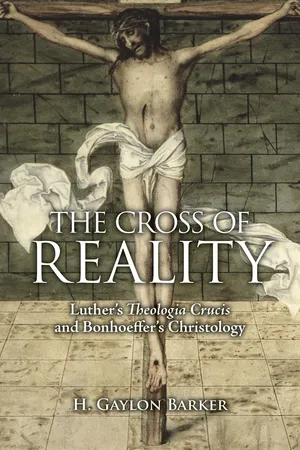
The Cross of Reality
Luther's Theologia Crucis and Bonhoeffer's Christology
- 480 pages
- English
- ePUB (mobile friendly)
- Available on iOS & Android
eBook - ePub
About this book
The Cross of Reality investigates Bonhoeffer’s interpretation and use of Luther’s theology in shaping his Christology. In this essay, H. Gaylon Barker uses the “theology of the cross” as a key to understanding the characteristic elements that make up Bonhoeffer’s theology; he also shows how Bonhoeffer’s conversation with his teachers and contemporaries, Karl Holl and Karl Barth in particular, develops.
Trusted by 375,005 students
Access to over 1.5 million titles for a fair monthly price.
Study more efficiently using our study tools.
Information
Topic
Theology & ReligionSubtopic
Christian Denominations3
Christological Development and Witness: 1933–1945
6
The German Church Struggle
In the first of his Finkenwalde newsletters on November 15, 1935, Bonhoeffer told his former students, “The summer of 1935 was, I believe, the most fulfilling period in my entire life thus far both professionally and personally.”[1] These words are telling in that they reveal a great deal about how Bonhoeffer saw his vocation. Finding himself in a ministry far different than he could have imagined years earlier, what he discovered was that the underground seminary at Finkenwalde was perhaps his highest calling. “Being director of Finkenwalde matched his skills and was a platform for his theological concerns. Instead of moving him to the fringes of the Church Struggle, Finkenwalde served to place him at the center of the struggle and positioned him to lay the foundation for the renewal of the church.”[2]
His time at Finkenwalde prepared him to answer his own question from his prison cell a few years later: “Who is Christ actually for us today?” In one sense, everything to that point was preparing and pointing him in that direction. From what we have seen from Bonhoeffer’s writings thus far, this concern represents the continuation and fulfillment of his christocentric preoccupation that began while a student. What emerges during this period is his concern to find more specific ways to relate that faith to his context.
As he sought to locate God in the concrete reality of this world and attempted to live out the implications of such a faith, he was never content with living by a set of principles or ideals. In defining his life in terms of Christian discipleship, it was a matter of living out his faith in Jesus Christ in the concrete realities of life in the here and now. Because faith is a relationship with Jesus Christ, it is a living, dynamic reality and becomes an expression of one’s life. As a result, faith is always probing and asking questions, never assuming that discipleship was a fixed commodity to be lived out by repetition.
Christology, therefore, was more than an academic question for Bonhoeffer. First and foremost, it was a faith question. Therefore, when changes took place in his world, he found that he had to wrestle with the implications of his faith as well. It is this faith question, and his constant reflection on its implication, that moves Bonhoeffer from a preoccupation with the academic theological questions to living out the faith implied in those questions.
In finding himself immersed in the emerging German Church Struggle, he could no longer remain behind the safety and security of the lecturer’s podium; for that reason, upon the completion of the summer semester 1933, he took leave of his university responsibilities. Just months after Hitler’s election as chancellor of Germany, several changes were made and laws implemented that threatened the life of the church.[3] In that context and for that reason, he worked with Martin Niemöller and others to help form the Pastors’ Emergency League, the group that would become the Confessing Church months later. However, by the fall of 1933 his direct involvement in the Church Struggle took an odd turn, when he left Germany to serve two German-speaking congregations in London.
His decision to go to London was due in part to his increasing feelings of isolation within the church struggle. The majority of the Young Reformers and the Pastors’ Emergency League did not share his sense of urgency; indeed, many thought he was too radical in his stance toward the German Christians. Bonhoeffer, however, believed that nothing should compromise the church’s confession of Christ alone, which is precisely what he identified as the core issue. Acknowledging the tensions between Bonhoeffer and his colleagues in the church struggle, John de Gruchy points out, “Bonhoeffer already in 1933, right at the outset of Hitler’s rise to power, was only too aware of the dangers ahead and of the extent to which the church could not remain aloof from the burning ethical issues of the day by recourse to a misappropriation of Luther’s teaching on the two kingdoms.”[4] He goes on to describe the conditions that led to Bonhoeffer’s uncompromising position: “In the land of the Reformation the doctrine of the two kingdoms was operative in such a way that the church was prevented from exercising any politically critical or prophetic function.”[5]
Finding refuge in London provided Bonhoeffer with a perspective from which to view what was happening to his church and his country from a new angle. This new perspective and the actions that grew out of it continued to be informed by his faith in and commitment to Jesus Christ. Because of the way in which he conceived of God relating to the world in the theologia crucis, it was not possible to separate the issues facing the church from the rest of the world; instead, his worldly concerns and commitments became all the more intensified because of his faith.
During this period, 1933–1945, Bonhoeffer’s academic interests fall into the background as his theology is placed in the service of the church; this means that his writings from this period are now written under different circumstances and take on a different character. Even the more systematic writings, such as Discipleship, are written to address issues arising out the German Church Struggle. Bonhoeffer’s cross of reality will emerge as the thread that holds his life and theology together.
The Impending Crisis
Upon the completion of his teaching responsibilities at the end of the summer semester 1933, Bonhoeffer prepared to depart for London, where he would spend the next eighteen months serving two congregations in the German-speaking community. Prior to his departure for London, however, he spent the month of August at Bethel, Germany, where he went to work on the Bethel Confession, one of the foundational documents of the emerging Confessing Church, along with Franz Hildebrandt, Hermann Sasse, and others.[6] Bethge has alluded to the urgency of this task in his description of the events and turmoil that marked the summer of 1933. The growing power of the German Christians created a situation in which there was a demand for clarity on the basic confession of the church. Given the circumstances, “In Bethel, Sasse and Bonhoeffer began work on the document that was to confront these same German Christians with the question of truth. The time seemed ripe for such a move. Throughout the country people were working on drafts for confessions,”[7] all intended to address the heretical teachings of the German Christians.
This task was viewed as necessary, because a majority of the people, including leaders of the church, was either supportive or uncritical of National Socialism. Those who supported Hitler did so because they believed he would restore traditional moral values to Germany. Heinz Eduard Tödt, for example, points out that “a large majority believed that they could stand for the cause of the church, and yet remain unpolitical but affirmative of the state. They lived in an enormous delusion as to the true character of National Socialism, because they did not want to interfere in politics and did not look for realistic information. Bonhoeffer the theologian did not give in to such delusions.”[8]
Kyle Jantzen, in Faith and Fatherland: Parish Politics in Hitler’s Germany, offers additional insights. He says that even though Hitler and Nazi ideology contradicted almost every core Christian belief, pastors and parishioners were inclined to favor them, primarily because the “protestant pastors feared they were losing their place in society.” He goes on to say that they were motivated by four factors: 1) they believed that political renewal would bring about a moral renewal; 2) clergy believed that they were being called to a partnership with Hitler in this process of renewal; 3) they feared Communism; and 4) because of problematic elements in their theology, the clergy were predisposed to authoritarian politics. So it was that many warmly embraced Hitler’s assent to power, seeing it positively as a way to renewal of the German nation. “With the new state,” declared Ravensburg church superintendent Hermann Ströle, “a spiritual change is also being generated. Through this spiritual change, the church will be called to a new great service . . . for our nation.”[9]
An example of the church’s support for the new Nazi state came from Bavarian Lutheran bishop Hans Meiser; he prepared a proclamation to be read from pulpits on Easter Sunday 1933, in which the new government and the future prospects for the renewal of society and the church were praised.
A state which brings into being again government according to God’s Laws should, in doing so, be assured not only of the applause but also of the glad and active co-operation of the Church. With gratitude and joy the Church takes note that the new state bans blasphemy, assails immorality, establishes discipline and order, with a strong hand, while at the same time calling upon man to fear God, espousing the sanctity of marriage and Christian training for the young, bringing into honor again the deeds of our fathers and kindling in thousands of hearts, in place of disparagement, an ardent love of Volk and Fatherland.[10]
The goal at Bethel, therefore, was to produce a confessional document that was “usable and widely accepted by the time the national synod met at the beginning of September.”[11] Through their efforts, a clear attempt by members of the nascent Confessing Church to respond to the political and theological challenges before them was on display. Far from being limited to issues of politics and the church’s relationship to and involvement in matters of government, the Confessing Church struggle was centered on the church’s confession of faith. Since the very foundation of the church’s existence was tied to its confession, it became a matter of truth. And Bonhoeffer, one of the early advocates of the Confessing Church and one of its most avid defenders, was adamant in his insistence on affirming the core confession of Christ.
The debate within the Confessing Church centered on the fight against the German Christians and how to appropriately respond to the challenges their ideology pose...
Table of contents
- Cover
- Title Page
- Copyright
- Dedication
- Table Of Contents
- Preface
- Abbreviations
- Introduction
- The Background and Context of Bonhoeffer’s Christology
- Theological and Christological Foundations: 1925–1933
- Christological Development and Witness: 1933–1945
- Conclusion
- Bibliography
- Index
Frequently asked questions
Yes, you can cancel anytime from the Subscription tab in your account settings on the Perlego website. Your subscription will stay active until the end of your current billing period. Learn how to cancel your subscription
No, books cannot be downloaded as external files, such as PDFs, for use outside of Perlego. However, you can download books within the Perlego app for offline reading on mobile or tablet. Learn how to download books offline
Perlego offers two plans: Essential and Complete
- Essential is ideal for learners and professionals who enjoy exploring a wide range of subjects. Access the Essential Library with 800,000+ trusted titles and best-sellers across business, personal growth, and the humanities. Includes unlimited reading time and Standard Read Aloud voice.
- Complete: Perfect for advanced learners and researchers needing full, unrestricted access. Unlock 1.5M+ books across hundreds of subjects, including academic and specialized titles. The Complete Plan also includes advanced features like Premium Read Aloud and Research Assistant.
We are an online textbook subscription service, where you can get access to an entire online library for less than the price of a single book per month. With over 1.5 million books across 990+ topics, we’ve got you covered! Learn about our mission
Look out for the read-aloud symbol on your next book to see if you can listen to it. The read-aloud tool reads text aloud for you, highlighting the text as it is being read. You can pause it, speed it up and slow it down. Learn more about Read Aloud
Yes! You can use the Perlego app on both iOS and Android devices to read anytime, anywhere — even offline. Perfect for commutes or when you’re on the go.
Please note we cannot support devices running on iOS 13 and Android 7 or earlier. Learn more about using the app
Please note we cannot support devices running on iOS 13 and Android 7 or earlier. Learn more about using the app
Yes, you can access The Cross of Reality by H. Gaylon Barker in PDF and/or ePUB format, as well as other popular books in Theology & Religion & Christian Denominations. We have over 1.5 million books available in our catalogue for you to explore.