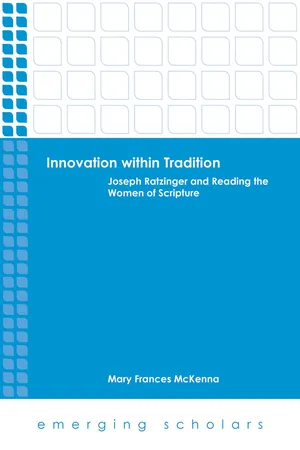
eBook - ePub
Innovation within Tradition
Joseph Ratzinger and Reading the Women of Scripture
- 272 pages
- English
- ePUB (mobile friendly)
- Available on iOS & Android
eBook - ePub
Innovation within Tradition
Joseph Ratzinger and Reading the Women of Scripture
About this book
Innovation within Tradition is an exploration of the meaning and implications of Joseph Ratzinger's biblical interpretation of the women of salvation history. Mary Frances McKenna argues that Ratzinger's work, through his development and refinement of the church's tradition, brings the important role and significance of the female characters of Scripture to the fore by placing them at the heart of Christian faith. Explicating the pope emeritus's concept of a "female line in the Bible," which has a profound impact on the meaning and interpretation of the women of salvation history, the volume shows that this concept illustrates the practical value and creative nature of his approach to theology and biblical interpretation. Pivotal to the argument are questions around the findings on the notion of person, feminist theology, salvation history, and Mary, as well as the use of history in theology and biblical interpretation and the potential for the continuing development and deepening of the church's comprehension of the meaning of revelation. The book advances a constructive approach, in coordination with these questions, for a Trinitarian theology of society, addresses old theological issues anew, and provides a starting point for an interdenominational understanding of Mary.
Information
Topic
Theology & ReligionSubtopic
Biblical Studies1
Joseph Ratzinger’s Theological Perspective
To place Ratzinger’s notion of a female line in the Bible within the context of his overall theological project, this chapter will explore the main contours of his thought as well as the framework and structure of his theological approach, beginning with his thinking on the God of Jesus Christ. Jesus Christ, fully human and fully divine, one person in two natures, mediates Ratzinger’s thought on God and humanity, and the relationality he identifies as essential to Christ is at the core of that thought. I will first explore Ratzinger’s Christology and then his thought on the meaning of God’s self-revelation in the persons of Father, Son, and Spirit. From there I will turn to the role that Mary plays in his thought and how she personifies a number of its important developments and characteristics. Together these will show how all aspects of his thinking interconnect. The framework and structure of Ratzinger’s theology are crucial here, too, particularly the interplay of faith, theology, and tradition, in which the Church continually deepens and develops its understanding of tradition through the Spirit’s guidance, which creates a generative structure for Ratzinger’s own constructive vision.
The God of Jesus Christ
A Pauline Augustinian Christology
Ratzinger’s theological thinking is christocentric in nature: Scripture is interpreted through the light of Christ, which illustrates his view that Christ is the determining factor for the meaning of the whole of Christianity.[1] For as he says, “. . . if it is indeed true that Jesus is the Son of God. Precisely this Being is the tremendous event on which everything else depends.”[2] It is through the lens of Jesus’ Being and the event of the incarnation, by which he is the Son of God, that Ratzinger views and understands the whole of Scripture, revelation, and tradition. This Jesus Christ is a radical challenge, as well as the answer for all humanity: “The Jesus who makes everything OK for everyone is a phantom, a dream, not a real figure. The Jesus of the Gospels is certainly not convenient for us. But it is precisely in this way that he answers the deepest questions of our existence.”[3] Ratzinger anchors his Christology in the Pauline interpretation of Jesus as the second Adam in such a way that it can be described as an interplay of the Gospels and the Pauline material.[4] This has implications for his overall theology and his understanding of salvation through Jesus Christ. Jesus is the apex and fulfillment of salvation history, such that the movement from creation and the fall to incarnation and resurrection are essential to his understanding of the full meaning of Scripture and the theological enterprise to understand and interpret them. This movement from Adam to Adam gives direction to Ratzinger’s theological work and is the principle and starting point of his Christology and soteriology. It is not Jesus Christ as a stand-alone individual, but Jesus Christ as the fullness of time in relation to the whole of Scripture and faith and also the fullness of the meaning and interpretation of humanity itself.
The Pauline aspect of soteriology plays an important role in this interpretation in that humanity requires conversion from the alienation of the fall and each human being’s salvation arises not from his own activity but God’s self-gift in Jesus Christ, even if the human response to God’s initiative is essential. Ratzinger’s thinking here is influenced by what can be called Pauline-Augustinianism, counter to the criticism that identifies his soteriology as influenced by (neo-)Platonic-Augustinianism.[5] His view is that salvation cannot be achieved or brought about within history, and when such is attempted, it becomes totalitarian. This has had important consequences for his engagement with political theologies during his time as prefect of the Congregation for the Doctrine of Faith. It could be argued that Ratzinger’s style led to a narrow theological approach, while political theologies’ focus is greater than just theology, and includes an active response to the suffering of the world, such as in liberation theology’s desire to respond to the appalling poverty and suffering of the people of South and Latin America.
Critical for Ratzinger’s Christology is his affirmation of the incarnation, that God became flesh and dwelt among us; this is the central proposition of the Christian creed and Christianity.[6] It also points to the historical nature of Christianity and to the notion of person, and hence relation: “The person of Jesus is his teaching and his teaching is he himself. Christian faith, that is, faith in Jesus as the Christ is . . . the acceptance of this person who is his word; of the word as person and of the person as Word.”[7] The ontological portraiture of Jesus’ being is most clearly manifest in his dialogue with God the Father: The communion with the Father through prayer determines who Jesus is, so that Ratzinger maintains, “the centre of the life and person of Jesus is his constant communication with the Father,” and “the centre of the person of Jesus is prayer.”[8] It is not Christ’s being or person as an abstract quality; rather, it is the relationship of Christ’s being and person with the Father that determines his being and person. The central emphasis on the relational nature of Jesus with the Father is highly significant to Ratzinger’s thinking. It also provides crucial, dynamic dimensions to his Christology and anthropology, and, as will be seen, his concept of “the female line of the Bible.”
God’s Self-Revelation as a Relational, Personal Being
The Triune God—Father, Son, and Holy Spirit—is, for Ratzinger, fundamentally relational and personal. God as a relational being is foremost a scriptural notion, reflected in the self-revelation of God in the Old Testament as the God of Abraham, Isaac, and Jacob, and God’s covenantal relationship with Israel. God’s response to Moses—“I am who I am”—means that God is: God is at work, God acts, God can act, God is an “I,” God is a person. This implies that God is neither abstract nor impersonal, like a mathematical formula, nor is God “nothingness.”[9] Likewise, the relational reality of God is in total opposition to the beast of the book of Revelation who, as he says, is a number and makes men nothing but numbers.[10] God as a personal relational being is most fully actualized and revealed in Jesus Christ, God’s Word.
Ratzinger outlines a relational anthropology in an important 1973 article,[11] in which he addresses similar issues to those raised by the Russian Orthodox theologian Vladimir Lossky.[12] Ratzinger and Lossky each offer a constructive examination of the topic and both provides important direction to the development of insights in the theological notion of person and its application to the human being. Lossky’s work takes up “a group of extremely important questions” that Hans Urs von Balthasar touches upon in discussing post-Chalcedonian theology in his considerations on Maximus the Confessor, but which Balthasar does not pursue in detail. The questions, according to Lossky, relate to the distinction between essence and existence and how they relate to the created human being,[13] which is Lossky’s point of departure. Ratzinger, too, is influenced by Maximus and Balthasar; indeed, Ratzinger contends that Maximus provides the most significant positive clarification of the christological concept of person.[14] Where Balthasar remains on the surface, as Lossky contends, on the level of Greek (Aristotelian) philosophy, Lossky’s and Ratzinger’s considerations seek to move beyond that and to appreciate how person as revealed in God’s self-revelation in Jesus Christ fully transitions to the human being. How, based on theological consideration on the triune God, is “person” appropriately applied to the human being? As we will see, both determine this based on Christology, but each takes a different, if complementary, approach. Lossky’s and Ratzinger’s considerations cannot be explored here in the detail required to draw out the full depths and potential of their thought. I can only attempt to identify some lines of thought on divine person and how those are applicable to the human being, which will later help illuminate our main theme, the female line in the Bible. I will first consider Lossky’s and then Ratzinger’s thought.
Lossky on Person
Vladimir Lossky, in his classic essay on the theological notion of person in the divine and human, notes that in the Greek father’s comprehensive doctrine on divine person to express “the absolute and primordial condition of a Trinitarian God in His transcendence,” they used a pair of synonyms, ousia and hypostasis, which denote absolute identity and absolute difference. This “terminological discovery,” as Lossky refers to it, expresses “the irreducibility of the hypostasis to ousia” without “opposing them as two different realities.”[15] Lossky argues that, where scholars create distinction between them, they “fall back into the domain of conceptual knowledge: one opposes the general to the particular.”[16] Against this Lossky argues that the distinction between these two terms cannot be found in concepts; rather, their theological truth exists beyond concepts that “become signs of the personal reality of God.”[17]
The issue of the appropriate application of person to the human being arises when, in the theological language of East and West, the human person coincides with the human individual, “an individual numerically different from all other men.”[18] This situation, Lossky rightly notes, fundamentally distorts the notion of divine person. Lossky asks how “person” sits within Jesus Christ, who is both fully human and fully divine, but whose humanity began at the “moment of Incarnation,” while his person is that of the Son of God which preexisted his humanity in eternal communion with the Father and Spirit. When considering this, Lossky accepts that Jesus’ humanity does have “the character of an individual substance.”
To avoid the errors of Nestorius and Apollinarius of Laodicea, Lossky argues that there is an irreducibility of Christ’s person to his human nature.[19] This means that in the human being, the person must also be distinguished from its nature or, in other words, its individual substance. A human person, then, is “someone who goes beyond his nature while still containing it.” Such a person exists in his or her nature while constantly exceeding it.[20] Lossky concludes that “‘person’ signifies the irreducibility of the person to his nature.” This is irreducibility rather than an individual person being irreducible to their nature because that would indicate another nature,[21] there would be two rather than one nature. Lossky’s concern is always to distinguish the person from its nature while never allowing a distinction between the two. The tree persons of God do not make God into three but reveal God as Tri-Unity. As a result, Lossky rightly insists we should abandon designating the human person with individual substance of reasonable nature. This is the opposite of the construal of Karl Rahner’s approach to the disconnect between the notion of divine person and how to date person has been applied to the human being. Rahner, wrongly in my view, argues that the addition of the term, “distinct manner of being” is required to clarify the notion of person in relation to God.[22] Lossky’s, and Ratzinger’s, approach, which works to identify how person is appropriately applied to the human being, protects the fullness of person for...
Table of contents
- Cover
- Title Page
- Copyright
- Dedication
- Table Of Contents
- Foreword
- Introduction
- Joseph Ratzinger’s Theological Perspective
- The Female Line
- The Female Line in the Old Testament
- The Female Line in the New Testament
- The Female Line in the Bible
- Bibliography
- Index of Names and Subjects
- Index of Scripture References
Trusted by 375,005 students
Access to over 1.5 million titles for a fair monthly price.
Study more efficiently using our study tools.
Frequently asked questions
Yes, you can cancel anytime from the Subscription tab in your account settings on the Perlego website. Your subscription will stay active until the end of your current billing period. Learn how to cancel your subscription
No, books cannot be downloaded as external files, such as PDFs, for use outside of Perlego. However, you can download books within the Perlego app for offline reading on mobile or tablet. Learn how to download books offline
Perlego offers two plans: Essential and Complete
- Essential is ideal for learners and professionals who enjoy exploring a wide range of subjects. Access the Essential Library with 800,000+ trusted titles and best-sellers across business, personal growth, and the humanities. Includes unlimited reading time and Standard Read Aloud voice.
- Complete: Perfect for advanced learners and researchers needing full, unrestricted access. Unlock 1.5M+ books across hundreds of subjects, including academic and specialized titles. The Complete Plan also includes advanced features like Premium Read Aloud and Research Assistant.
We are an online textbook subscription service, where you can get access to an entire online library for less than the price of a single book per month. With over 1.5 million books across 990+ topics, we’ve got you covered! Learn about our mission
Look out for the read-aloud symbol on your next book to see if you can listen to it. The read-aloud tool reads text aloud for you, highlighting the text as it is being read. You can pause it, speed it up and slow it down. Learn more about Read Aloud
Yes! You can use the Perlego app on both iOS and Android devices to read anytime, anywhere — even offline. Perfect for commutes or when you’re on the go.
Please note we cannot support devices running on iOS 13 and Android 7 or earlier. Learn more about using the app
Please note we cannot support devices running on iOS 13 and Android 7 or earlier. Learn more about using the app
Yes, you can access Innovation within Tradition by Mary Frances McKenna,Mary Frances McKenna in PDF and/or ePUB format, as well as other popular books in Theology & Religion & Biblical Studies. We have over 1.5 million books available in our catalogue for you to explore.