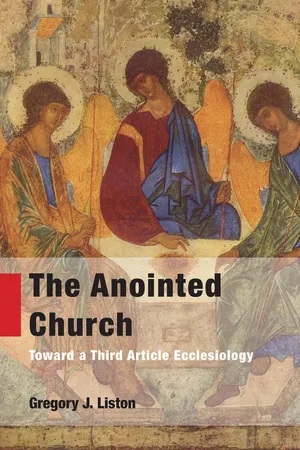
eBook - ePub
The Anointed Church
Toward a Third Article Ecclesiology
- 422 pages
- English
- ePUB (mobile friendly)
- Available on iOS & Android
eBook - ePub
About this book
The phrase Third Article Theology is used in two senses: first, to characterize a methodological approach that intentionally starts with the Spirit, and second, as the theological understanding that emerges from this approach. Over recent decades, Spirit Christology has utilized the approach of Third Article Theology to gain significant insight into the person and life of Christ. The Anointed Church extends this work, providing the first constructive and systematic ecclesiology developed through the approach of Third Article Theology. Gregory J. Liston argues that a pneumatological lens irreducibly informs the connection between other theological doctrines and ecclesiology. Utilizing this insight, the Church is examined from the vantage points of Christology and the Trinity through such a pneumatological lens. The constituent features of a Third Article Ecclesiology developed in this manner are compared and contrasted with critical evaluations of ecclesiological understandings developed through alternative approaches, particularly those of Barth, Zizioulas, and Volf.
Trusted by 375,005 students
Access to over 1.5 million titles for a fair monthly price.
Study more efficiently using our study tools.
Information
Topic
Theology & ReligionSubtopic
Christian Theology3
The Church as Participant in Trinitarian Life
In “The Church on Earth: The Roots of Community,” Colin Gunton argues that in the Trinity, the church developed “a distinctively Christian ontology” but notes with regret that “its insights were for the most part not extended into ecclesiology.”[1] Gunton goes on to describe how he believes a Trinitarian ecclesiology can and should be constructed. Initially recognizing the historical importance of the link between Christ and the church, he immediately notes that “Christology’s tendency . . . to universalise”[2] often results in a static and authoritarian ecclesial understanding. To counteract this tendency he suggests the Spirit’s role in Christ’s life must be recognized and prioritized, so that ecclesiology is derived from Jesus’ humanity rather than just his divinity. Gunton’s comments here are very pertinent, presaging the approach taken in part two of this research. By recognizing the analogical continuities between the Spirit’s role in Christ and the church, part two developed an ecclesiology conditioned by a balanced recognition of Christ’s humanity.
But Gunton goes further. He comments,
Christology is only the starting point, because it is so closely related to the question of the status of the events from which the Church originated. If we wish to say something of what kind of sociality the Church is we must move from a discussion of the relation of Christology to pneumatology to an enquiry into what it is that makes the Church what it is: and that necessitates a move from the economic to the immanent Trinity; or from the ontic to the ontological.[3]
Matching this intent, the purpose of part three is to view ecclesiology from a Trinitarian vantage point through the lens of pneumatology. In short, part two examined a direct comparison between the work of the economic Trinity and the church; part three deals with a less direct analogy between the immanent Trinity and ecclesiology. Two key reasons make this immanent Trinitarian analogical link more challenging than the previous Christological connection. First, the Christological connection to ecclesiology is more explicitly biblical than the Trinitarian connection. While not absent, references analogically linking the Trinity and the church are much less common than Christological connections.[4] Second, and more pertinently, in comparing Christ and the church, the two entities being discussed both “include” divinity and humanity. In comparing the Trinity and the church, this similarity no longer holds. One entity is entirely divine and the other is partially (and perhaps predominantly) human. As such, care must be taken that the clear distinction between Creator and creature is not minimized.
Miroslav Volf notes three clear distinctions[5] between the Trinity and the church.[6] The first distinction is between what the immanent Trinity is, and our apprehension of it. The second distinction is between our Trinitarian apprehension and ecclesiology. Terms like “perichoresis” or “communion” cannot be used in precisely the same way of both God and humanity, and ecclesial participation in the life of the Trinity must be understood as creaturely in order that pantheism be avoided.[7] The third distinction is between an eschatological (or optimal) ecclesiology and historical reality. As Volf recognizes, the church is “moving between the historical minimum and the eschatological maximum. For a sojourning church, only a dynamic understanding of its correspondence to the Trinity is meaningful.”[8]
These distinctions mean that any simplistic, direct equivalence between the Trinity and the church is more than likely mistaken. Gunton recognizes this when he writes that “the temptation must be resisted to draw conclusions of a logicising kind: appealing directly to the unity of the three as one God as a model for a unified church; or conversely . . . arguing from the distinctions of the persons for an ecclesiology of diversity.”[9] It would be a mistake to conclude, however, that there is no analogical correlation at all between the Trinity and ecclesiology. Certainly there is no direct logical connection. There is, however, a personal and pneumatological link, for we participate “by the Spirit in the Son’s communion with the Father.”[10] Gunton again:
The doctrine of the Trinity replaces a logical conception of the relation between God and the world with a personal one. . . . Such relation as there is is personal, not logical, the product of the free and personal action of the triune God. The world is therefore contingent, finite and what it is only by virtue of its continuing dynamic dependence upon its creator; or, to say the same thing in another way, by the free action of the Spirit on and towards it.[11]
The question that arises is precisely what analogical connection can be made between the Trinity and the church—in what way does the life of the church participate in the life of the Trinity? This is the key question that part three of this research addresses. Before it can be answered, however, there is a prior question: Which Trinity does the church participate in? Not that there are many Trinities, but there are many doctrines of the Trinity, as evidenced for example by the disagreements over the filioque.[12] As such, in determining how the church is analogically connected with the Trinity the route taken must follow Volf’s distinctions. Step one is to determine the conception of the immanent Trinity that is most responsible to the biblical revelation. Step two determines the analogical implications of that understanding for the church in its sojourning between its historical minimum and its eschatological maximum. The discussion in part three proceeds in these steps, as outlined below.
Chapter 7 traverses the route from the economic to the immanent Trinity, from God’s revelation to God’s being. Recognizing the inherent risks arising from starting with God’s unity and “solving” his diversity (or the reverse), this chapter focuses on that aspect of the revelation where the unity and diversity of the Godhead is clearly and simultaneously evident: Spirit Christology. As Coffey has noted: “Spirit Christology provides our best mode of access to the theology of the Trinity.”[13] The recent attempts of Coffey, Moltmann, and Habets to trace this path are considered. Applying the Spirit Christological analysis in chapter 2, the first two attempts are categorized as Spirit-priority and Son-Spirit-separation proposals respectively. In contrast, Habets’s argument that a coherent Spirit Christology implies a “reconceived” understanding of the Trinity where the Father eternally begets the Son by the Spirit and the Son returns the love of the Father by the Spirit not only maintains a close connection between the economic and immanent Trinity (contra Moltmann) but also enables a clear personal role for the Holy Spirit within the Godhead (contra Coffey). Consequently, this “reconceived” Trinitarian understanding will be used analogically to determine a coherent Trinitarian Third Article Ecclesiology.[14]
Chapter 8 constructs a viable analogical link between the immanent Trinity and the church. Initially Miroslav Volf’s characterization of the church as the image of the Trinity is considered.[15] While recognizing its many positive features, it is argued that the analogical connection between the Trinity and ecclesiology is not “reflective” but pneumatological. More specifically, the church participates not with the Trinity, as a “reflective” methodology espouses, but in its very life, joining “by the Spirit in Jesus’s communion with the Father.”[16] These concerns are further illuminated through Kathryn Tanner’s work, which critiques those who, like Volf, draw direct and logical comparisons between the Trinity and the church. The question is raised regarding whether Tanner’s concerns apply equally to the methodology of Third Article Theology. It is argued that a pneumatologically enabled but Christologically conditioned approach can be used to construct a viable analogical link between the Trinity and the church, as exemplified in the work of Heribert Mühlen. Mühlen contends that in both the Trinity and the church the Holy Spirit is “one person in many persons,” and that through the Spirit, Christ and the church together form a single corporate personality—a “Great-I.” His work demonstrates that a Third Article Theology approach can provide a viable bridge between the two loci. Without undermining this key methodological point, it is also noted that Mühlen’s work suffers from a “speculative” Trinitarian starting point that is insufficiently grounded in the biblical witness.
The main aim of part three, then, is to draw an analogical link between a “reconceived” understanding of the Trinity and the ontology and life of the church, using a pneumatologically enabled but Christologically conditioned approach. Using Wolterstorff’s terminology, the “reconceived” Trinity is the control belief, ecclesiology is the data belief, and Scripture and the creeds form the background beliefs. If we join the Son’s Trinitarian life through the Spirit, then how does this genuine participation impact our understanding and practice of ecclesial life? How does the church participate in Christ’s filial relationship with the Father? And how, consequently, does our constitution in relationship affect the relationships of those individuals within the overall church? In short, how do the extra- and intra-ecclesial relationships function? The straightforward reality that Christ is only one person means that these questions are difficult to answer from the isolated vantage point of Christology, but the perspective gained from a “reconceived” doctrine of the Trinity provides an ideal perspective from which to observe these ecclesiological characteristics.
Chapter 9 argues that the immanent Trinitarian identities of the Son and the Spirit are reprised (with inevitable continuities and discontinuities) on a series of expanding stages: Christologically in the hypostatic union, soteriologically in the mystical union, and most pertinently ecclesiologically in the union between individual church members. In each of these unions the salient features of the “reconceived” Trinity are repeated: (a) the Son and the Spirit are logically distinct but completely inseparable; (b) the Spirit repeatedly acts as the “personing person” and the Son as the “personed person” who is variously begotten, incarna...
Table of contents
- Cover
- Title Page
- Copyright
- Table Of Contents
- Acknowledgements
- Toward a Third Article Ecclesiology
- The Church as Sequel to the Incarnation
- The Church as Participant in Trinitarian Life
- Bibliography
- Index
Frequently asked questions
Yes, you can cancel anytime from the Subscription tab in your account settings on the Perlego website. Your subscription will stay active until the end of your current billing period. Learn how to cancel your subscription
No, books cannot be downloaded as external files, such as PDFs, for use outside of Perlego. However, you can download books within the Perlego app for offline reading on mobile or tablet. Learn how to download books offline
Perlego offers two plans: Essential and Complete
- Essential is ideal for learners and professionals who enjoy exploring a wide range of subjects. Access the Essential Library with 800,000+ trusted titles and best-sellers across business, personal growth, and the humanities. Includes unlimited reading time and Standard Read Aloud voice.
- Complete: Perfect for advanced learners and researchers needing full, unrestricted access. Unlock 1.5M+ books across hundreds of subjects, including academic and specialized titles. The Complete Plan also includes advanced features like Premium Read Aloud and Research Assistant.
We are an online textbook subscription service, where you can get access to an entire online library for less than the price of a single book per month. With over 1.5 million books across 990+ topics, we’ve got you covered! Learn about our mission
Look out for the read-aloud symbol on your next book to see if you can listen to it. The read-aloud tool reads text aloud for you, highlighting the text as it is being read. You can pause it, speed it up and slow it down. Learn more about Read Aloud
Yes! You can use the Perlego app on both iOS and Android devices to read anytime, anywhere — even offline. Perfect for commutes or when you’re on the go.
Please note we cannot support devices running on iOS 13 and Android 7 or earlier. Learn more about using the app
Please note we cannot support devices running on iOS 13 and Android 7 or earlier. Learn more about using the app
Yes, you can access The Anointed Church by Gregory J. Liston,Gregory J. Liston in PDF and/or ePUB format, as well as other popular books in Theology & Religion & Christian Theology. We have over 1.5 million books available in our catalogue for you to explore.