- 826 pages
- English
- ePUB (mobile friendly)
- Available on iOS & Android
eBook - ePub
About this book
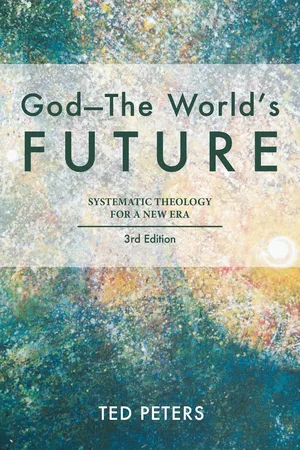
God—The World's Future has been a proven and comprehensive textbook in systematic theology for over twenty years. Explicitly crafted to address our postmodern context, Peters explains the whole body of Christian historical doctrine from within a "proleptic" framework, "whereby the gospel is understood as announcing the pre-actualization of the future consummation of all things in Jesus Christ." Peters skillfully deploys this concept not only to organize the various theological areas or loci but also to rethink doctrines in light of key postmodern challenges from ecumenism, critical historical thinking, contemporary science, and gender and sexuality issues. The Third Edition is thoroughly revised with updated chapters, additional chapters, updated annotations and bibliographies, and further elaborations in light of recent developments in method and theological reflection. This classic text opens up systematic theology in new dimensions, retrieving traditional categories and topics for a new generation of students and learners to give a fresh reading of Christian theology and articulation of the liberating message of the gospel of God's grace for the future of the world.
Information
2
The Fountain of Creation
3. God the Trinity
Awareness of God
Classical Theism and God’s Attributes
God as Trinity
Islam and God’s Reality
God as Father and Feminist Consciousness
Trinitarian Liberation
Classical Theism and God’s Attributes
God as Trinity
Islam and God’s Reality
God as Father and Feminist Consciousness
Trinitarian Liberation
4. God and the Continuing Creation
How God Relates to the World
The Gospel and Creation
Big Bang, Entropy, Evolution, and Ecology
A Proleptic Concept of Creation
The Gospel and Creation
Big Bang, Entropy, Evolution, and Ecology
A Proleptic Concept of Creation
5. Becoming Human and Unbecoming Evil
Becoming Human
Two Sexes and One Jesus
Unbecoming Evil
Original Sin
God, Sin, and the Future Whole
Two Sexes and One Jesus
Unbecoming Evil
Original Sin
God, Sin, and the Future Whole
Introduction to Part Two
We believe in one God, the Father Almighty,
Maker of heaven and earth,
Of all that is, seen and unseen.
Maker of heaven and earth,
Of all that is, seen and unseen.
—Nicene Creed
The Apostles’ and Nicene Creeds divide and order confessional commitments into three articles: first, the Father and creation; second, the Son and redemption; and third, the Spirit identified with sanctification and consummation. The systematic theology presented in this book follows this trinitarian pattern. Each of the three articles may be subdivided, and each subdivision becomes a topic, or locus, for theological explication.
Part Two opens the doctrinal content of systematic theology by examining the Christian understanding of God. This examination addresses various subdivisions or loci within the First Article such as God’s attributes, the Trinity, and creation. Creation is further subdivided so as to focus on the nature of the cosmos as well as on the human being as a creature of creation with the accompanying problem of sin and evil that contaminate the creation. We will take up creation again later, in the chapter on Astrotheology.
In Part One on methodological foundations, I discussed faith and revelation, which are prerequisites for the creedal introduction, “We believe.”Now I turn to just what it is that “we believe.”
3
God the Trinity
O infinite goodness of my God, for it seems to me I see that such is the way You are and the way I am! O delight of angels, when I see this I desire to be completely consumed in loving You! . . . Oh, what a good friend you make, my Lord!
—Saint Teresa of Avila
Theology’s overriding question is this: Who is God? Christians more specifically ask: What is the significance of the story of Jesus for understanding God? The attempt to answer this question leads to the Christian doctrine of the Trinity: God is the transcendent One who has become one with humanity in the person of Jesus Christ and through whose Spirit we and the whole cosmos are being brought to fulfillment. In Jesus, the transcendent has become present; in the Spirit conflicting fragments are becoming integrated into a whole. The heart behind and within this process is termed God. When we use the word God we usually do so as if we knew what we were talking about. Upon close examination, however, we find that in the Christian vocabulary the word is ambiguous. On the one hand, God can refer to the first person of the Trinity, the Father of Jesus Christ. On the other hand, God can refer to the Trinity as a whole, inclusive of Son and Spirit. This ambiguity seems to bother very few people. For those who have a penchant for precision, the word God could be reserved for the first person of the Trinity, the Father, and the term godhead used to designate the Trinity proper. Such precision may be helpful for theological explication, but it is worth noting that the New Testament symbols lack this precision and speak of the divine in a much more ambiguous yet protean fashion. The symbols for the divine in the Old Testament begin with the mysterious Tetragrammaton (יהוה)—designated now by the word Yahweh—revealed to Moses in the burning bush. The Old Testament also borrowed common Middle Eastern vocabulary to speak of the Holy One of Israel as simply God (El or Elohim), the Most High (El-Elyon), the covenanting God (El-Berith), or the God of the Mountain and Power (El-Shaddai). Yahweh of Israel is the creator and judge of the whole world. In the New Testament, the God of Israel can be designated with the simple Greek word θέоϛ, the generic term for the gods of Olympus. Familial connotations arise when speaking of God as Father, a counterpoint to speaking of Jesus as God’s Son. What dominates scripture is the cluster of royal appellations such as king and Lord warranting the human response of praise. The term Lord is the most frequently used symbol in Christian liturgy. This royalty symbolism relies on the beyond sensibility, yet the beyond is frequently accompanied by intimate connotations. The glory of the divine royalty is tied to its tensive opposite, humility and humiliation. The prince of peace is born in a stable, not a castle. The messianic king dies the death of a criminal on a cross. The good shepherd becomes the sacrificial lamb. Perhaps the built-in paradox is most succinctly expressed in the symbol of the lamb upon the throne evoking both Beyond and Intimate sensibilities. These are symbols, not snapshots. Symbols provide a cipher to which the divine reality correlates without divulging the essence of the holy. God is not literally a king or a father or a lamb. Nor are symbols paradigms, depicting a divine model to which humans should conform their behavior. Rather than images or paradigms, symbols are markers that identify the experience of revelation. Symbols lie at the metaxy, at the edge, where mundane reality intersects with the transcendent reality of God. Our theological task is to explicate these symbols so they construct a world of meaning that orients human life toward God.
Awareness of God
Essential to every spiritual practice or religious belief system is the evocation of a sense of the Beyond. We intuit that reality is more than what is perceived, that sensory experience communicates only a superficial appearance of what is really real. Behind, underneath, or above what we see and hear is a transcendent yet present reality that is suprasensory, supranatural, spiritual, divine, or all of these. What the religious mind does at this point is answer a question that derives from experience. The question: Is reality more than what we perceive it to be? The question of the Beyond can explode suddenly, in a flash. Many a poet or philosopher has been intellectually stunned by the flash. It is the sudden but stunning awareness of thereness, brute and indelible thereness. The experience may begin with a sense of the preciousness of the moment. Amid the hubbub of activity, the mind silently pauses and fixes on the sheer presence of what is there. Each individual item in the room or on the landscape is perceived with utmost clarity, with the awareness that it is what it is and not something else. Both persons and things exist, standing out in clear relief from the possibility that they might not have existed, or, because of their finitude, that they might not exist in the future. Life appears as a door to something profound. The door remains closed, but one senses that there behind it the whole meaning of existence—or nonexistence—is kept. This experience is described by some philosophers as ontological shock. It gives rise to the ontological question: Why is there something and not nothing? This is a question of profound depth and universal scope. It asks about the possibility of the nonexistence of everything. A close look, however, will reveal that it is derived from a more personal, more existential question, namely: Why do I exist? Before we ask about the existence of the world, we want to know about our own existence. Whether in a dream or while awake, sooner or later each of us asks this question in various forms. For example, even if everything else in the world continued to exist as it is, what would it be like if I did not exist? Or, conversely, even if I should continue to exist as I am, what would it be like if all the persons and things I love would disappear in the next moment? Even if they do not disappear in the next moment, I know that they are ephemeral and mortal and will disappear in time. All will die. So will I. What then is the meaning of all this? If nothing but nonexistence is the future of all that I am and all that I love, then I ask: Is everything ultimately meaningless? Is there a “more than” that transcends, supports, and gives meaning and perhaps even eternity to what I perceive as what is? When confronted with the brute thereness of things and the accompanying awareness of possible nonbeing, we suddenly sense that what is is not just what is. Is there something more? But what is that something more? The answer can take us in one of two directions, either toward fulfillment of meaning or toward its annihilation. Like standing on the very edge of a high cliff we can look back at the terra firma that lies behind us, or we can turn the other direction and look out into the abyss of nothingness. We can either affirm what is with some joy and appreciation or we can ponder with anxiety its possible, if not inevitable, loss into the meaningless pit of nonexistence. The question arising from the experience of brute thereness is the question of God. It is not the answer. It is the question. The answer comes initially by an act of God that is a revelation of God. It is mediated to Christians through the house of faith in which they live—that is, through the symbols. Christian religious structures are built on these symbols as their foundation. What Christians need to do from time to time is return to the edge and, from this vantage point, reexamine their foundations. This is the task of the self-critical principle. If we find that our religious structures need renovation, then we may tear something down and rebuild. This is the task of constructive explication as a whole. When it comes to the doctrine of God, we employ the critical in behalf of the constructive.
The Beyond and the Intimate
The Apostles’ Creed opens: “I believe in God, the Father Almighty, maker of heaven and earth.” In his Small Catechism, Martin Luther asks, “What does this mean?” Then he answers, “I believe that God has created me and all that exists.” Luther puts “me” first and then only subsequently mentions “all that exists.” With subtle but dramatic impact, he conveys a marvelous existential truth: the almighty designer and creator of galaxies and planets has me in mind. The totality of reality is not what it is without my place in it. I am not here by accident. I am an indispensable part of the grand whole, and God knows it. In fact, God actually cares for me. The juxtaposition of “all that exists” with what might otherwise be thought to be a person’s relative insignificance gives voice to a necessary and healthy tension within our experience and understanding of God—the tension between two sensibilities: the Beyond and the Intimate.[1] The Beyond, which in a previous chapter we identified as a sensibility, draws our attention toward that which is radically transcendent. A translation of the Greek ἐπέκεινα, the Beyond is the ultimate and in itself indefinable reality that surpasses all categories of intracosmic thinking. Although indefinable and transcendent, it is not absent. It calls, and something within the human soul mumbles an answer. Or, perhaps better, it calls and we mumble a question, asking about the origin of the call. We can know about the Beyond only through revelation. But the Beyond stands in dialectical tension with the Intimate. Whereas the Beyond is the absolute, the Intimate is the relative. Down at the deepest level of our personal being, we do not want to be alone. Yet, because we are finite and apparently discrete persons, the best we can do is live side by side with other people and things. Getting next to someone else through friendship is a gain, but it is not enough. No one can overcome the barriers and bounds that separate our inner soul from the world around, so no matter how deep the love or how many the shared interests, in the last analysis, we are left alone at the bottom of our ephemeral being. Therefore, when we listen for the call of the Beyond, we listen with the silent and secret hope that the call comes from within as well as without. We want the Beyond and the Intimate to meet each other in the depths of our own person. The testimony of the biblical symbols such as Emmanuel—meaning “God with us”—is that they do.
Yahweh of Israel
In his great speech before all the tribes of Israel gathered at the city of Shechem, Joshua opens by acknowledging that “your ancestors . . . served other gods” (Josh. 24:2). He challenges the people to put away the gods of the Egyptians and the Amorites and concludes with the dramatic line, “As for me and my house, we will serve the Lord” (Josh. 24:15b). Joshua’s Lord is the Holy God of Israel, the one who heard the cries of an oppressed people held captive in Egypt and who “with a mighty hand and an outstretched arm” reached into the course of human history, rescued what would become his people, and gave...
Table of contents
- Cover
- Title Page
- Copyright
- Table Of Contents
- Preface to the First Edition
- Preface to the Second Edition
- Preface to the Third Edition
- Abbreviations
- Theology’s Context and Method
- The Fountain of Creation
- The Foretaste of New Creation
- The Life of the New Creation
- Proleptic Co-Creation
- Selected Bibliography
- Index
- Additional Praise for God—The World's Future
Trusted by 375,005 students
Access to over 1.5 million titles for a fair monthly price.
Study more efficiently using our study tools.
Frequently asked questions
Yes, you can cancel anytime from the Subscription tab in your account settings on the Perlego website. Your subscription will stay active until the end of your current billing period. Learn how to cancel your subscription
No, books cannot be downloaded as external files, such as PDFs, for use outside of Perlego. However, you can download books within the Perlego app for offline reading on mobile or tablet. Learn how to download books offline
Perlego offers two plans: Essential and Complete
- Essential is ideal for learners and professionals who enjoy exploring a wide range of subjects. Access the Essential Library with 800,000+ trusted titles and best-sellers across business, personal growth, and the humanities. Includes unlimited reading time and Standard Read Aloud voice.
- Complete: Perfect for advanced learners and researchers needing full, unrestricted access. Unlock 1.5M+ books across hundreds of subjects, including academic and specialized titles. The Complete Plan also includes advanced features like Premium Read Aloud and Research Assistant.
We are an online textbook subscription service, where you can get access to an entire online library for less than the price of a single book per month. With over 1.5 million books across 990+ topics, we’ve got you covered! Learn about our mission
Look out for the read-aloud symbol on your next book to see if you can listen to it. The read-aloud tool reads text aloud for you, highlighting the text as it is being read. You can pause it, speed it up and slow it down. Learn more about Read Aloud
Yes! You can use the Perlego app on both iOS and Android devices to read anytime, anywhere — even offline. Perfect for commutes or when you’re on the go.
Please note we cannot support devices running on iOS 13 and Android 7 or earlier. Learn more about using the app
Please note we cannot support devices running on iOS 13 and Android 7 or earlier. Learn more about using the app
Yes, you can access God--The World's Future by Ted Peters in PDF and/or ePUB format, as well as other popular books in Theology & Religion & Christian Theology. We have over 1.5 million books available in our catalogue for you to explore.