eBook - ePub
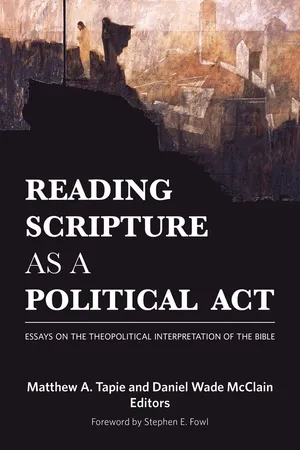
Reading Scripture as a Political Act
Essays on the Theopolitical Interpretation of the Bible
- 334 pages
- English
- ePUB (mobile friendly)
- Available on iOS & Android
eBook - ePub
Reading Scripture as a Political Act
Essays on the Theopolitical Interpretation of the Bible
About this book
Although scholars increasingly understand Scripture to contain political dimensions and implications, the interpretation of Scripture is often marginalized in most scholarly discussions of political theology. Reading Scripture as a Political Act takes a step toward remedying this situation by exploring some of the ways the church has read Scripture politically. In particular, this volume examines the political character of premodern and modern theologians' readings of Scripture with attention to how their readings relate to or address political challenges in their particular social and historical settings. The essays attempt to illuminate the ways that the theological interpretation of Scripture shaped the theopolitical imaginations of Augustine, Basil of Caesarea, Bonaventure, Thomas Aquinas, Bartolome de las Casas, John Wesley, Karl Barth, Henri de Lubac, and John Howard Yoder, among others. Several essays in the volume also take constructive steps and suggest how these models of reading Scripture can inform the contemporary task of reading Scripture in political contexts. The volume covers the earliest Christian centuries to the late modern era, and considers carefully the close coordination between Scripture, theology, and social and political concerns. As a whole, the collection provides a robust survey of Christian theopolitical interpretation of the Bible.
Information
Topic
Theology & ReligionSubtopic
Christian Theology1
Main Body
1
Empires and Enemies
Re-Reading Lament as Politics
Rebekah Eklund
The biblical lament is a cry for God’s help in the midst of distress. Save! Rise up! Hear! Especially in apocalyptic contexts, the lamenter insists—despite the available evidence—that all the nations fall under God’s sovereignty and are subject to the justice of the judge of all the earth (Pss. 67:4; 82:8; 94:2; 96:10, 13; 98:9). In the midst of injustice, the lamenter challenges God to act according to God’s own character, that is, to bring about justice. In this way, lament is a public expression of protest regarding the way things are, and hope in the way things will be in God’s good future. When we read the laments of scripture today in our own political settings, or with our suffering neighbors, we participate in a practice that possesses an inherently political character. Indeed, lament functions as resistance and renarration: resistance to the idea that the oppressor gets the last word, and a renarration of the present injustice in light of God’s inexorable promise of peace and justice for those who suffer (Rev. 21:3-4).
To investigate the claim that reading biblical lament is a Christian political practice, this essay explores the lament of the martyrs under the altar in Revelation against the backdrop of Daniel’s lament, which helps to situate the martyrs’ lament within the long history of Israel’s laments.[1] Both Daniel and Revelation are apocalyptic texts, both use Babylon as a cipher for another political threat, both are embedded within contexts of imperial oppression and communal challenge, and both use lament to call upon God’s justice to defeat the oppressor and vindicate God’s suffering people. The essay concludes with a brief consideration of the relationship between reading biblical lament and enacting it through contemporary nonviolent public protests against injustice.
Enemies and Empires
The enemy is such a defining element of the biblical lament that Claus Westermann calls it one of the three constitutive elements of the lament, alongside God and the lamenter.[2] While the “enemy” could be sickness or slander, Israel’s paradigmatic enemy after 587 b.c.e. is Babylon, which in turn becomes a cipher for later enemies, especially Antiochus IV (as in Daniel) and Rome (as in Revelation). The enemy of empire poses a special problem for Israel’s identity as God’s covenant people, as expressed so eloquently by the pseudonymous author of 4 Ezra: “And now, O Lord, behold, these nations, which are reputed as nothing, domineer over us and devour us. But we your people, whom you have called your first-born, only begotten, zealous for you, and most dear, have been given into their hands” (6:57-58; cf. 3:32, 35b; 5:23-27).
As Israel’s laments over time protested the domination of Egypt, Assyria, Babylon, Persia, the Seleucids, and Rome, the New Testament authors likewise appropriated lament within their own sociopolitical reality: the Roman Empire as represented by Herod the Great, Caesar Augustus, Quirinius of Syria, the colluding Sadducees and the chief priests (“We have no king but Caesar,” John 19:15), Herod Antipas, Pontius Pilate, Nero, Domitian. Inasmuch as Jesus is the Messiah-King who weeps, is abandoned, and is executed as a criminal, lament in the New Testament contributes to the power-reversal inherent in the gospel: the last shall become first; the mourners shall be comforted; the martyrs who lose their lives to the empire shall be vindicated, the mighty emperor thrown down, and the slaughtered Lamb shall ascend his rightful throne.[3] The cry of lament that echoes in the New Testament protests all that is “not yet” about this good news: the last are still last; the emperor still reigns; the faithful are dragged to trial and killed; Christ has not yet returned and creation groans with longing for that day. But the lamenter also trusts in the fulfillment of what God began by taking on flesh in Jesus.[4]
Antiochus IV as Babylon: Lament as Resistance in Daniel
In the Old Testament, Daniel and his companions are the exemplars of faithfulness to God under oppression: they choose death in a fiery furnace rather than commit idolatry by worshiping the Babylonian king’s golden image. In Daniel 7–12, Daniel receives a series of visions, one of which includes four beasts that correspond to four empires: Babylon, the Medes, the Persians, and finally the Greeks, from which spring the ten “horns” of the Seleucid dynasty. These details prompt scholars to locate the composition of Daniel’s latter chapters to the crisis in Judea under the Seleucid ruler Antiochus Epiphanes IV, who in 167 b.c.e. outlawed key Jewish practices (most notably, circumcision) and desecrated the temple by replacing its holy objects with a statue of Zeus. Daniel is thus a symbol of resistance both in exile in Babylon in the sixth century b.c.e. and in occupied Judea 400 years later.
After an especially distressing vision, Daniel prays a lengthy lament, which contains a strong element of penitence for Israel’s past sins.[5] First, Daniel fasts in sackcloth and ashes, which are acts of ritual mourning, and then he prays and makes confession to God (9:3-4a). Daniel pleads with God to forgive Judah, Jerusalem, and all Israel for their rebellion (9:5-11), pointing out that God’s reputation is at stake, since the city of Jerusalem and the people of Israel both “bear your name” (9:18, 19; cf. 9:16b; Exod. 32:9-14). Daniel concludes with a series of imperative petitions, a common feature of lament: Hear! Forgive! Listen! Act! Do not delay! (9:19).[6]
While Daniel is still praying, the angel Gabriel arrives to explain the vision that had left Daniel appalled in the previous chapter (8:27). While the angel provides no easy assurance of the enemy’s defeat, his answer declares that God controls and has decreed even these turbulent historical events. Every empire is under the sovereignty of the God of Israel, the judge of all the earth. By laying claim to God as the one who continues to be God of Israel despite Israel’s sins, Daniel’s lament “contradicts imperial claims to ultimacy,” whether those of Babylon or Antiochus, and thus functions as a form of radical hope in the midst of calamity.[7] In fact, Anathea Portier-Young proposes that “the book of Daniel urges Judeans persecuted by Antiochus IV to adopt specific forms of nonviolent resistance,” including “persevering in the practices of their faith even at the cost of their lives.”[8] Daniel’s lament is itself a practice of nonviolent resistance to oppression, as it provides a “recitation of alternative values” and a reshaping of Israel’s identity as the people of God.[9] Likewise, the lament of the martyrs in Revelation renarrates the apparent triumph of the Roman Empire and represents one form of resistance to imperial demands to abandon God and worship the emperor’s idols instead.
Rome as Babylon: Lament as Resistance in Revelation
If Daniel is implicitly or by application a text of encouragement to a suffering community, Revelation is explicitly an exhortation, directly addressed to seven churches in Asia Minor. Revelation’s apocalyptic visions[10] encourage nonviolent resistance to the imperial cult and public witness to Christ’s Lordship, all in the light of God’s ultimate victory over both Satan and Rome.[11] The lament of the martyrs contributes to this overarching purpose. Their cry occurs early in Revelation, after John’s vision of the heavenly throne and just after the slaughtered Lamb is declared worthy to open the scroll. The “souls of those who had been slaughtered for the word of God and for the testimony they had given” cry out from beneath the altar, “Sovereign Lord, holy and true, how long will it be before you judge and avenge our blood on the inhabitants of the earth?” (Rev. 6:10).[12]
The martyrs have presumably lost their lives in one of the waves of imperial persecution.[13] When they cry out, they address God as δεσπότης (NRSV: Lord), a relatively rare word in the New Testament. Although δεσπότης can refer to God in the LXX and in Jewish and Christian literature (for example, Luke 2:29; Acts 4:24), it is also “a regular Greek translation of two Latin terms for the Roman emperor, dominus and princeps.”[14] Here, as perhaps also in Luke-Acts, the slaughtered souls address God as the true δεσπότης, not the emperor, just as Jesus is the true Lord (κύριος).[15]
Additional symbols undergird the martyrs’ lament with political force. The martyrs’ lament occurs when the Lamb opens the fifth seal, after the first four seals have unleashed the famous four horsemen of conquest, war, famine, and plague. As symbols of war, horses represent the might of Rome, but John repurposes them: “Those thundering hoofs that once heralded the irresistible power of Roman armies are now signaling the inevitable doom of the empire.”[16] The sword (μάχαιρα) of the second horseman is another “symbol of imperial authority” (see Rom. 13:4).[17] Even the altar under which the martyrs cry out may function as an allusion to Rome’s authority and its blasphemous claims to divinity. While most interpreters take the altar in 6:9 as a heavenly altar, David May argues that it is a Roman altar, meant to evoke the “monumental altar to Zeus at Pergamum,” where the first martyr mentioned in Revelation died (2:13).[18] Even if the altar is meant to be the heavenly altar and not an earthly, Roma...
Table of contents
- Cover
- Title Page
- Copyright
- Table Of Contents
- Foreword
- Introduction
- Main Body
Trusted by 375,005 students
Access to over 1.5 million titles for a fair monthly price.
Study more efficiently using our study tools.
Frequently asked questions
Yes, you can cancel anytime from the Subscription tab in your account settings on the Perlego website. Your subscription will stay active until the end of your current billing period. Learn how to cancel your subscription
No, books cannot be downloaded as external files, such as PDFs, for use outside of Perlego. However, you can download books within the Perlego app for offline reading on mobile or tablet. Learn how to download books offline
Perlego offers two plans: Essential and Complete
- Essential is ideal for learners and professionals who enjoy exploring a wide range of subjects. Access the Essential Library with 800,000+ trusted titles and best-sellers across business, personal growth, and the humanities. Includes unlimited reading time and Standard Read Aloud voice.
- Complete: Perfect for advanced learners and researchers needing full, unrestricted access. Unlock 1.5M+ books across hundreds of subjects, including academic and specialized titles. The Complete Plan also includes advanced features like Premium Read Aloud and Research Assistant.
We are an online textbook subscription service, where you can get access to an entire online library for less than the price of a single book per month. With over 1.5 million books across 990+ topics, we’ve got you covered! Learn about our mission
Look out for the read-aloud symbol on your next book to see if you can listen to it. The read-aloud tool reads text aloud for you, highlighting the text as it is being read. You can pause it, speed it up and slow it down. Learn more about Read Aloud
Yes! You can use the Perlego app on both iOS and Android devices to read anytime, anywhere — even offline. Perfect for commutes or when you’re on the go.
Please note we cannot support devices running on iOS 13 and Android 7 or earlier. Learn more about using the app
Please note we cannot support devices running on iOS 13 and Android 7 or earlier. Learn more about using the app
Yes, you can access Reading Scripture as a Political Act by Matthew A. Tapie, Daniel Wade McClain, Matthew A. Tapie,Daniel Wade McClain,Matthew A. Tapie,Daniel Wade McClain, Matthew A. Tapie, Daniel Wade McClain in PDF and/or ePUB format, as well as other popular books in Theology & Religion & Christian Theology. We have over 1.5 million books available in our catalogue for you to explore.