- 404 pages
- English
- ePUB (mobile friendly)
- Available on iOS & Android
eBook - ePub
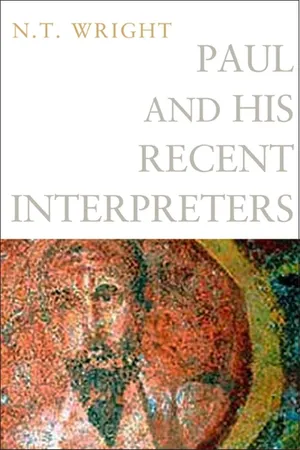
Paul and His Recent Interpreters
About this book
This companion volume to N. T. Wright's Paul and the Faithfulness of God and Pauline Perspectives is essential reading for all with a serious interest in Paul, the interpretation of his letters, his appropriation by subsequent thinkers, and his continuing significance today. In the course of this masterly survey, Wright asks searching questions of all of the major contributors to Pauline studies in the last fifty years.
Information
Part I
PAUL AMONG JEWS AND GENTILES?
Chapter One
SETTING THE STAGE
1. Introduction
If Paul had never been heard of, and his letters had suddenly come to light in a hoard of papyri long buried in the sands of Egypt, there are certain questions we would want to ask about them. Who was the author? Did the same person write all these letters, or only some? In what culture did the author(s) live, and how might that culture help us understand what was being said? When were they written? Were they real letters, or was the literary form simply adopted as a teaching tool? Supposing them to be real letters, who were they addressed to? How would they have been understood? Can we get a sense, from the letters, of the larger world in which the author and the readers lived? What human motivations can we discern both in the letters themselves and in their circumstances, so far as we can reconstruct them? Historians ask questions like these all the time. Any academic study of Paul, a letter-writer from two thousand years ago, must be grounded in the attempt to answer such questions with all the tools available to us. The aim, all along, is ‘exegesis’: to get out of the text what is there, rather than, as with ‘eisegesis’, to put into it ideas from somewhere else.
We engage in this historical task neither out of mere antiquarian curiosity nor out of nostalgia for a long-forgotten past. We do it because we crave genuine understanding, a real meeting of minds and even of worlds. As soon as we think about it, we know we should do our best, in reading any texts from other contexts, to avoid two dangers: anachronism, imagining that people in a former time saw the world the way we do, and what Coleridge called ‘anatopism’, imagining that people in a different place saw things the way we do. 1 Of course, we are at liberty to read the texts how we like – just as, notoriously, the guardians of ancient scrolls and manuscripts have sometimes been known to use them for shoe-leather, or for lighting the fire. But we know instinctively, I think, the difference between use and abuse. History is about what happened, and why it happened. We do not advance that quest by projecting our own personalities, or cultural assumptions, on to material from other times and places.
Of course, we see things through our own eyes, and imagine them within our own worlds of understanding. But history is about learning to let the evidence guide us into seeing with other people’s eyes, and into imagining the world in other people’s visions. The task is to understand, so far as we can, what it was like to live, to think, to imagine and to believe within worlds other than our own. The otherness is important, and remains so. We can never attain complete knowledge, a ‘God’s-eye view’. But nor does the act of knowing collapse into the projection of our own prejudices. We are not positivists; but nor are we solipsists. 2
Part of the historical task, when one is faced with a new document from an older world and a different place, is to try to understand the train of thought expressed in the writing, and, behind that again, the mind of the writer. We usually assume that there is a train of thought that made some sense to the writer. People do sometimes deliberately write ‘nonsense’, but even this is usually for a purpose. In other words, within the general historical questions about who, when, where and how, there are the more focused questions of what and why: what is being said here, and why is it being said? Often, with ancient papyri, this is quite easy: a short letter home from a soldier, a shopping list, an IOU. But with many documents, be they poetry or philosophy, plays or biographies, it may take time to get inside the flow of thought, to see how the various ideas expressed relate to one another. The aim, however, is the same: to move towards an historical description of the themes and ideas in the document. When, as is the case with Paul, the subject-matter is regularly and emphatically concerned with a being referred to as ho theos, ‘the god’, and with what this divinity has done and is intending to do, and with how both writer and readers are supposed to be relating to this being, then we naturally give a particular label to the themes and ideas we are finding. We call them ‘theology’.
And now the danger of anachronism or anatopism comes back with a vengeance. We in the western world know a bit about ‘theology’, at least if we belong to some tradition that teaches it or perhaps sings about it. (The same problem would occur, of course, if the subject-matter appeared to be medical, and we knew a bit about medicine; or philosophical, and we had studied philosophy.) We will easily assume that technical terms mean what similar terms mean in our world; that ideas we are accustomed to think of as compatible, or indeed incompatible, will be seen in that way in the text; that arguments we find convincing now would be found convincing then. But the point for the moment is that in order to listen to the text, to let it be itself, to engage in dialogue with it, and to advance towards understanding it, we must allow the basic questions (who wrote it, to whom, at what time, and by what means) to lead us to the historical questions: what is being said, what it meant at the time to the writer and indeed to the readers, and not least why this writer wanted to say these things to these people at that moment. (Actually, in practice things do not move in a straight line. Often the way to find out who wrote the letter and why is first to be sure we have picked up the train of thought.) Historical study of our hypothetical new-found texts thus necessarily includes historical study of meaning and motivation. When the subject-matter has to do with ho theos, the meaning and motivation have to do with theology.
This task always involves the interpreter. We never have a mere fly-onthe-wall role, let alone, as we said, a God’s-eye view. This involvement, the dialogue between text and interpreter, can easily get muddled up with the question of ‘what might this mean for us today’, but wise interpretation will always recognize the difference between ‘granted I am looking through my own eyes, what seems to be going on in this text?’ and ‘granted this text says X, how does X apply in my world today?’ The task of interpretation thus involves going to and fro, as in a real-life conversation. Our culture supplies us with other models, for instance the dialogue of the deaf one sometimes hears when a politician is interviewed on the radio. Real dialogue is the path to understanding; it is the task of ‘interpretation’, of ‘hermeneutics’. (There are cultural differences here in our own world. Montreal has – at least, it had when I lived there – two radio stations offering classical music. The Englishlanguage one told us who was ‘playing’ the music; the French-language one told us who was ‘interpreting’ it.)
This task is often focused not simply on the question as to whether we have understood this text. As I have just suggested, it frequently looks in the other direction: what has this text to say to us in our own world here and now? That question might well emerge, not simply from ‘religious’ or specifically Christian texts, but from any discovery. An ancient philosophical text might be hailed as offering good advice about happiness, or relationships, or money. An ancient poem might shed light on dark corners of human experience. An entire genre of fantasy novels, of which Dan Brown’s The Da Vinci Code is the best known example, works on the assumption that a new discovery from the ancient world might radically transform not only how people today understand the first century but also how they understand themselves, and the church they belong to (or perhaps don’t belong to), today. This is one of the reasons people do history and indeed archaeology: in the hope of a moment of rich connection, of water from an ancient spring slaking our modern thirst.
But now at last we must give up the pretence that we have just discovered these Pauline letters, making us the first people to read them. We are simply the latest in a long line of readers. And the question, What might this mean for us today? is one we share with that long line. Serious readers have pondered these questions before us. We do not want to be enslaved by their ideas, but nor should we suppose that we have nothing to learn from them. We do not want to end up reinventing the wheel.
I approach the matter like this because it might be easy to imagine that the question of ‘What does this mean today?’ confronts us in the Bible in a way that is not true with other writings. Though I believe that there is indeed a sense in which this might be so, that sense is found within, not detached from, the wider truth that the letters of Paul meet us as documents from the past, and that our engagement with them has a lot in common with our engagement with all other documents from the past. Biblical hermeneutics is a sub-branch of hermeneutics more generally. Careful thinking about the nature of our engagement with texts from the past ought not to diminish any sense that the early Christian documents are sui generis. It ought to enable us to be much clearer as to where exactly that supposed uniqueness might lie.
We should not make the mistake of thinking that addressing the question of contemporary relevance is only done by those who read Paul within a faith-community committed to regarding his letters as authoritative. Many today want to learn from Paul, but to be selective about which parts of his writings they will embrace and which they will decline. Many want to apply a hermeneutic of suspicion, exposing his supposed prejudices and shortcomings both personal, intellectual and perhaps cultural. This, too, is a form of ‘interpretation for today’: it is a way of saying, ‘Yes, these texts have been important’, but also ‘That has been a disaster.’ My point here is not to adjudicate between such approaches; simply to point out that all readers of any text worth reading, whatever its content, are engaged in this fourfold task: history, content (in Paul’s case, ‘theology’), exegesis and application. These four strands intertwine like the four parts in a string quartet. You can study them individually, you can write out the separate parts; but you only get the music if all four are playing simultaneously.
The people who have read Paul’s letters before us include scholars, both ancient and modern; and all such scholars have their own contexts, their own cultures, their own reasons for wanting to study Paul, their own hopes and fears about what he might be saying. The movements of scholarship which have been most influential in the last two hundred years have again and again been attempts at historical analysis, often in the belief that such work, by proposing different analyses of content, will challenge certain elements, perhaps foundational elements, within the Christian church. Some have, for that reason, done their best to ignore what has been called ‘historical criticism’, or even to vilify it: those scholars, they suppose, are always undermining the gospel! But the protest is in fact very similar, in form though not in content, to the protests of Luther and Calvin against the mediaeval church. Read the Bible afresh, they said, and you will see that things have gone wrong. Such a protest cannot be ruled out a priori. Even if it is ultimately wrong, it may have important points to make.
All this leads to the underlying thesis of this book. First, many of the roots of contemporary discussions of Paul go back to one such movement in the...
Table of contents
- Contents
- Preface
- List of Abbreviations
- Part I: PAUL AMONG JEWS AND GENTILES?
- 1 Setting the Stage
- 2 The Theological Questions
- 3 The New Perspective and Beyond
- 4 Life after Sanders
- 5 ‘The Old Is Better’?
- Part II: RE-ENTER ‘APOCALYPTIC’
- 6 The Strange Career of ‘Apocalyptic’
- 7 From Käsemann to Beker
- 8 The ‘Union School’? De Boer and Martyn
- 9 An Apocalyptic Rereading of Romans? Douglas Campbell
- Part III: PAUL IN HIS WORLD – AND OURS?
- 10 Social History and the Pauline Communities
- 11 Social Study, Social Ethics: Meeks and Horrell
- 12 Paul in the Marketplace: Towards a Wider Context?
- Bibliography
- Index of Ancient Sources
- Index of Modern Authors
Trusted by 375,005 students
Access to over 1.5 million titles for a fair monthly price.
Study more efficiently using our study tools.
Frequently asked questions
Yes, you can cancel anytime from the Subscription tab in your account settings on the Perlego website. Your subscription will stay active until the end of your current billing period. Learn how to cancel your subscription
No, books cannot be downloaded as external files, such as PDFs, for use outside of Perlego. However, you can download books within the Perlego app for offline reading on mobile or tablet. Learn how to download books offline
Perlego offers two plans: Essential and Complete
- Essential is ideal for learners and professionals who enjoy exploring a wide range of subjects. Access the Essential Library with 800,000+ trusted titles and best-sellers across business, personal growth, and the humanities. Includes unlimited reading time and Standard Read Aloud voice.
- Complete: Perfect for advanced learners and researchers needing full, unrestricted access. Unlock 1.5M+ books across hundreds of subjects, including academic and specialized titles. The Complete Plan also includes advanced features like Premium Read Aloud and Research Assistant.
We are an online textbook subscription service, where you can get access to an entire online library for less than the price of a single book per month. With over 1.5 million books across 990+ topics, we’ve got you covered! Learn about our mission
Look out for the read-aloud symbol on your next book to see if you can listen to it. The read-aloud tool reads text aloud for you, highlighting the text as it is being read. You can pause it, speed it up and slow it down. Learn more about Read Aloud
Yes! You can use the Perlego app on both iOS and Android devices to read anytime, anywhere — even offline. Perfect for commutes or when you’re on the go.
Please note we cannot support devices running on iOS 13 and Android 7 or earlier. Learn more about using the app
Please note we cannot support devices running on iOS 13 and Android 7 or earlier. Learn more about using the app
Yes, you can access Paul and His Recent Interpreters by N. T. Wright in PDF and/or ePUB format, as well as other popular books in Theology & Religion & Biblical Criticism & Interpretation. We have over 1.5 million books available in our catalogue for you to explore.