- 363 pages
- English
- ePUB (mobile friendly)
- Available on iOS & Android
eBook - ePub
About this book
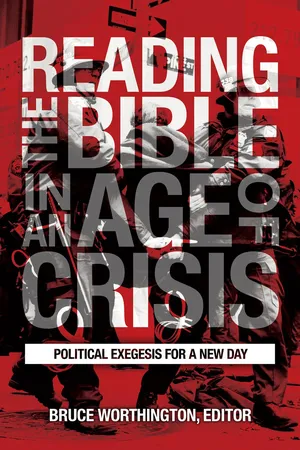
We live in an age in which economic, ecological, and political crises are not the exception, but the rule. The Cold War polarities that shaped an earlier "political exegesis" have been replaced; Bruce Worthington argues that increasingly, crisis is the engine of a global "turbo-capitalism." In this volume, edited by Worthington, biblical scholars and activists describe and exemplify the shape of a biblical interpretation that takes contemporary crisis seriously as its most important context. Succinct opening essays summarize the salient aspects of our critical situation, especially in relation to the dominance of capitalism and its pervasive values; in later parts, contributions address themes of economic, political, and environmental crisis in dialogue with texts from the First and Second Testaments. Throughout the volume, the authors are careful to describe the basis for making interpretive analogies across historical, cultural, and socioeconomic distances between the world of the Hebrew Bible, the New Testament, and our own. Richard A. Horsley writes a postscript pointing to next steps in political interpretation.
Trusted by 375,005 students
Access to over 1.5 million titles for a fair monthly price.
Study more efficiently using our study tools.
Information
3
Global Crisis and the Second Testament
9
Homelessness, Neoliberalism, and Jesus’ “Decision” to Go Rogue
An Analysis of Matthew 4:12-25
Robert J. Myles
As our dominant ideological climate, the age of neoliberal policy, pragmatism, and consensus has, often unknowingly and uncritically, filtered into our everyday lives, our thought processes, and even our interpretations of the Bible. It has, in the words of David Harvey, “become hegemonic as a mode of discourse. It has pervasive effects on ways of thought to the point where it has become incorporated into the common-sense way many of us interpret, live in, and understand the world.”[1] James Crossley’s recent book, Jesus in an Age of Neoliberalism, has begun to uncover a number of these ideological peculiarities within historical Jesus research. He successfully exposes, among other things, how Western individualism has influenced the construction of Jesus within both historical and popular quests.[2] In this chapter, I want to bring a similar lens to bear on the connection between Jesus and homelessness as it is constructed within Gospel exegesis and scholarship, in particular the beginnings of Jesus’ itinerant ministry within the Gospel of Matthew. In doing so, I will undertake a re-reading of Matthew 4:12-25 using Marxist exegesis that attempts to embed both Jesus and the first disciples in a structured social world as it is encoded within the Matthean text. This should assist in disrupting narratives of neoliberalism in the world before the text as they shape and distort our dominant hermeneutical filters.
Built upon classical liberal and economic ideals, neoliberalism refers to the contemporary political movements emphasizing open markets, small government, privatization, and personal moral and economic responsibility. Its advent is usually associated with the Reagan and Thatcher era of the 1980s, and then was continued through the so-called “Third Way” policies beginning in the 1990s. It has now become a political orthodoxy across many Western democracies in which governments, whether left-wing or right-wing, focus more on managing the economy as best they can within neoliberal conditions than on “traditional” ideological stances. Within this matrix, homelessness is usually interpreted as a “choice” made for lifestyle reasons or individual moral and/or economic failings.
It is not uncommon to find interpretive connections between Jesus and homelessness in contemporary biblical scholarship. For all practical purposes, Jesus’ itinerant ministry was a homeless one.[3] A popular reconstruction of Christian origins developed by Gerd Theissen, for instance, describes the wandering charismatic followers of Jesus as essentially homeless, lacking family (having abandoned or renounced family), lacking possessions, and lacking protection. He writes:
Giving up a fixed abode was an essential part of discipleship. Those who were called left hearth and home (Mark 1:16; 10:28ff.), followed Jesus, and like him became homeless. ‘Foxes have holes, and birds of the air have nests; but the Son of man has nowhere to lay his head’ (Matt. 8.20) is a saying which applied to them.[4]
As I have argued elsewhere, the connection interpreters often make between Jesus and homelessness, however, is overwhelmingly constrained by neoliberal thinking.[5] But it is at this nexus of Jesus and homelessness that a peculiar contradiction emerges: because Jesus is supposed to be the moral hero of the story, his homelessness becomes romanticized and the desperation and destitution that might typically accompany the experience gets extracted. If Jesus is, for Christians and/or biblical scholars, the ultimate object (or commodity) of theological and/or scholarly desire, in which Jesus functions in his salvific role as a mediator of our “surplus enjoyment” (plus de jouissance), then his homelessness acts as a fantasmatic screen, shielding us from the traumatic experience of homelessness proper and the apparent failure of our wider sociopolitical system in which homelessness remains a tangible political problem. In other words, homelessness is idealized in Jesus in a way that encourages us to effectively divert our critical attention from some of these inherent contradictions contained within our own contexts of reading.
Within many contemporary interpretations, Jesus’ itinerancy is predominantly conceived of as the result of his own free choosing (or at least a pious response to the driving force of the Spirit). A heightening of Jesus’ agency enables the re-inscription of the prominent neoliberal myth that most people “choose” to become homeless for lifestyle reasons. For example, writing at the highpoint of Thatcherism in the 1980s, the British Matthean scholar R. T. France suggests that Jesus’ “chosen way of life is one of homelessness and insecurity . . . and his disciples were called to share his style of life. This was a matter of choice, not of necessity, as Jesus’ family was probably a comfortable, if not affluent, ‘middle-class’ one.”[6] The reverberations here of individual choice, homelessness as a lifestyle, and a universalizing estimation of the middle-class, is intriguing when viewed in tandem with neoliberal mantras espousing the centrality of individual responsibility. Similar reverberations emerge within some of the scholarly attempts to draw parallels between Jesus’ itinerant ministry and the Greco-Roman philosophical school of the Cynics. It must be immediately cautioned, of course, that the Cynics’ poverty was a chosen lifestyle, not one they were necessarily born into, as were peasants. In fact, most Cynics appear to have come from the educated elite and become “cynical” about Greco-Roman society. Stephen C. Barton sums up the contrast between the cynics and the itinerancy of Jesus and his disciples as follows:
[W]here the Cynics adopt a deliberate asceticism as an integral part of the wise man’s revolt against culture and return to nature, the gospels speak more of involuntary deprivation and hardship in consequence of faithful missionary discipleship; and where the Cynics seek to reform the individual by a highly provocative onslaught on civilized conventions and popular opinion, there is in the gospels a positive summons to Israel and the nations to personal and social reform in preparation for the advent of God.[7]
In contrast to its conventional treatment in biblical studies, however, a range of scholarly perspectives on contemporary homelessness construct the issue as far more complex, often stemming from various economic and social crises, such as housing shortages, high unemployment, inadequate resourcing for the mentally ill, social distancing, and estrangement. This culminates in the creation of a vulnerable underclass, predisposing already at-risk members of society into episodes of homelessness.[8] For the critical theorist Slavoj Žižek, homelessness emerges (along with the underclass, the ghettoized, and the permanently unemployed) as a symptom of the late capitalist universal system; a reminder of the structural deficiencies that remain beneath the surface and negate the “totalitarian logic of the proper capitalist utopia.”[9] Might we not also conceive of Jesus’ apparent homelessness as a symptom of wider structural crises? Not necessarily as a result of capitalism, of course, but rather the systemic and structural violence of the agrarian society in first-century Palestine and Judea?
While Jesus’ itinerancy, by which I mean his traveling from one place to the next, is an integral part of his ministry, Matthew’s Gospel includes a number of other episodes that pre-empt a shift to the margins. The flight to Egypt (Matt. 2:13-23), for example, involves an infant forcefully displaced both geographically and politically from his hometown (cf. 8:20; 13:54-58). Homelessness and displacement are not usually conditions that people freely choose to enact. Rather, external factors, often far beyond their control, influence their ability to act and react within a particular structured environment. The same is true within the narrative of Matthew’s Gospel in which Jesus’ actions must always be understood in relation to other events, characters, and external pressures. In what follows, I re-read the connection between Jesus and homelessness as symptomatic of wider social and political conditions as they are encoded within the text.
Structuring the Beginning of Jesus’ Ministry (Matt. 4:12-25)
Matthew 4:12-25 contains four distinguishable scenes: first, the arrest of John the Baptist (vv. 12-16); second, the proclamation of the kingdom (v. 17); third, the call of the first disciples (vv. 18-22); and finally, the inauguration of itinerant ministry, healings, and the spread of Jesus’ fame (vv. 23-25). We ought to exercise caution in our structuring of the text, however. In recent years a structuring of Matthew that views the opening words of 4:17 (“From that time Jesus began . . .”) as constituting an introductory formula to a new major section of the Gospel has gained some traction.[10] A consequence of this structuring is that Jesus’ displacement to Capernaum in 4:12-13 becomes isolated from subsequent events.
Key to this structuring is the much-disputed formula ἀπὸ τότε (from that time) in 4:17. Ulrich Luz points out that the inclusion of this clause is intended precisely to establish a connection with the preceding verses.[11] The Matthean text often uses the adverb τότε as a connective particle to link two events through an unspecified passage of time. F. Neirynck argues that enough narrative connections exist between 4:17 and 4:12-16 to warrant its inclusion in the same paragraph.[12] Indeed, as will be argued below, it is the eventual occurrence of the arrest of the Baptist which prompts Jesus to withdraw to Capernaum, go about calling the first disciples, and begin his itinerant ministry.
If taken together, the beginnings of the Matthean Jesus’ ministry are best understood as an embedded response to the arrest of the Baptist, in addition to other social and political threads that are encoded within the text. While religious motivations for Jesus’ ministry are certainly evident (and noted particularly by the eschatological context of proclamation of the kingdom), these must be balanced against the various political, economic, and social forces that drive his actions. A politicizing of these textures reveals that the arrest of the Baptist functions as a significant trigger for Jesus’ “withdrawal” from Nazareth and the beginning of his ministry in Capernaum. As a result, the Matthean Jesus’ itinerant ministry is from its very inception symptomatic of various crises within his wider sociopolitical environment.
Jesus Withdraws (Matt. 4:12-16)
After hearing of John’s arrest, Jesus, sensing danger, withdraws (ἀνεχώρησεν) from Nazareth and settles in Capernaum. Commenting on Matthew 4:12-13, Luz supposes that
Matthew does not provide information about the subjective motives of Jesus for his return. Jesus goes to Galilee for the sole and u...
Table of contents
- Cover
- Title Page
- Copyright
- Table Of Contents
- Contributors
- Abbreviations
- Global Crisis and the Practice of Biblical Studies
- Global Crisis and the First Testament
- Global Crisis and the Second Testament
- Index
Frequently asked questions
Yes, you can cancel anytime from the Subscription tab in your account settings on the Perlego website. Your subscription will stay active until the end of your current billing period. Learn how to cancel your subscription
No, books cannot be downloaded as external files, such as PDFs, for use outside of Perlego. However, you can download books within the Perlego app for offline reading on mobile or tablet. Learn how to download books offline
Perlego offers two plans: Essential and Complete
- Essential is ideal for learners and professionals who enjoy exploring a wide range of subjects. Access the Essential Library with 800,000+ trusted titles and best-sellers across business, personal growth, and the humanities. Includes unlimited reading time and Standard Read Aloud voice.
- Complete: Perfect for advanced learners and researchers needing full, unrestricted access. Unlock 1.5M+ books across hundreds of subjects, including academic and specialized titles. The Complete Plan also includes advanced features like Premium Read Aloud and Research Assistant.
We are an online textbook subscription service, where you can get access to an entire online library for less than the price of a single book per month. With over 1.5 million books across 990+ topics, we’ve got you covered! Learn about our mission
Look out for the read-aloud symbol on your next book to see if you can listen to it. The read-aloud tool reads text aloud for you, highlighting the text as it is being read. You can pause it, speed it up and slow it down. Learn more about Read Aloud
Yes! You can use the Perlego app on both iOS and Android devices to read anytime, anywhere — even offline. Perfect for commutes or when you’re on the go.
Please note we cannot support devices running on iOS 13 and Android 7 or earlier. Learn more about using the app
Please note we cannot support devices running on iOS 13 and Android 7 or earlier. Learn more about using the app
Yes, you can access Reading the Bible in an Age of Crisis by Bruce Worthington in PDF and/or ePUB format, as well as other popular books in Theology & Religion & Biblical Criticism & Interpretation. We have over 1.5 million books available in our catalogue for you to explore.