Kathryn Tanner is undoubtedly one of the most important contemporary North American theologians; her work is hallmarked by its depth, precision, provocativeness, and grace. This volume celebrates the vision and breadth of Tanners unique contribution. Essays by established scholars, colleagues, and former students trace out the key loci and themes, from theological method, the Trinity, Christology, and creation to economics, environmental and social ethics, and politics, to generate constructive and ecumenical conversation that presents Tanner as an important, contemporary public theologian.
eBook - ePub
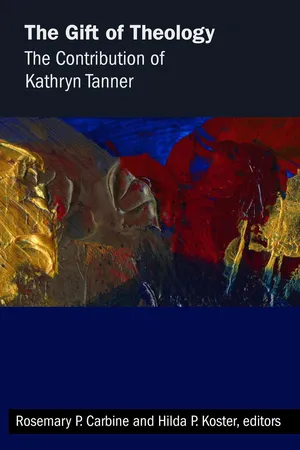
The Gift of Theology
The Contribution of Kathryn Tanner
- 336 pages
- English
- ePUB (mobile friendly)
- Available on iOS & Android
eBook - ePub
The Gift of Theology
The Contribution of Kathryn Tanner
About this book
Trusted by 375,005 students
Access to over 1.5 million titles for a fair monthly price.
Study more efficiently using our study tools.
Information
Topic
Theology & ReligionSubtopic
Christian Theology4
The Gift of Theology to Praxis
11
Closed Eyes and Blocked Vision: Gendering Tanner’s Theology of Sin and Grace
Joy Ann McDougall
In an essay written fifteen years ago, Rebecca Chopp observed that few feminist theologians of her generation were engaging with classical Christian symbols or doctrinal issues in their work.[1] Whereas “second-wave” Christian feminists had done the initial spadework of critiquing, mining, and reinterpreting their confessional traditions, so-called “third-wave” Christian feminist theologians had become occupied elsewhere—in digesting secular feminist theories and incorporating their sophisticated gender frameworks and analyses of social location into their methodologies. Feminist theology, Chopp lamented, appears to have become captive to the atheological (and at times anti-theological) limits of secular feminist theory.
As an academic and a church theologian, deeply invested herself in critical feminist theories and indeed methodological questions, Chopp’s remarks were hardly condemnatory. Rather she was issuing a challenging invitation to her colleagues—to use feminist theories not only to address methodological questions but to do constructive theological work. Just as Aquinas and Schleiermacher had done with the revolutionary philosophical systems of their day, Chopp encouraged contemporary feminist theologians to deploy the insights gained from new gender theories along with their theological imaginations to “transform theological symbols and visions.”[2] In short, she was asking the next wave of feminist theologians to do what she felicitously describes elsewhere as “saving work:” to offer bold interpretations of Christianity that revitalize the life of the church and its public witness to the world.[3]
Chopp was not alone at the time in recommending that feminists return to the task of interpreting and reformulating Christian doctrines and confessional traditions. In a subtle and provocative essay in the same anthology—an essay that has received scant scholarly attention—theologian Kathryn Tanner lent support to Chopp’s invitation by contributing a distinctive take on the nature and authority of past theological traditions for contemporary feminist work.[4] Tanner anchors her view of theological traditions in a political theory of culture, one in which past cultural and symbolic resources are not ultimately fixed in terms of their meaning, but instead gain and lose their significance as they are deployed in particular configurations to support different social and political ends. In more familiar terms, Tanner argues that past theological traditions are not a stable homogenous “deposit of faith” that can be transmitted without change or remainder to different times and contexts. Christian theological traditions are always and everywhere a “social construction”—a selection and an interpretation of heterogeneous past cultural resources in support of certain hegemonic understandings of Christian identity and social order. Note that Tanner does not intend to utterly relativize the truth-claims or the authority of appeals to tradition, but rather recognizes that all such appeals to past traditions involve acts of political, imaginative, and indeed theological judgment. All Christian systematic theologians—and feminists in this regard are no different—assemble, order, and elucidate a range of diverse cultural resources in support of their particular vision of Christian identity. Indeed, Tanner expects feminist theologians to assume the same demanding intellectual effort at historical inquiry that she first articulated in her programmatic work, Jesus, Humanity and the Trinity, namely, of weighing the different ways that Christians historically have made sense of the whole of Christianity in order to argue persuasively and prophetically for one’s contemporary vision of what Christianity is all about. Such historical inquiry into Christianity, Tanner avers, can be both “freeing and empowering” for it “expand[s] the range of imaginative possibilities for theological construction in any one time and place, a way of expanding the resources with which one can work.”[5]
Building on this understanding of Christianity’s traditions and their authority, Tanner urges Christian feminist theology to remain “traditional.” Specifically, she advises her feminist colleagues to appropriate “as many elements as possible from patriarchal discourse” and to “rearticulate” them “to a feminist purpose.”[6] At the same time, feminist theologians should actively “counter,” “interrupt,” and “disarticulate” patriarchal Christian traditions that “serve the interests of men at the expense of women,” “supports sexist institutional structures,” and “social practices that demean and exclude women.”[7] Tanner further argues that Christianity’s “valued past” should be a veritable “site of political contest” for feminist theologians today. This is not least because appeals to “a valued past” in Christian theology authorize present and future Christian practice: “Whoever controls the interpretation and designation of the past that authorizes present practice,” she reminds her feminist colleagues, “gains … the power to delimit what is authentically Christian, what is appropriate for a Christian to say or do.”[8]
On a first hearing, Tanner’s approach to theological traditions may appear purely pragmatic—and smack of raw power politics at that. But, what lies just beneath the surface is a firm conviction that Christianity’s symbolic resources are not irremediably patriarchal. For Tanner as for Chopp, Christian theological traditions present a rich reservoir of past and present symbolic resources that can be loosened from their moorings to patriarchy (at least most of them!), and be redirected in support of just and life-giving feminist visions of God, self, and the world. Although Tanner never quite puts this into words, as a Christian and a feminist, she possesses a reasoned faith, resolute hope, and a deep love for the treasures of these Christian traditions.
A quick glance at recent publications in Christian feminist theology suggests that the current generation of feminist theologians heeded Chopp’s and Tanner’s advice. Over the past fifteen years, an impressive number of feminist proposals have burst on the scene that constructively engage core Christian doctrine, even the sacred cows of particular Christian traditions. These include an anthology of feminist/womanist Reformed dogmatics, as well as major feminist interpretations of the Reformed doctrines of justification and sanctification, sin and grace, and ecclesiology; the Lutheran theology of the cross; Anglican theologies of the Trinity, the incarnation, and spirituality; and a host of Roman Catholic proposals in Mariology, theological aesthetics, and sacramental theology, to offer just a sampling.[9]
Significantly, none of these works are feminist apologetics focused on defending the orthodoxy or the confessional loyalty of their respective proposals. These are also not “add and stir” projects that simply add experience from women’s life-worlds and gender justice concerns to contribute a feminist flavor to a traditional theological recipe. Rather, these are constructive feminist systematic theology works in which each author appeals to her central doctrinal traditions as the key to mount her constructive feminist agenda. Moreover, with the help of critical feminist theories and theological imagination, each offers creative and often unexpected interpretations of these familiar doctrines. In so doing, each paves a way to keep feminist faith with their respective ecclesial traditions.
This is not to suggest that this particular group of feminist theologians view their past theological traditions as an unequivocal blessing. While these inherited traditions may offer symbolic resources for supporting women’s (and men’s) flourishing and contemporary gender justice concerns, they also bear a history of damaging effects and ongoing potency for distorting women’s identity, deflating their agency, and diminishing their well-being. Hence, these authors approach their Christian traditions with what Serene Jones has aptly called “double-visions”[10] or what I describe as sophisticated two-fisted strategies of theological reform and innovation. On the one hand, they seek by various interventions to contest and to disarm patriarchal interpretations of their traditions. On the other, by appealing to feminist theories and women’s lived experiences in order to elucidate their scriptural and doctrinal traditions, these feminist authors claim, construct, and renew the authority of their Christian theological traditions to support the well-being and flourishing of women.
Despite the fact that Tanner has urged feminist theology to lay claim to their theological traditions for feminist ends, she has—except for a couple of occasional essays that she has penned herself—left the task of doing constructive feminist systematic theology to others.[11] Perhaps even more surprising is the fact that there has been little feminist reception of Tanner’s major work, Jesus, Humanity and the Trinity (2001), the work in which she herself most clearly assembles, re-orders, and deploys both patristic and Reformed theological traditions to develop her constructive theological stance. This essay seeks to address this lacuna. In particular, I seek to demonstrate how Tanner’s vision of a radically transcendent gift-giving God, along with her notion of sin that she develops in nuce in this work, provides a powerful set of traditional resources to develop a robust feminist theology of sin and grace.
This essay aims not only to expose the feminist possibilities latent in Tanner’s work, but also to call for a change of course in contemporary Christian feminist discourse about sin. Here, my theological hunch and admittedly my discontent about the current state of play in Christian feminist theology is that it has too precipitously abandoned the classical notion of a transcendent and sovereign God as the foundation for constructing their feminist proposals. Feminist theologians have largely steered clear of appealing to this traditional God-concept on the faulty assumption (taken over mainly from modern theology’s depiction of divine transcendence and its antinomy with human freedom) that such a move automatically reintroduces a dangerous hierarchy of divine-human relations that eviscerates women’s agency, and offers divine legitimacy to sexist and patriarchal patterns of domination and subjugation in the creaturely realm.[12]
At the same time that Christian feminist theologians have largely stopped speaking about sin in terms of a distorted or ruptured relation to an almighty and transcendent God, they have gravitated towards immanent analyses of sin, anchored solely in the creaturely realm, for example, in one’s psychological or moral development, the interpersonal realm, or else various forms of inequity and exploitation in institutional structures.[13] Let me be clear on this point: such feminist immanent analyses of sin have been well-targeted and essential in order to expose and to redress the highly particular “faces” of gender oppression that course through our ecclesial bodies and other social institutions in our contemporary society.[14] Moreover, they have provid...
Table of contents
- Cover
- Title Page
- Copyright
- Table Of Contents
- Notes on Contributors
- Acknowledgements
- Foreword
- Introduction: The Gift of Kathryn Tanner’s Theological Imagination
- Doing Theology: Gift and Task
- The Fullness of God’s Gift-Giving
- Christianity as Culture: A Gift to Theology
- The Gift of Theology to Praxis
- Afterword
- List of Kathryn E. Tanner’s Main Works
- Index
Frequently asked questions
Yes, you can cancel anytime from the Subscription tab in your account settings on the Perlego website. Your subscription will stay active until the end of your current billing period. Learn how to cancel your subscription
No, books cannot be downloaded as external files, such as PDFs, for use outside of Perlego. However, you can download books within the Perlego app for offline reading on mobile or tablet. Learn how to download books offline
Perlego offers two plans: Essential and Complete
- Essential is ideal for learners and professionals who enjoy exploring a wide range of subjects. Access the Essential Library with 800,000+ trusted titles and best-sellers across business, personal growth, and the humanities. Includes unlimited reading time and Standard Read Aloud voice.
- Complete: Perfect for advanced learners and researchers needing full, unrestricted access. Unlock 1.5M+ books across hundreds of subjects, including academic and specialized titles. The Complete Plan also includes advanced features like Premium Read Aloud and Research Assistant.
We are an online textbook subscription service, where you can get access to an entire online library for less than the price of a single book per month. With over 1.5 million books across 990+ topics, we’ve got you covered! Learn about our mission
Look out for the read-aloud symbol on your next book to see if you can listen to it. The read-aloud tool reads text aloud for you, highlighting the text as it is being read. You can pause it, speed it up and slow it down. Learn more about Read Aloud
Yes! You can use the Perlego app on both iOS and Android devices to read anytime, anywhere — even offline. Perfect for commutes or when you’re on the go.
Please note we cannot support devices running on iOS 13 and Android 7 or earlier. Learn more about using the app
Please note we cannot support devices running on iOS 13 and Android 7 or earlier. Learn more about using the app
Yes, you can access The Gift of Theology by Rosemary P. Carbine, Hilda P. Koster, Rosemary P. Carbine,Hilda P. Koster, Rosemary P. Carbine, Hilda P. Koster in PDF and/or ePUB format, as well as other popular books in Theology & Religion & Christian Theology. We have over 1.5 million books available in our catalogue for you to explore.