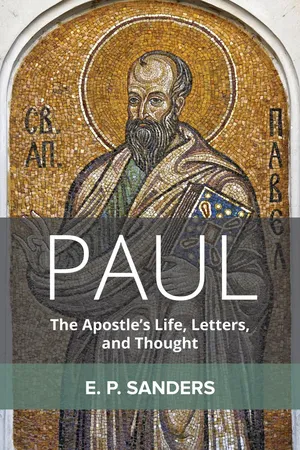
- 898 pages
- English
- ePUB (mobile friendly)
- Available on iOS & Android
eBook - ePub
About this book
Decades after setting the study of Paul on a profoundly new footing with Paul and Palestinian Judaism (Fortress Press, 1977), E. P. Sanders now offers an expansive introduction to the apostle, navigating some of the thorniest issues in scholarship in language accessible to the novice and seasoned scholar alike. Always careful to distinguish what we can know historically from what we may only conjecture, and these from dogmatically driven misrepresentations, Sanders sketches a fresh picture of the apostle as an ardent defender of his own convictions, ever ready to craft the sorts of arguments that now fill his letters but were not the basis for his own beliefs and attitudes. He also gives sustained attention to a historical sketch of Paul's context, particularly Second Temple Judaism, in order to set comparisons of Paul and that context on solid ground. Here are familiar themes from Sanders's earlier work in a presentation that reveals a career's reflection, along with new thinking regarding development in Paul's thought. All of the letters are carefully introduced in a text that will prove a worthy guide to the student and interested reader.
Information
Topic
Theology & ReligionSubtopic
Biblical Studies2
The Letters
5
The Collection, Publication, and Dates of the Letters
Collection and Publication
Paul wrote his letters to individual people and churches. The “churches,” however, did not have their own buildings and professional staffs. As we noted above, the word translated “church”—ekklēsia—would better be translated “congregation” since it referred to a group of people, not to a building or an organization. This makes it likely that each letter, after being read aloud to the congregation, was kept by an individual, probably the one who was able to provide a gathering place. We may assume that some people kept the letters more carefully than did others. Loss and wastage, damage by insects and rodents, destruction by fire, and other calamities are likely. We have no idea how many letters Paul wrote; to our knowledge only seven still survive—thanks to having been copied numerous times, as pointed out above.
The first surviving reference to the existence of a collection of Christian letters appears in the book of Revelation (the Apocalypse) in the New Testament. The author had a vision of “one like the Son of Man,” who dictated to him seven letters to seven churches (Rev. 1:13). Apocalypses do not ordinarily contain letters, and it is overwhelmingly probable that the seven letters to seven churches reveal the influence of the publication of Paul’s letters.
Revelation was written in the 90s. In this same period other “letters”—that is, homilies cast into letter form—immediately appear. Hebrews, a homily or theological essay, has aspects of the letter form and refers to one of Paul’s colleagues: “I appeal to you, brothers and sisters . . . our brother Timothy has been set free . . .” (Heb. 13:22-25). Another essay, the book of James, is written in the form of a letter (“James, a servant of God . . . to the twelve tribes in the Dispersion,” James 1:1).
Moreover, James explicitly takes issue with an aspect of Paul’s teaching: “a person is justified by works and not by faith alone” (James 2:14). In this section the author cites the case of Abraham, apparently alluding to chapter 4 in Paul’s letter to the Romans. (James, I hasten to add, misconstrued Paul’s emphasis on faith as excluding works. Paul steadfastly believed in good works, as we shall frequently see.) Both Hebrews and James were written about the same time as Revelation.
In this partial list of early documents that reveal the existence of a corpus of Paul’s letters, we should especially mention 1 Clement, written by Clement of Rome to Corinth in about the year 96, which refers to Paul’s first letter to Corinth several times. Thus 1 Clem. 47:1-3: “Take up the letter of blessed Paul the apostle. What did he first write to you ‘in the beginning of the gospel?’” The quotation is from Phil. 4:15, thus displaying knowledge of Philippians as well as of 1 Corinthians.
I skip over a few other references to Paul and his letters in early Christian literature. Early in the second century, Ignatius, the Bishop of Antioch in Syria, while on his way to martyrdom in Rome, wrote seven letters to seven churches, quoting heavily from Paul.
Thus sometime in the 90s Paul’s seven letters became widely known in Christian circles, which means that they had been collected and published. Their impact was enormous, and Paul’s letters were never again out of the limelight. (On how letters were published, see above, pp. 134-35.)
The tendency to use quotations from Paul, once his writings became available, was so strong that we may confidently think that Christian literature that does not contain quotations or allusions to his letters was written prior to the publication of the Pauline letter corpus. This literature includes all four Gospels and the Acts of the Apostles.
We noted above that it is possible that the motivation for the collection of Paul’s letters in fact came in part from the publication of Acts, which in the mid- to late 80s may have inspired someone to travel around Asia Minor and Greece to see what further information could be found. The collector or collectors came home with a fantastic treasure.
If Paul was known to have written seven letters to seven churches, what were they? On the evidence provided by early quotations (such as those in 1 Clement), the collection seems to have included letters to seven churches and one individual. I give them in order of length, which was significant in the history of arrangement of the Pauline corpus:[1]
| Corinthians | (the entire correspondence) |
| Romans | |
| Ephesians | |
| Thessalonians | (both 1 Thess. and 2 Thess.) |
| Galatians | |
| Colossians | |
| Philippians | |
| Philemon |
It will be noted that this list contains three letters that are not on the list of “undisputed” letters by Paul, and which I do not attribute to him: Ephesians, Colossians, and 2 Thessalonians.
If those who doubt that Paul himself dictated these letters are correct, the conclusion must be that people wrote in his name either before or at the time of the publication of the letters. I think that that is precisely what happened. A later crisis, or at least some later issues, arose when Paul was no longer available—probably because he had died, but possibly just because he had moved too far west. In response to the new situation, someone, presumably a disciple or close follower, wrote in Paul’s name what he thought Paul would have written.
| Letters Whose Authenticity Is Not Questioned | Disputed Letters (Letters written in Paul’s name by his followers; called “deuteropauline letters”) | |
| Sequence in Modern Bibles | Chronological Sequence | |
| Romans | 1.Thessalonians | |
| 1 Corinthians | 1 Corinthians | |
| 2 Corinthians | 2.Corinthians.10‒13 | |
| Galatians | 2 Corinthians 1‒9 | |
| Philippians | Galatians | |
| 1.Thessalonians | Philippians | |
| Philemon | Romans; Philemon (sequence unknown) | |
| Ephesians | ||
| Colossians | ||
| 2 Thessalonians | ||
| 1 Timothy | ||
| 2 Timothy | ||
| Titus | ||
These lists are not eccentric. Some New Testament scholars might construct them a little differently, but the view that Paul himself did not write or dictate every letter that is attributed to him in the New Testament has been accepted for decades. One might wish to compare the above lists with a categorization in the work of a leading conservative scholar, J. D. G. Dunn.[2]
One of the reasons for thinking that Paul himself did not write Ephesians and Colossians is that they rely very heavily on the undisputed letters. Many sentences in Colossians are made up of three- or four-word phrases taken word-for-word from one of the authentic letters. Ephesians also quotes heavily from the undisputed letters. Paul himself doubtless repeated favorite words and phrases, but we do not find the sort of verbatim agreement in the undisputed letters that we find in Colossians and Ephesians. As G. W. MacRae once said, Colossians is too Pauline to be Pauline.[3]
People who know Greek can study this very easily because Pauline parallels, with underlining to show verbatim agreement, have been published, and the verdict of “too Pauline to be by Paul himself” has been confirmed in independent studies.[4]
There are other arguments against the authenticity of 2 Thessalonians, Colossians, and Ephesians. They reflect circumstances near to the end of the first century (decades after Paul’s death), the theology differs from Paul in striking ways,[5] the vocabulary and style are sufficiently different from the undoubted letters to raise objections, and so on.
Before beginning this book, however, I resolutely resolved not to discuss authenticity in detail. The topic requires knowledge of Greek, and issues of grammar, syntax, and vocabulary are very tedious to explain in a book written for English readers. Moreover, all too often the outcome is dictated by dogma rather than by evidence. For most right-wing Christians, if the letter says “Paul,” Paul wrote it, and there is no debate, no body of evidence that can change a predetermined “fact.” With the exception of the brief comments above and a few more on Ephesians, immediately below, I shall not, therefore, explain in any detail why some letters are considered “authentic” (written or dictated by Paul himself) and others are believed to have been written pseudonymously by one or more of his followers or disciples.
I do, however, wish to present a few points about the authorship of Ephesians. The Goodspeed-Knox-Mitton hypothesis (see notes 1 and 4), to simplify and generalize slightly different positions, is that Ephesians was probably written at Ephesus, and also probably by the collector and editor of the letters. It reveals precise knowledge of all of the undoubted letters in the corpus (except Philemon), and must therefore have originated after they had been collected. It was probably intended to be a “cover letter,” conscientiously emphasizing some of Paul’s main themes. It is, therefore, highly “Pauline” in its own way, showing interesting developments within what must have been a Pauline “school.” It depends more heavily on Colossians than on any of the other letters, and so it may have come from about the same time and place as did Colossians.
Colossians, in turn, seems to have been written by someone who had studied Romans, 1 and 2 Corinthians, and Galatians: what Germans call the Hauptbriefe, the “main letters.” Thus when it was written at least part of the collection must have been assembled.
Colossae was a fairly small place near Ephesus, a great city. The very close literary relationship between Ephesians and Colossians leads many scholars to think that the collection itself was put together in this region, probably in Ephesus.[6]
Although I do not treat Colossians and Ephesians as Pauline in the strict sense—dictated by him—I do not intend thereby to belittle them. They are important in their own right and important in the development of Christianity in general and of Paulinism in particular. I have two notes to add to this discussion of the collection:
If Paul kept copies of his own letters, it would have been mechanically possible for him to compose a letter (say, Ephesians) that consisted of phrases and lines from his earlier letters. But there is no reason to think that he made copies of his letters and saved them. This would have taken a lot of scribal time and effort, and Paul can hardly have had a full-time secretary. Nor would he have any reason to think of saving his letters for posterity, since he thought that the Lord would return within a short period of time (see 1 Thessalonians and chap. 9 below). Nor was he so infertile of thought that he needed to replay substantial pieces of earlier writings. Letters like Galatians and the Corinthian correspondence clearly show that hisbrain was working as he dictated. To envisage him as pawing back through previous work and lifting phrases from here and there is to change his character considerably.
Some of the same objections may be put to the proposal that the presence of a secretary and the naming of co-senders means that the l...
Table of contents
- Cover
- Title Page
- Copyright
- Table Of Contents
- Preface
- Introduction
- Paul's Life
- The Letters
- Appendix I: Homosexual Practices in Greece and Rome
- Appendix II: Where was Galatia? Who were the Galatians?
- Glossary
- Index of Ancient and Biblical Literature
- Index of Authors
- Index of Subjects
Trusted by 375,005 students
Access to over 1.5 million titles for a fair monthly price.
Study more efficiently using our study tools.
Frequently asked questions
Yes, you can cancel anytime from the Subscription tab in your account settings on the Perlego website. Your subscription will stay active until the end of your current billing period. Learn how to cancel your subscription
No, books cannot be downloaded as external files, such as PDFs, for use outside of Perlego. However, you can download books within the Perlego app for offline reading on mobile or tablet. Learn how to download books offline
Perlego offers two plans: Essential and Complete
- Essential is ideal for learners and professionals who enjoy exploring a wide range of subjects. Access the Essential Library with 800,000+ trusted titles and best-sellers across business, personal growth, and the humanities. Includes unlimited reading time and Standard Read Aloud voice.
- Complete: Perfect for advanced learners and researchers needing full, unrestricted access. Unlock 1.5M+ books across hundreds of subjects, including academic and specialized titles. The Complete Plan also includes advanced features like Premium Read Aloud and Research Assistant.
We are an online textbook subscription service, where you can get access to an entire online library for less than the price of a single book per month. With over 1.5 million books across 990+ topics, we’ve got you covered! Learn about our mission
Look out for the read-aloud symbol on your next book to see if you can listen to it. The read-aloud tool reads text aloud for you, highlighting the text as it is being read. You can pause it, speed it up and slow it down. Learn more about Read Aloud
Yes! You can use the Perlego app on both iOS and Android devices to read anytime, anywhere — even offline. Perfect for commutes or when you’re on the go.
Please note we cannot support devices running on iOS 13 and Android 7 or earlier. Learn more about using the app
Please note we cannot support devices running on iOS 13 and Android 7 or earlier. Learn more about using the app
Yes, you can access Paul by E. P. Sanders in PDF and/or ePUB format, as well as other popular books in Theology & Religion & Biblical Studies. We have over 1.5 million books available in our catalogue for you to explore.