- 468 pages
- English
- ePUB (mobile friendly)
- Available on iOS & Android
eBook - ePub
About this book
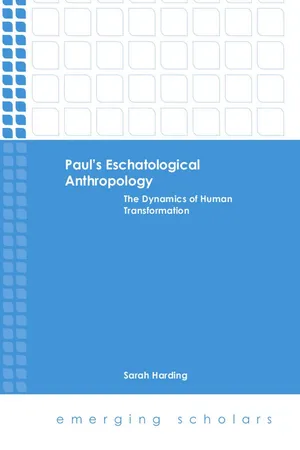
In this study, Sarah Harding examines Paul's anthropology from the perspective of eschatology, concluding that the apostle's view of humans is a function of his belief that the cosmos evolves through distinct aeons in progress toward its telos. Although scholars have frequently assumed that Paul's anthropological utterances are arbitrary, inconsistent, or dependent upon parallel views extant in the first-century world, Harding shows that these assumptions only arise when Paul's anthropology is considered apart from its eschatological context. That context includes the temporal distinction of the old aeon, the new aeon, and the significant overlap of aeons in which those "in Christ" dwell, as well as a spatial dimension that comprises the cosmos and the powers that dominate it (especially sin and the Holy Spirit). These eschatological dimensions determine the value Paul attaches to any particular anthropological "aspect." Harding examines the cosmological power dominant in each aeon and the structures through which, in Paul's view, these influence human beings, examining texts in which Paul discusses nous, kardia, and soma in each aeon.
Trusted by 375,005 students
Access to over 1.5 million titles for a fair monthly price.
Study more efficiently using our study tools.
Information
Topic
Theology & ReligionSubtopic
Biblical Commentary7
Anthropology in the New Aeon
1. Introduction
Having discussed the anthropology of the old aeon, and considered the dynamics of human renewal in the overlap of aeons, we now arrive at the third “eschatological moment,” and consider anthropology in the new aeon, a “dominion of love because the Lord is the Word of love incarnate.”[1] In the new aeon, believers discard the σῶμα ψυχικόν and assume a σῶμα πνευματικόν (1 Cor. 15:44), contextualized within a renewed cosmos. However, while the overlap of aeons continues, the weakness and mortality attendant on the ἔξω ἄνθρωπος (2 Cor. 4:16) persists. Believers remain susceptible to Sin, even if they do not actually sin. In the Holy Spirit they possess a powerful support that prevents this potentiality from becoming an actuality, if only they “walk by the Spirit” (Gal. 5:16). But if there is any struggle against temptation, it terminates at death. This is the great and insurmountable benefit of death, namely, that it removes believers from temptations to sinfulness, without separating them from Christ (Rom. 8:35).[2] While they anticipate the new aeon, deceased believers inhabit an intermediate state (2 Cor. 5:1–10), in possession of a guarantee that they will inherit the resurrection at the παρουσία (parousia).[3] This guarantee is the Holy Spirit. M. M. B. Turner remarks, “It [the Holy Spirit] is the inner connection between what Paul claims to be an activity of the Spirit now and what the same Spirit will do at the end that makes his pneumatology ‘eschatological.’”[4] The Holy Spirit that is active in believers during the overlap of the aeons (Rom. 6:4, 11, 13; 2 Cor. 4:12; Eph. 2:5, 6; Col 2:13), is the same Holy Spirit that, in functional unity with Christ, inaugurates the new aeon and endows believers with the σῶμα πνευματικόν, the anthropological profile appropriate to the renewed cosmos of the parousia.
In this chapter we shall endeavor to understand when believers assume the σῶμα πνευματικόν, and the nature of this body; and, if an interim period separates believers from the assumption of the σῶμα πνευματικόν, we also need to determine its anthropology. However, before proceeding with our discussion, it is necessary that we elucidate several issues relating to Paul’s view of resurrection. We begin with death, upon which many divergent opinions converge. Death is a multivalent concept in the apostle’s letters, and carries a number of different meanings, the most common of which is bodily death, the cessation of organic functions (Rom. 6:23; 1 Cor. 15:31; 2 Cor. 4:12, 16; 2 Cor. 4:10–11).[5] Paul can also speak of spiritual death, the alienation of humans from God manifested in sinfulness (Rom. 6:23), and perpetuated in the inheritance of Adam (Rom. 6:23; 7:13; Eph. 2:1, 5); and death to Sin, the unresponsiveness of those in Christ to the enticements of Sin, and the concomitant responsiveness to God (Rom. 6:4, 6, 11, 13).[6] It is Paul’s differing relation to bodily death that is frequently cited in support of an alleged development in his view of resurrection.[7] In his earlier discussions of resurrection (1 Thess. 4:13–18; 1 Corinthians 15), the apostle appears to have expected to be alive at the parousia;[8] in his later discussions, his expectations seem to have changed (2 Cor. 5:1–10; Phil. 1:21–23).[9] But from the perspective of supposed developments in his thinking, this is a subjective change because it involves Paul’s own relationship with death. It is also somewhat problematic in view of the difficulty understanding why the apostle would not consider the possibility of his own demise prior to the parousia, particularly in a society with a relatively low age of mortality. G. E. Ladd comments, “Paul was no stranger to death before he wrote II Corinthians.”[10] In 1 Cor. 15:30–31 the apostle declares, “And why are we putting ourselves in danger every hour? I die every day.” Rather than attributing any development in Paul’s view of resurrection to his own relation to bodily death, it might be more appropriate in this instance to seek the determining factor in the context of his theologizing.
More important than this alleged subjective change is the claim that, in his later correspondence, Paul introduced objective changes into his view of resurrection that differed from, and are even inconsistent with, his earlier views. Notable is the supposed postulation of an intermediate state. Following their death, and prior to the parousia, Paul intimates that believers experience fellowship with Christ (2 Cor. 5:1–10; Phil. 1:21–23); previously, however, he described those who die in Christ negatively as κοιμᾶσθαι (“to be asleep,” 1 Thess. 4:13, 14; 1 Cor. 15:18), a euphemism absent in his later treatment.[11] It is inferred that if believers are not “asleep,” they must be awake in some intermediate state. However, some scholars consider the postulation of such a state an “unnecessary theological move.”[12] Those who die in Christ, it is argued, are transferred to a state of eternity or timelessness, where duration has no meaning. Hence there is no experiential interlude between death and the parousia that might function as an intermediate state.[13] Thus, it has been asserted that Paul does not make any positive statements regarding the life to come.[14] Nevertheless, it does appear that something positive can be said about the intermediate state, particularly in view of Paul’s comments in Phil. 1:23 that upon death he will immediately be “with Christ.” The claim that nothing can separate believers from “the love of Christ” (Rom. 8:35) presumably includes death. Indeed, the progressive approximation of believers to the “image of Christ” (2 Cor. 3:18; 4:16) demands that no hiatus intervenes between the death of believers and the parousia.[15] It appears necessary to postulate an intermediate state to coordinate these observations.
However, leaving aside the issue of the anthropology appropriate to the intermediate state, none of these positions contradict the view that all believers assume a σῶμα πνευματικόν (1 Cor. 15:44) at the parousia. However, in 2 Cor. 5:1, speaking of bodily death, Paul declares, “We know that if the earthly tent we live in is destroyed, we have [ἔχομεν] a building from God.” Taking ἔχομεν (“we have”) as indicative of a sure possession and identifying the “building from God” with the σῶμα πνευματικόν, it is sometimes claimed that Paul is rejecting his earlier view that believers assume a σῶμα πνευματικόν at the parousia, now to be assumed directly upon the demise of believers.[16] Despite appearing to contradict Paul’s opini...
Table of contents
- Cover
- Title Page
- Copyright
- Table Of Contents
- Acknowledgments
- Abbreviations
- Introduction to This Investigation
- Eschatology and Anthropology in Paul
- Anthropology in the Old Aeon
- Anthropology in the Old Aeon
- Anthropology in the Overlap of Aeons
- Anthropology in the Overlap of Aeons
- Anthropology in the New Aeon
- Conclusion of This Investigation
- Bibliography
Frequently asked questions
Yes, you can cancel anytime from the Subscription tab in your account settings on the Perlego website. Your subscription will stay active until the end of your current billing period. Learn how to cancel your subscription
No, books cannot be downloaded as external files, such as PDFs, for use outside of Perlego. However, you can download books within the Perlego app for offline reading on mobile or tablet. Learn how to download books offline
Perlego offers two plans: Essential and Complete
- Essential is ideal for learners and professionals who enjoy exploring a wide range of subjects. Access the Essential Library with 800,000+ trusted titles and best-sellers across business, personal growth, and the humanities. Includes unlimited reading time and Standard Read Aloud voice.
- Complete: Perfect for advanced learners and researchers needing full, unrestricted access. Unlock 1.5M+ books across hundreds of subjects, including academic and specialized titles. The Complete Plan also includes advanced features like Premium Read Aloud and Research Assistant.
We are an online textbook subscription service, where you can get access to an entire online library for less than the price of a single book per month. With over 1.5 million books across 990+ topics, we’ve got you covered! Learn about our mission
Look out for the read-aloud symbol on your next book to see if you can listen to it. The read-aloud tool reads text aloud for you, highlighting the text as it is being read. You can pause it, speed it up and slow it down. Learn more about Read Aloud
Yes! You can use the Perlego app on both iOS and Android devices to read anytime, anywhere — even offline. Perfect for commutes or when you’re on the go.
Please note we cannot support devices running on iOS 13 and Android 7 or earlier. Learn more about using the app
Please note we cannot support devices running on iOS 13 and Android 7 or earlier. Learn more about using the app
Yes, you can access Paul's Eschatological Anthropology by Sarah Harding in PDF and/or ePUB format, as well as other popular books in Theology & Religion & Biblical Commentary. We have over 1.5 million books available in our catalogue for you to explore.