- 922 pages
- English
- ePUB (mobile friendly)
- Available on iOS & Android
eBook - ePub
About this book
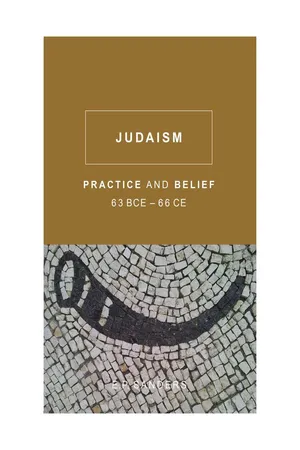
In this now-classic work, E. P. Sanders argued against prevailing views regarding the Judaism of the Second Temple period, for example, that the Pharisees dominated Jewish Palestine or that the Mishnah offers a description of general practice. In contrast, Sanders carefully shows that what was important was the "common Judaism" of the people with their observances of regular practices and the beliefs that informed them. Sanders discusses early rabbinic legal material not as rules, but as debates within the context of real life. He sets Pharisees, Sadducees, and Essenes in relation to the Judaism of ordinary priests and people. Here then is a remarkably comprehensive presentation of Judaism as a functioning religion: the temple and its routine and festivals; questions of purity, sacrifices, tithes, and taxes; common theology and hopes for the future; and descriptions of the various parties and groups culminating in an examination of the question "who ran what?" Sanders offers a detailed, clear, and well-argued account of all aspects of Jewish religion of the time.
Information
Topic
Theology & ReligionSubtopic
Jewish Theology2
Common Judaism
5
Common Judaism and the Temple
Common, Normal and Normative
Within Palestine, ‘normal’ or ‘common’ Judaism was what the priests and the people agreed on. We shall see that in general Jews of the Greek-speaking Diaspora shared in this normal Judaism, although their participation in temple worship, which was an important ingredient, was restricted. In this part of our study, I shall continue to concentrate on Palestine, though I shall also illustrate the degree to which Jews of the western Diaspora shared religious practices and theological beliefs with their Palestinian contemporaries.[1] That there was a world-wide feeling of solidarity among Jews is easily proved. Scattered throughout the pages that follow we shall see payment of the temple tax by Diaspora Jews, pilgrimage to the temple from abroad, world-wide alarm at the threat of Gaius to have his statue erected in the temple, the ways in which Gentiles singled out Jews as different, the benefits that Diaspora Jews reaped when Julius Caesar was grateful to Palestinian Jews for support, and many other points.[2]
‘Normal’ Judaism was, to a limited degree, also ‘normative’: it established a standard by which loyalty to Israel and to the God of Israel was measured. Outside Palestine there could be little coercion to accept the norm, except for moral suasion, and even within Palestine there were definite limits to what could be enforced. Outside Judaea the official guardians of the religion, the priests, had little actual power after the Roman conquest. Thus whatever we find to have been ‘normal’ was based on internal assent and was ‘normative’ only to the degree that it was backed up by common opinion—which has a good deal of coercive power, but which allows individuals who strongly dissent to break away.
Jews in general believed that their sacred books were truly Holy Scripture. God gave them the law through Moses, and they were to obey it. The prophets and the other books (‘writings’) were also meant for guidance and instruction. Throughout the empire Jews gathered in houses of prayer on the sabbath to learn God’s way. They worshipped him with prayers and offerings; and they observed holy days, which functioned either to renew their covenant with him, to celebrate great moments of the nation’s past, to mark the seasons of the agricultural year and give thanks for them, or to atone for sin.
Morton Smith has encapsulated these points in a memorable sentence:
Down to the fall of the Temple, the normative Judaism of Palestine is that compromise of which the three principal elements are the Pentateuch, the Temple, and the ‘amme ha’arez, the ordinary Jews who were not members of any sect.[3]
I would add only that most Diaspora Jews were included in this common Judaism. They were loyal to the law and also to the temple, though they could seldom attend its services. They also shared some post-biblical practices, such as attending synagogue.
There were numerous differences within ‘normal Judaism’, and we shall eventually consider some of them. The present emphasis, however, is on what was common.
Physically there were three foci of religion: the temple, the synagogue (or house of prayer) and the home. We shall take these in turn before asking whether or not there was a common Jewish theology. I shall now try to describe the practice and belief of the ordinary priests and the common people—not the chief priests or ‘the powerful’, and not the Pharisees, Sadducees or Essenes. It is much easier to write about the named groups, and so the Judaism of our period is often treated as if it were composed of members of Josephus’ three parties. We shall see that it is not impossible to discuss the ordinary people, though we can seldom give names of individuals. Josephus, an aristocrat who became a Hellenistic historian, followed both traditions in usually narrating events in terms of named leading characters and ‘the masses’. He seldom named even ‘the powerful’. Individuals from ‘the people’ very occasionally have names, but no descriptions: thus Jonathan and Ananias, Pharisees ‘from the lower ranks’ of the populace (hoi dēmotikot), were on a committee sent to investigate Josephus during the revolt (Life 197), but we learn nothing about them. We do learn that during the revolt common people were sometimes given places of responsibility, but this highlights the normal situation: they were generally disregarded, except when they formed large groups. Nevertheless, since the common people were actors in many of the events that Josephus describes, we can sometimes get past his indifference to them (an indifference common to many ancient historians), and we can also take some steps towards determining what the ‘normal situation’ was. Before the description of Jewish practice, however, it will be useful to consider wherein ancient Judaism differed from other cultures.
Sacrifice, Ethics, and the Distinctiveness of Judaism
To the reader who is not thoroughly acquainted with ancient religion, Judaism’s emphasis on animal sacrifice may seem alien and even repugnant. In antiquity, however, it was otherwise. In Rome, Greece, Egypt, Mesopotamia and most other parts of the ancient world, religion was sacrifice. Below we shall discuss such topics as the sacrificial slaughter of animals; the distribution of their parts among the priest, the altar and the worshipper; support of the temple by offerings of money, animals and agricultural produce; rites of purification; and the observance of special holy days that involved additional sacrifices, dancing and music. Every element has numerous parallels in the ancient world. When Greeks or Romans commented on Judaism, they found none of this strange. The Jewish sabbath and food laws drew comment, but not sacrifices and purifications.
Thanks to fairly recent publications, Greek religious practices are easy to study at a general level. The reader of Greek Religion by Walter Burkert, or The Cuisine of Sacrifice among the Greeks, a volume of essays edited by Marcel Detienne and Jean-Pierre Vernant, will learn a lot about animal sacrifice, holy areas and purifications.[4] Jewish sacrificial practice differed from that of the Greeks in two principal ways. In the first place, in Judaism during the Roman period the view prevailed that there should be only one temple and one place of sacrifice; the last temple to be established outside Jerusalem was the Zadokite temple in Egypt (above, p. 34). The Greeks and Romans had almost countless temples, and sacrifice could be offered even where there was no temple.
Secondly, Jewish sacrificial worship was more expensive. There was a large hereditary priesthood that was supported by non-priests. In Greece and Rome priesthood was not a profession or a caste.[5] In Rome, and not infrequently in the Greek-speaking world, it was an honour to be a priest, an honour reserved for the elite; like other honorary positions it was sometimes expensive for the office holder.[6] Rulers whom we now think of as generals, conquerors, kings and emperors were also priests. Julius Caesar was a high priest (Pontifex Maximus, e.g. Antiq. 14.190). Alexander the Great, in his triumphant conquest of much of the known world, sacrificed regularly.[7] In Greece and Rome, it is difficult to understand just what a priest was because the ‘distinction between civic magistracy and priesthood’ is elusive. Those who wanted to get on in the world sought priestly appointments (e.g. Pliny the Younger).[8] In Judaism, on the other hand, priestly office was hereditary, priests were forbidden to support themselves by working the land, and the care and feeding of the priesthood were substantial costs borne by the rest of society, especially farmers. Another element that made Jewish sacrificial worship expensive was the use of holocausts, ‘whole-burnt offerings’, of which there were at least two each day in the Jerusalem temple. Such sacrifices were unknown in Greece.[9] In Judaism, although a majority of the sacrifices provided food for the priest and/or the worshipper, some animals were entirely consigned to the altar. In Greece all sacrificed animals were eaten, and the gods usually got only some of the bones. In this second case, the expense of religion and the importance of a priestly caste, we can find parallels to Judaism in Babylonia, Egypt and other countries.
With regard to sacrifice, priesthood and temples, Judaism was unique because it had a single temple to the one God and a centralized cult. In comparison to Greece and Rome, the size and influence of Judaism’s hereditary priesthood also stand out.
Judaism was distinctive in another way. It attempted to bring the entirety of life under the heading, ‘Divine Law’. As a religion, it was not strange because it included sacrifices, but because it included ethical, family and civil law as well. Jews sometimes spoke of their ‘philosophy’, a term that is justified by the scope of a law that includes an entire way of life.[10] Judaism was not just a ‘cult’. Our word ‘religion’, it should be explained, though derived from the Latin religio, does not have a precise ancient counterpart. Despite this, it is a very useful word. In using it, we now mean ‘anything having to do with God or the gods, including every topic that appears in laws or admonitions that are attributed to the deity’. In Judaism, this is more-or-less everything. Jews thought that Moses received the law from God, and they also considered the prophets and authors of other sacred Jewish writings ‘inspired’.[11] Although in a very general sense Greeks might say that their laws were of divine origin (Plato, Laws I), they did not treat individual points as being divinely revealed, as the rest of Plato’s Laws makes clear. Even in discussing the correct calendar of festivals and sacrifices, the Athenian says only that he and his companions would be helped by ‘oracles from Delphi’ (Laws VIII § 828): it was up to humans to determine what they should be. Similarly, Athenians did not think that the ancient reformer of the law, Solon, passed on divine commandments, and many aspects of human behaviour were governed by secular law. In the Graeco-Roman world ethics were discussed by philosophers but were not, as a rule, thought to have divine sanction, while Jews thought that the rules governing treatment of ‘the neighbour’ and ‘the stranger’ were given by God to Moses. They corresponded to God’s own nature: ‘You shall be holy; for I the Lord your God am holy . . . You shall love your neighbour . . . You shall love [the stranger]’ (Lev. 9.2–34).
This is not to say that in Greece and Rome there were two watertight compartments, ‘religion’ and ‘state’. On the contrary, the two were closely intertwined. All or virtually all civic activities involved sacrifice. A ‘civil’ court convicted Socrates of the capital offence ‘atheism’. Failure to participate in civic religion and (during the Roman empire) refusal to pay appropriate homage to the Genius of Rome and the Emperor were crimes. Jews needed special exemption from pagan civic religious rites, and later Christians often ran foul of the state because they would not join in common religious acts. Today, even in the United States, where it is against ...
Table of contents
- Cover
- Note from the Publisher
- Title Page
- Copyright
- Table Of Contents
- List of Illustrations
- Preface
- Abbreviations
- Chronological Table
- Context
- Common Judaism
- Groups and Parties
- Bibliography
- Index of Names
- Index of Passages
- Index of Subjects
Trusted by 375,005 students
Access to over 1.5 million titles for a fair monthly price.
Study more efficiently using our study tools.
Frequently asked questions
Yes, you can cancel anytime from the Subscription tab in your account settings on the Perlego website. Your subscription will stay active until the end of your current billing period. Learn how to cancel your subscription
No, books cannot be downloaded as external files, such as PDFs, for use outside of Perlego. However, you can download books within the Perlego app for offline reading on mobile or tablet. Learn how to download books offline
Perlego offers two plans: Essential and Complete
- Essential is ideal for learners and professionals who enjoy exploring a wide range of subjects. Access the Essential Library with 800,000+ trusted titles and best-sellers across business, personal growth, and the humanities. Includes unlimited reading time and Standard Read Aloud voice.
- Complete: Perfect for advanced learners and researchers needing full, unrestricted access. Unlock 1.5M+ books across hundreds of subjects, including academic and specialized titles. The Complete Plan also includes advanced features like Premium Read Aloud and Research Assistant.
We are an online textbook subscription service, where you can get access to an entire online library for less than the price of a single book per month. With over 1.5 million books across 990+ topics, we’ve got you covered! Learn about our mission
Look out for the read-aloud symbol on your next book to see if you can listen to it. The read-aloud tool reads text aloud for you, highlighting the text as it is being read. You can pause it, speed it up and slow it down. Learn more about Read Aloud
Yes! You can use the Perlego app on both iOS and Android devices to read anytime, anywhere — even offline. Perfect for commutes or when you’re on the go.
Please note we cannot support devices running on iOS 13 and Android 7 or earlier. Learn more about using the app
Please note we cannot support devices running on iOS 13 and Android 7 or earlier. Learn more about using the app
Yes, you can access Judaism by E. P. Sanders in PDF and/or ePUB format, as well as other popular books in Theology & Religion & Jewish Theology. We have over 1.5 million books available in our catalogue for you to explore.